
Walk any grading contractor’s yard long enough, and you will hear the same complaint: new machines cost a fortune, and the used market is full of equipment nobody bothered to maintain. Then you’ll hear the other side of that conversation too, the operator who bought a decades-old Caterpillar grader for a fraction of the price and is still running it every week, blade sharp, moldboard swinging, engine sounding better than it has any right to.
That’s the story behind vintage motor graders, and it’s why we put this list together.
The ten machines below aren’t random picks pulled from a lot. They’re graders we’ve had listed, each with a real service record, real hours, and a real history, spanning 1975 through 1999. Some are Caterpillar 140G workhorses that have logged more than a decade of hard grading work. Others are 140H and 12H units built with more refined hydraulics and better operator stations. One has fewer than a thousand hours on the clock, which, for a grader built in 1999, is almost unheard of.
We ranked all ten, and the order might surprise you. A grader’s hour meter tells you something, but it doesn’t tell you everything. Model reputation, parts commonality, how the machine was engineered, and how well that particular design has held up over decades of fieldwork all factor into how much a grader is worth your money today. This list weighs all of it, not just the number on the dash.
If you’re shopping for a used motor grader, for a small municipal contract, a private road project, or a working farm, this ranking gives you a clear picture of which vintage machines earn their keep, and why. Getting this decision right matters more than most buyers expect, since the wrong grader can mean months of downtime and repair bills that erase whatever you saved on the purchase price.
How We Built This Ranking
Ranking ten vintage graders spanning 24 years of Caterpillar engineering means using more than one number. Hours matter, but they’re a piece of a larger picture, not the whole story. Here’s what actually went into each machine’s position on this list:
- Field reputation, how the model has historically performed for grading contractors, county road crews, and private operators over the decades.
- Durability, the strength of the frame, drivetrain, and moldboard system, and how well that design has aged under real working conditions.
- Serviceability, how straightforward the machine is to maintain, diagnose, and repair, especially out in the field.
- Features and controls, the type of controls a machine has, from mechanical and early hydraulic setups to the more refined systems found on later 140H-series graders.
- Operator comfort, cab layout, visibility, and how much fatigue a long shift puts on the person running the machine.
- Parts commonality, how easy it is to source parts, both OEM and aftermarket, for that specific model and year.
- Condition signals from hours, never treated as a pass or fail number, but read alongside the model’s known service life and typical wear patterns.
- Job relevance, which grading tasks each machine is genuinely built for, from fine finish work to heavy road-base construction.
A grader with low hours but an older, less refined control system won’t automatically outrank one with more hours and a stronger reputation for going the distance. That balance is what this entire ranking is built on, and it’s the same balance a smart buyer should be striking when comparing any two vintage machines side by side, regardless of what list they came from.
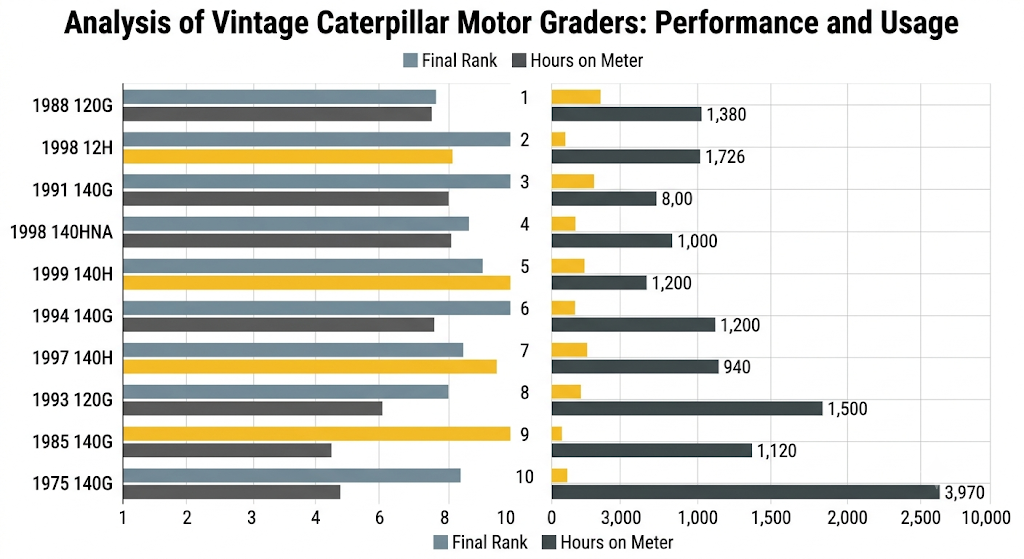
Hours and final ranking don’t move together here, several lower-hour machines land mid-list, while a few high-hour graders hold top spots on reputation and platform strength alone.
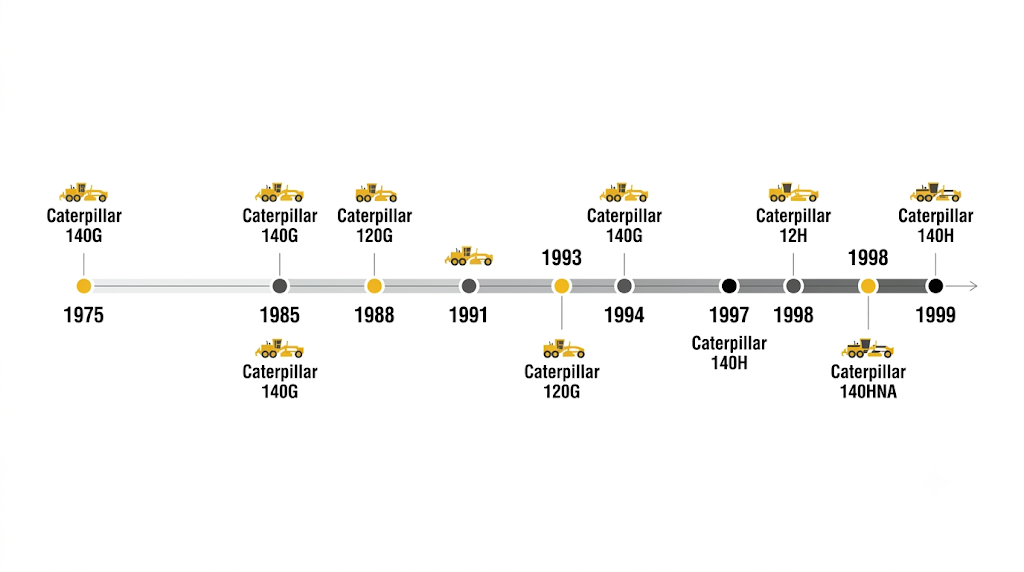
Nearly a quarter-century separates the oldest and newest machines on this list, spanning three distinct generations of Caterpillar grader design.
The Ranked List: 10 Vintage Motor Graders
1. 1999 Caterpillar 140H, 812 Hours
The 140H sits at the top of this list, and this particular unit makes the case better than any other machine here. Eight hundred and twelve hours is astonishingly low for a grader built in 1999, most machines this age have logged that many hours in a single busy year. The 140H platform itself is the most refined design in this entire lineup, with a smoother hydraulic system, better blade responsiveness, and a more comfortable operator station than anything from the 140G or 120G family. Pair that platform with near-zero wear, and you get a grader that performs like it just rolled off a dealer lot decades ago. The one thing a buyer should check before heavy use: hydraulic seals and hoses that sat idle for long stretches can dry out even when hours stay low, so a full fluid and seal inspection is worth the time before this machine goes to work full-time. For contractors who want the best available platform with the least wear, this is the standout.
2. 1997 Caterpillar 140H, 8,947 Hours
Two spots on this list belong to the 140H, and that’s not a coincidence, the platform earned it. This 1997 unit carries a moderate 8,947 hours, enough to be thoroughly broken in without carrying the wear concerns of a much higher-hour machine. Any early-life mechanical issues have long since surfaced and been addressed, which typically makes a mid-hours grader like this one a safer bet than either a brand-new-feeling unit or a heavily worn one. It has the same improved hydraulics and operator comfort as its 1999 sibling, just with a lower price tag to match the added hours. This is the machine for a buyer who wants a modern-feeling grader without paying a premium for near-zero mileage. The main thing to confirm before buying: ask for transmission and final drive service records, since those are the components that show the most wear at this hour range.
3. 1994 Caterpillar 140G, 14,315 Hours
This is the machine we’ve written about before, and for good reason. As we covered in a near-zero-depreciation asset in 2026, the 1994 140G has built a reputation as one of the strongest value-holding graders in the used equipment market. The 140G is arguably Caterpillar’s most proven grader design of the era, mechanically simple, incredibly rugged, and backed by decades of parts commonality across the entire G-series lineup. Fourteen thousand hours sounds like a lot on paper, but 140G units are known for outlasting their hour meters when properly maintained, and this one has clearly been kept up. Buyers get a machine with strong resale value, wide parts availability, and a reputation that speaks for itself in any equipment yard. The tradeoff compared to the 140H units above it: a more basic cab and control layout, which some operators still prefer for its simplicity.
4. 1998 Caterpillar 12H, 11,145 Hours
The 12H is a different class of machine entirely, bigger, heavier, and built with more raw pushing power than anything else in the 140-series lineup on this list. At 11,145 hours, this unit sits right in a comfortable middle range, with enough use to prove it holds up but not so much that major components are due for an overhaul. The added mass and wider blade capability make the 12H a strong choice for heavy road-base work, large-scale site prep, and jobs where a lighter 140-class grader would struggle to keep pace. It gives up some of the nimbleness needed for fine finish grading, which is the main reason it sits below the 140-series units above it rather than ahead of them. For contractors moving serious material, this is the machine built for that job.
5. 1991 Caterpillar 140G, 11,515 Hours
Another solid entry from the 140G family, this 1991 unit carries hours almost identical to the 12H above it, and it earns its spot through the same qualities that make the 1994 140G so respected: rugged simplicity, strong parts availability, and a design that has proven itself across generations of grading work. Eleven thousand five hundred hours represents balanced, moderate wear, not a machine that’s been babied, but not one that’s been run into the ground either. It’s a dependable middle-of-the-pack choice for buyers who want the proven 140G platform without paying for the lowest-hour examples on this list. Expect a basic control layout and cab, consistent with the era, but don’t mistake basic for weak, this design has earned its reputation the hard way, and it remains a common sight on county and municipal fleets for exactly that reason.
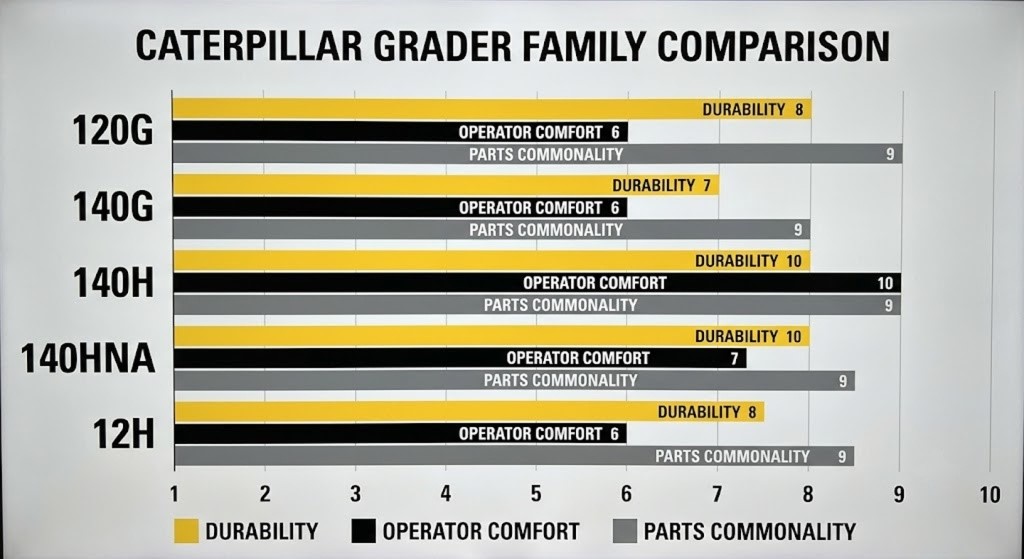
The 140G family built its reputation on durability and parts availability, while the 140H and 140HNA close the gap with stronger operator comfort and refined controls.
6. 1985 Caterpillar 140G, 4,520 Hours
Here’s a case where low hours don’t automatically translate to a top ranking. This 1985 unit has just 4,520 hours, remarkably light use for a machine pushing 40 years old, likely a sign it spent years as a backup unit or saw light seasonal duty. That’s genuinely appealing, but the 140G platform at this vintage carries older analog controls and a more basic cab than the machines ranked above it, which caps how far low hours alone can carry it. Some old-school operators actually prefer this simplicity, since there’s less electronics to fail and more of the machine can be diagnosed and fixed with basic hand tools. The caveat here is age, not use: hoses, seals, and rubber components degrade over time regardless of hours, so a thorough inspection matters more than the number on the meter.
7. 1975 Caterpillar 140G, 6,900 Hours
The oldest machine on this list is also one of the most mechanically straightforward, and that counts for something with buyers who want a grader they can service themselves without a laptop or a dealer technician. At 6,900 hours, this 1975 unit has seen real work but nowhere near the wear of some of the higher-hour machines ranked above it. What keeps it from ranking higher is simply its age relative to the rest of the field, cab comfort, hydraulic refinement, and available features all trail the later machines on this list. That said, the core driveline and structural components on the 140G changed very little across decades of production, which is exactly the kind of parts commonality that makes buying older graders for sale a smart long-term play. This is a solid pick for a buyer who values mechanical simplicity over modern comfort.
8. 1988 Caterpillar 120G, 11,800 Hours
The 120G is a smaller, lighter-class grader than everything else in the 140-series lineup on this list, and that size difference is the main reason it sits in the bottom half of the rankings rather than a reflection of poor condition. At 11,800 hours, this 1988 unit shows moderate, consistent wear consistent with steady use over its lifetime. What it lacks in raw power and blade width compared to the 140-class machines, it makes up for in maneuverability and a lower operating cost, making it a strong fit for gravel road maintenance, smaller municipal contracts, and jobs that don’t demand a full-size grader. Fuel consumption and daily operating costs also run lower on a machine this size, which matters over a long ownership period. Buyers looking for an affordable entry point into grading work, rather than a do-everything machine, will find real value here.
9. 1993 Caterpillar 120G, 14,669 Hours
The second 120G on this list shares the same smaller-class limitations as its 1988 counterpart, but with the added weight of 14,669 hours behind it, the highest hour count of any 120G here. It’s still a genuinely capable light-duty grader, and the 120G’s mechanical simplicity means high hours don’t hit as hard as they would on a more complex machine, since fewer electronic systems means fewer things to diagnose when something eventually needs attention. Still, between the smaller platform and the elevated wear, this unit is best suited for buyers with modest grading needs and a tight budget, rather than contractors chasing versatility. Get the maintenance records on the hydraulic pump and steering system before committing, since those tend to be the first components to show their age in this hour range.
10. 1998 Caterpillar 140HNA, 16,485 Hours
The 140HNA, the North America variant of the 140H platform, closes out this list, and its position comes down almost entirely to one number: 16,485 hours, the highest of any machine here. That’s notable because this unit shares the same refined platform advantages that put the 1999 and 1997 140H units at the top of this ranking, including improved hydraulics and a more comfortable cab. But at this hour range, major components like the transmission, final drives, and hydraulic pump are far more likely to be approaching the end of their service life, which means a buyer should budget for reconditioning rather than expect a turnkey machine. It’s still a strong platform underneath the wear, and a capable choice for someone prepared to invest in bringing it back to full strength, proof that the newest model year on paper doesn’t guarantee the top spot.
Comparison Insights: What the Rankings Reveal
Looking at these ten machines side by side, a few patterns stand out. The 140H and 140HNA units offer the most refined operator experience, but hours swing wildly between them, from 812 to over 16,000, which shows just how differently two machines built on the same platform can age. The 140G family, meanwhile, holds its position through sheer reputation and parts commonality rather than low hours, and the 120G units confirm that machine class and job fit matter just as much as condition. No single factor decided this ranking on its own, and that’s the point: a smart buyer weighs several signals together rather than fixating on one number and ignoring the rest of the story a machine has to tell.
Ranked Summary
| Rank | Model | Year | Hours | Why It Ranked Here |
| 1 | 140H | 1999 | 812 | Near-zero wear on the most refined platform in the lineup |
| 2 | 140H | 1997 | 8,947 | Same proven platform, well broken-in without excess wear |
| 3 | 140G | 1994 | 14,315 | Iconic design with strong resale value and parts availability |
| 4 | 12H | 1998 | 11,145 | Larger class grader built for heavy road-base work |
| 5 | 140G | 1991 | 11,515 | Balanced hours on a dependable, proven design |
| 6 | 140G | 1985 | 4,520 | Low hours offset by older controls and cab simplicity |
| 7 | 140G | 1975 | 6,900 | Oldest unit, valued for mechanical simplicity and shared parts |
| 8 | 120G | 1988 | 11,800 | Smaller class limits versatility despite moderate hours |
| 9 | 120G | 1993 | 14,669 | Same smaller platform carrying higher accumulated wear |
| 10 | 140HNA | 1998 | 16,485 | Highest hours on the list, more reconditioning likely needed |
Vintage Grader Comparison
| Model Family | Durability | Parts Commonality | Operator Comfort | Best Use Case |
| 140H / 140HNA | High | Strong | Best in this lineup | Finish grading, municipal roads, mixed-use jobs |
| 140G | Very High | Excellent | Basic to moderate | General-purpose grading, long-term ownership |
| 12H | High | Good | Moderate | Heavy road-base work, larger job sites |
| 120G | Moderate to High | Excellent | Basic | Lighter grading, gravel roads, smaller operations |
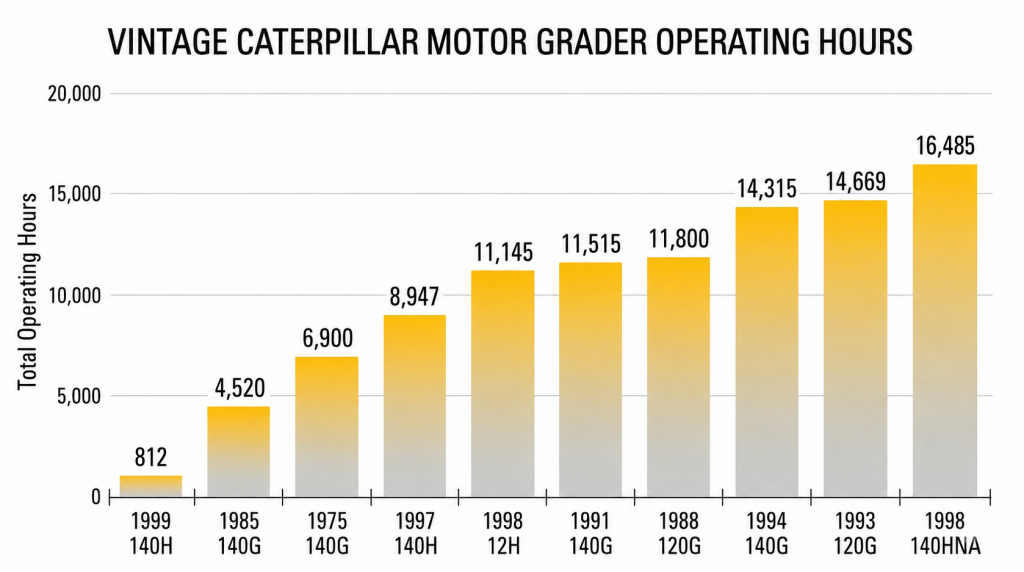
The hour spread across this list is enormous, running from under a thousand hours to more than sixteen thousand, proof that vintage grader shopping takes more than a glance at the odometer.
Hours vs. Ranking Insight
| Model & Year | Hours | Rank by Hours Alone | Final Rank | What Changed the Outcome |
| 1999 140H | 812 | 1 | 1 | Lowest hours matched the strongest platform, no adjustment needed |
| 1985 140G | 4,520 | 2 | 6 | Low hours held back by older controls and cab simplicity |
| 1975 140G | 6,900 | 3 | 7 | Age and basic features outweighed the low hour count |
| 1997 140H | 8,947 | 4 | 2 | Platform reputation pushed it above lower-hour machines |
| 1998 12H | 11,145 | 5 | 4 | Larger class and heavy-duty capability moved it up |
| 1991 140G | 11,515 | 6 | 5 | Balanced wear on a proven design held its position steady |
| 1988 120G | 11,800 | 7 | 8 | Smaller class capped its ceiling despite average hours |
| 1994 140G | 14,315 | 8 | 3 | Model reputation and resale strength outweighed higher hours |
| 1993 120G | 14,669 | 9 | 9 | Higher wear on a smaller-class machine held its position |
| 1998 140HNA | 16,485 | 10 | 10 | Highest hours on the list, with no offsetting advantage |
What This Ranking Means for Buyers
For a buyer today, this list makes one thing obvious: the hour meter is a starting point, not a verdict. Some of the highest-value machines here, like the 1994 140G, carry more hours than several units ranked below them, yet they hold their position through proven design and strong resale value. That’s consistent with what we’ve found across the vintage market more broadly, older Caterpillar graders, as we detailed in our piece on why older motor graders depreciate more slowly than newer models, tend to hold their value once they clear the steepest part of the depreciation curve that newer machines are still riding out.
Parts commonality plays just as large a role. A grader built decades ago that shares components with dozens of other machines in the same family stays serviceable far longer than a newer unit with a narrower parts pool, and it’s typically cheaper to keep running too. Combine that with a clear-eyed read on hours, model reputation, and the actual job you need the machine for, and you end up with a buying decision that holds up long after the sale.
Rugged build quality, decades of proven field performance, and parts availability that spans generations, these are exactly why older Caterpillar graders keep earning a place on serious buyers’ shortlists, hours notwithstanding. That combination is also why the vintage segment of the used grader market keeps growing rather than shrinking, even as newer machines continue to hit dealer lots.
Final Word
These ten graders prove that a lower price tag doesn’t mean lower performance, you just need to know what you’re buying and why it ranks where it does on a list like this one. Every machine on this list comes with verified hours and a real service history, and each one is listed right now on usedmotorgrader.com alongside dozens of other dependable used motor graders built to keep working for years. Call our team today, request the full inspection reports, and put a genuinely proven Caterpillar grader on your job site this month.
FAQs
1. Are vintage motor graders still good work machines?
A: Yes, when they’ve been properly maintained and bought with a clear understanding of their history. Many of the graders on this list have logged over a decade of hard work and still have plenty of service life left, thanks to rugged Caterpillar engineering built to outlast its original owners.
2. Do lower-hour vintage graders always cost more?
A: Not necessarily, and hours are only one piece of the pricing picture. Model reputation, condition, features, and parts availability all factor into value just as much as the number on the meter.
3. How important is parts availability when buying an older grader?
A: It’s one of the biggest factors in long-term ownership cost. Models with strong parts commonality, like the Caterpillar G-series, stay cheaper and easier to service for decades after production ends.
4. Which model on this list is the best all-around pick?
A: The 1994 Caterpillar 140G offers the strongest overall balance of durability, parts availability, and resale value, making it a smart pick for buyers who want long-term reliability over the lowest possible hours.
Tags: Top Rated Motor Graders, Top Motor Grader Models, Motor Grader For Sale