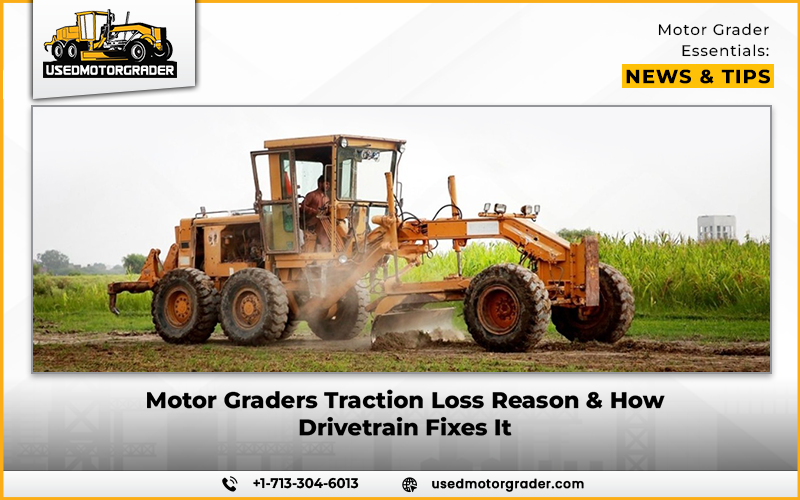
A grader with 255 net horsepower, like the John Deere 672G/GP, can still sit spinning its tires in a wet cut. That sounds backwards until power and grip are separated. Engine output sets how much work the machine can attempt. The tires decide how much of it reaches the ground, and a deep cut finds that limit fast.
Why a Heavy Cut Can Overwhelm Traction
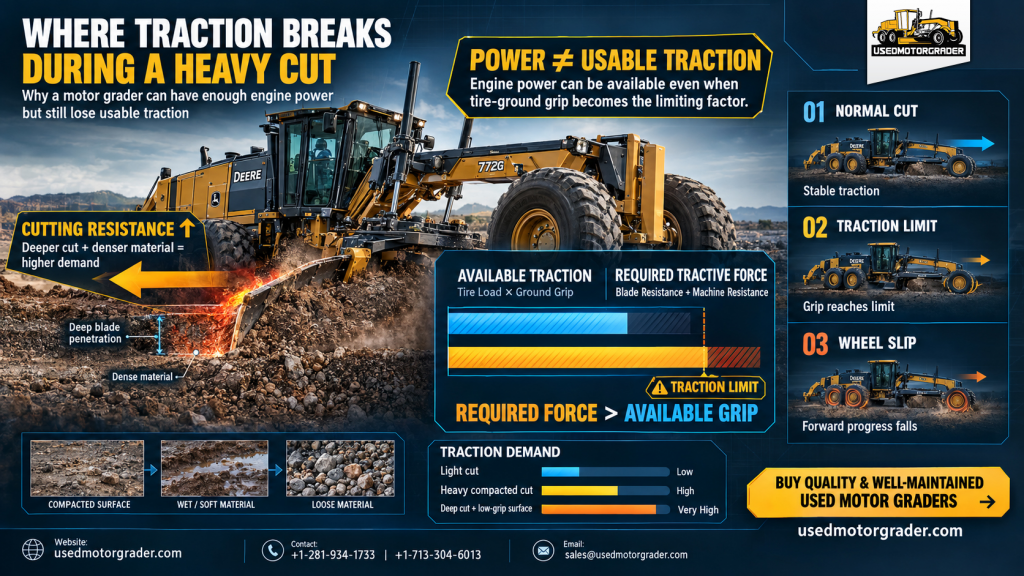
Resistance at the moldboard climbs with every inch of depth, and depth is only one input:
- Material density, moisture, and compaction at the cutting edge
- Blade angle and pitch, which set how much material the moldboard engages
- Windrow buildup ahead of the blade, which adds drag as it grows
That resistance returns through the circle and drawbar as a demand for pulling force, and the wheels must answer it with horizontal force at the ground. Blade drag also shifts load between axles, so the driven tires do not always carry the weight they carried standing still.
The Difference Between Power, Torque and Usable Traction
Horsepower is the rate of work. Torque is the twisting force behind it, and the transmission multiplies it into wheel torque. Usable traction is the final limit: vertical load on the driven tires times the grip of the surface. Even engine power is not one number. Cat lists the 140’s net power rising from 179 hp in first gear to 231 hp in eighth, while Deere rates the 672G/GP at 255 hp and 963 lb-ft of peak torque.
Cat’s blade pull ratings show the arithmetic. For the 160 AWD, they assume a 0.9 traction coefficient, which Cat equates with no slip: 35,344 lb at a 39,270 lb base weight. Handbook ranges for rubber tires on wet clay loam are 0.40 to 0.50, so that same weight would pull roughly 15,700 to 19,600 lb before slipping. This is simple arithmetic, not an OEM rating, but it shows why more horsepower cannot raise a grip ceiling.
What Happens Through the Drivetrain
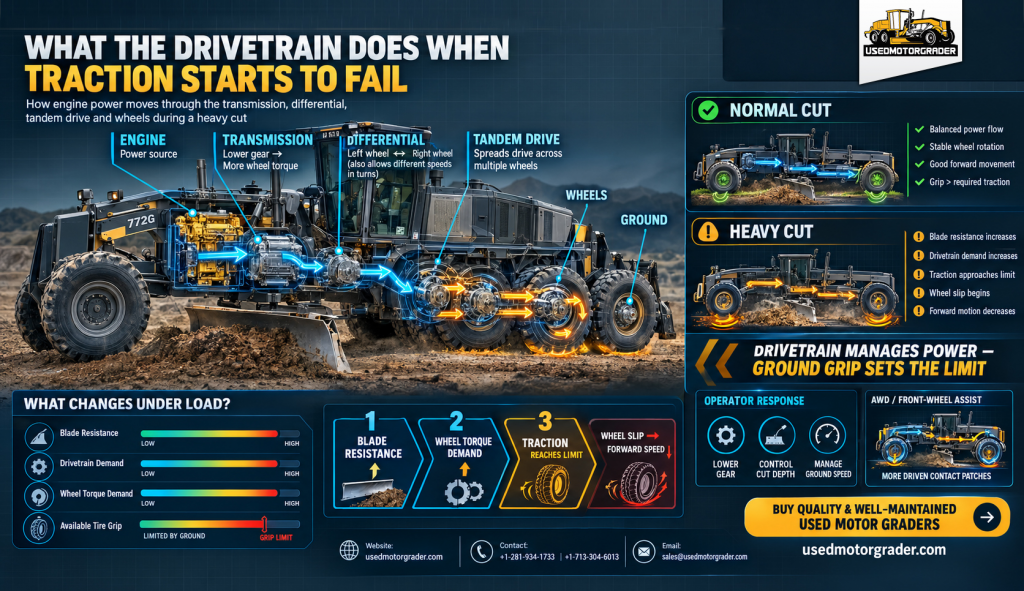
Power travels from the engine through the transmission, driveline, differential, and final drives into the tandem chains, wheels, and ground.
Transmission
Low gears trade speed for force. The Cat 160 manages 2.5 mph in first and 29.5 mph in eighth. A heavy cut in too high a gear lets the engine lug while the wheels get too little multiplication. Cat and Deere use direct-drive powershift units, while Komatsu’s GD655-7 adds a torque converter to its 8F/4R dual-mode unit for more tractive effort. Newer is not automatically better, and motor graders that balance performance and technology are usually the ones worth comparing.
Differential
An open differential splits torque evenly and lets wheels turn at different speeds in turns. When one side loses grip, though, torque to the other side is capped at what the slipping wheel can hold. A lock turns the axle as one unit, so the gripping wheel keeps pulling, at the cost of resisting turns. Cat’s automatic system unlocks in turns and relocks when straight, which Cat says helps protect the power train. Deere’s disengages beyond 10 degrees of turn, while older models like the 672B used a foot-operated hydraulic lock. Cat lists automatic lock and unlock as standard on its 140 and 160, worth confirming on any CAT motor grader for sale.
Tandem Drive
On Cat graders, each tandem case drives both wheels on its side through roller chain and oscillates (15 degrees front up, 25 down on the 160), so four rear tires follow uneven ground and stay loaded. They need to: 30,592 lb of the Cat 140’s 42,647 lb typical weight rides on the rear axle. The mechanics of how motor grader tandem drives transfer power and where they wear are covered in a companion piece.
AWD / Front-Wheel Assist
Front-wheel assist adds a third axle to the pull, spreading tractive force over more contact patches. Deere’s six-wheel drive is an automatic dual-path hydrostatic system adjustable on the fly. Cat’s 160 rates slightly more net power with AWD on (223 hp in first gear versus 213 hp), but the main change is the extra contact patch. It helps on soft shoulders, wet material, loose aggregate, and slopes. It does not end slip, since the front axle carries less weight: 13,455 lb of 45,431 lb typical on the 160. Anyone comparing a motor grader for sale with and without AWD is choosing a different traction profile.
Ground Conditions Can Change the Entire Equation
Identical machines, different outcomes:
- Dry compacted base: strong grip, highest cutting resistance
- Wet clay: moisture cuts friction while the blade still collects heavy material
- Loose gravel: the surface shears under the tire
- Saturated or soft fill: tires sink, and rolling resistance climbs
- Frozen, rutted or mixed ground: grip varies from tire to tire
This is the territory behind motor grader adaptability, and it is why a road grader for sale from a wet-climate fleet may carry a different history than one from dry base work.
Operator Technique Still Matters
Traction is shared between operator, drivetrain, and ground. Shallower passes, a lower gear, and steady ground speed keep wheel torque under the grip limit. Downshift before the tires spin, not after: Cat’s over-speed protection blocks a downshift until travel speed is safe, so a late call costs momentum. Aids such as Cat’s programmable AutoShift take over some decisions, though motor grader features that require frequent adjustment add their own attention load.
How Traction Loss Differs From a Power or Drivetrain Problem
Traction loss has a signature:
- Tires turning faster than the machine travels
- Engine load rising while forward speed drops
- Material piling ahead of the blade
- One side pulling harder than the other
A power deficiency shows as an engine dragging in every condition. Hydraulic load draws on the same engine but appears at the blade, not the tires. Slip that vanishes when the cut gets lighter points to the ground, not a failing transmission. Blade loading leaves evidence too, and uneven motor grader moldboard wear can show how a machine was cut.
What This Means When Buying a Used Motor Grader
Hours do not record how a machine was worked. Any used motor grader for sale can show the same meter as another while one spent its life on dry base and the other on saturated clay. Check the parts that carry traction:
- Transmission shifts under load
- Tandem oil condition, noise, and chain case wear
- Differential lock and unlock response
- Uneven tire wear that points to chronic slip
- Driveline play and vibration
Machine size matters too, as motor grader classes and performance differences show. A CAT motor grader for sale with documented drivetrain work removes guesswork that hours cannot.
| Traction Factor | What Changes During a Heavy Cut | Effect on the Grader | Drivetrain / Operator Response |
| Cutting depth | More material engaged, windrow grows | Pulling demand rises, speed falls | Lighter pass or lower gear |
| Gear selection | Torque multiplication versus speed | Cat 160: 2.5 mph first, 29.5 mph eighth | Downshift before spin |
| Tire-ground grip | Force capped by load times grip | Cat rates 160 AWD pull at 0.9; wet clay loam 0.40 to 0.50 | Keep tires loaded |
| Differential | One wheel can spin on low grip | Open axle capped by weaker wheel | Lock when straight |
| Tandem drive | Rear wheels follow uneven ground | Cat 160 oscillates 15 degrees up, 25 down | Four tires stay in contact |
| Front drive | Front axle joins the pull | Cat 160 front axle: 13,455 of 45,431 lb | AWD adds a contact patch |
Key Takeaways
- Heavy cutting raises resistance, and with it the force the tires must deliver.
- Engine power alone does not guarantee traction; tire load and surface grip set the ceiling.
- Gearing, differential lock, tandem oscillation, and extra driven wheels manage available grip and never exceed it.
- Operator technique and ground conditions decide how often the limit is reached.
- Drivetrain configuration and condition belong in any used-grader evaluation.
Final Word
Buying is simpler when the machine, the paperwork, and the availability line up. UsedMotorGrader.com lists well-maintained used motor graders from top brands, in very good condition, with important machine documents and convenient availability. Browse a used motor grader for sale at usedmotorgrader.com and choose with the drivetrain facts in hand.
FAQs
1. Why does a motor grader lose traction during deep cuts?
A: Deeper cuts raise blade resistance until the force required exceeds tire load multiplied by surface grip. The tires then slip with engine power still in reserve.
2. Does a higher-horsepower motor grader always have better traction?
A: No. Traction depends on weight over the driven tires, the surface, and the drive layout. A higher-rated road grader for sale can still spin in wet clay.
3. How does a tandem drive help a motor grader maintain traction?
A: Oscillating tandems keep four rear tires loaded on uneven ground, and the rear axle carries most of the machine’s weight. Combined with a differential lock, the drive keeps reaching the tires that have grip.
4. Can drivetrain condition affect the traction of a used motor grader?
A: Yes. Worn clutches, a sluggish differential lock, or tired tandems reduce how reliably torque reaches the ground. Check them on any motor grader for sale before trusting the hour meter