A motor grader’s tandem drive is the pair of gearboxes mounted at the rear of the machine that turn engine torque into forward motion and traction at four wheels instead of two. Each tandem case sits on a walking-beam housing, carrying a front and rear wheel on its own side of the machine, and it oscillates independently of the frame so the grader keeps all four rear tires on the ground even when the terrain rolls or dips beneath it. Strip away the moldboard, the circle, and the hydraulics, and the tandem drive is still what actually moves the machine down the road.
For anyone buying a used grader, that matters more than almost any other single component. A tandem rebuild touches gears, chains, bearings, seals, and sometimes the housing itself, and the labor alone can tie up a shop for days. Sellers know this, and machines with documented tandem work command a real premium on the used market.
Understanding how the system is built, and how it fails, is what separates negotiating from strength from finding out later what a worn tandem case actually costs.
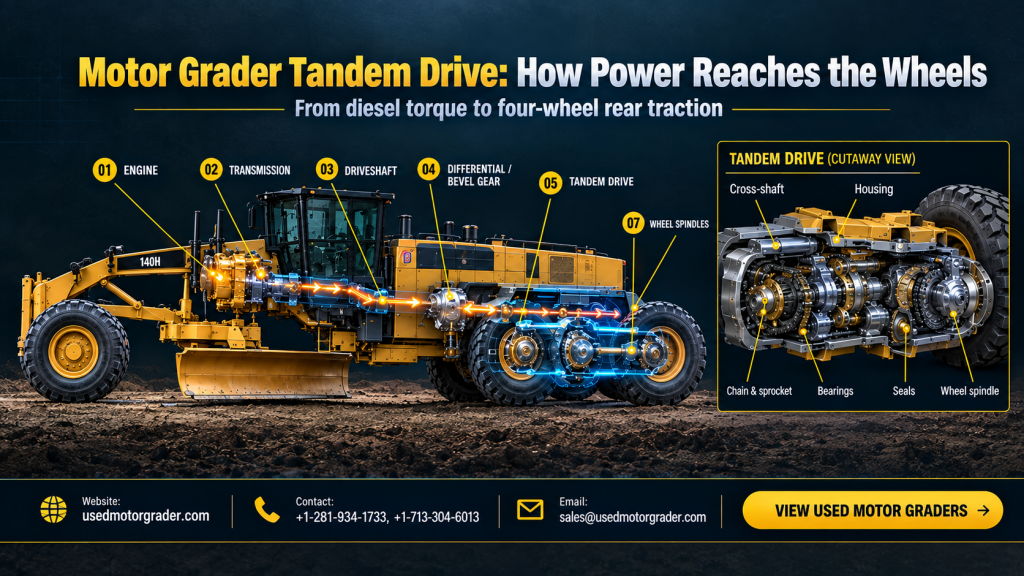
The Power Path: Engine to Wheel
Power on a modern grader takes a fairly direct route from the engine to the ground, but each stage along the way has a specific job to do:
- Engine: The diesel engine produces raw torque and turns a torque converter or a powershift clutch pack, depending on the transmission design.
- Transmission: A powershift transmission, or a torque-converter/direct-drive hybrid like the dual-mode system on many current Komatsu graders,
multiplies torque and sets the working gear range. - Driveshaft: A driveshaft carries that output rearward to the rear frame.
- Differential/bevel gear set: This is where power splits left and right, and on machines with a differential lock, where an operator can force both sides to turn together in slippery conditions.
- Cross-shaft into the tandem case: Each side’s output feeds a cross-shaft that enters its own tandem housing.
- Chain-and-sprocket or planetary reduction inside the tandem: This is the final reduction stage, and it’s what actually turns the wheel spindles.
- Wheel spindles: Each tandem drives two wheels, one forward of the housing’s pivot point and one behind it.
That last step is what makes a grader’s rear drive different from a straight truck axle. Instead of one differential feeding two wheels on a fixed axle, each tandem case feeds two wheels through an oscillating housing, letting the wheel pair follow the ground independently of the frame.
A grader working a washboarded haul road or a rutted gravel shoulder depends on this oscillation to keep tire contact, and therefore traction, on all four rear wheels rather than just the two that happen to sit on the high spots.
Because the housing pivots at its center on a transverse trunnion, and because power still has to reach both wheels through that moving joint, the chain-and-sprocket set (or, on some designs, a planetary gearset) inside the case has to keep transmitting torque smoothly as the housing rocks under load.
That constant articulation is a large part of why tandem internals wear the way they do, and why they need dedicated attention that a fixed truck axle never sees.
Tandem Drive System Types
It’s tempting to treat “chain-driven” and “planetary” as two competing philosophies that different manufacturers simply chose between, but the split is not nearly that even. Nearly every full-size, construction-grade grader on the used market, including Caterpillar’s 12- through 16-series machines, John Deere’s G-series, Komatsu’s GD-series, Volvo’s G-series, Case, and most of the Chinese-built XCMG and SDLG models sold internationally, uses a chain-driven tandem case.
The planetary alternative shows up mainly on smaller, rigid-axle machines and specialty or forestry-spec units that trade the walking-beam bogie for a simpler, fixed rear axle.
Chain-Driven Tandem Systems
Inside a chain-driven tandem, a solid cross-shaft carries a sprocket at each end. Two roller chains run from that shaft forward to the front wheel spindle and rearward to the rear wheel spindle, so each wheel gets its own chain rather than sharing a differential inside the case.
Caterpillar’s tandem-drive technical documentation for the 14M-series grader shows sun and ring gears feeding the wheel sprocket at the input stage, with the chain-and-sprocket pair carrying the final reduction out to each spindle, a pattern that repeats, with model-specific variation, across most modern chain-tandem designs.
Because there’s no differential between the front and rear wheel on a single tandem, both wheels on that side turn at a fixed ratio to each other, which is part of why chain slack and oscillation tolerances matter so much to how evenly the wheels track over uneven ground.
Planetary (Rigid-Axle) Final Drives
A smaller group of graders, built around off-highway axles from suppliers like Oerlikon Graziano and the Funk TeamMate II line, build inboard planetary reduction into a fixed rear axle instead of a chain-and-sprocket tandem case. A sun-and-planet gearset at each wheel end handles the final torque multiplication, similar in principle to a wheel loader’s axle.
This layout has fewer moving parts exposed to contamination and skips chain maintenance entirely, but it gives up the independent wheel oscillation that keeps a chain tandem’s four wheels in contact with rough terrain, one reason it stays a minority choice on the full-size construction and highway-maintenance graders that make up most of the used market.
| Criteria | Chain-Driven Tandem | Planetary Rigid-Axle Final Drive |
| Torque capacity | High; load is split across two chains per side, sized for full-size grading loads | High per wheel end, though there’s no oscillating structure to spread out uneven ground loads |
| Maintenance rhythm | Oil changes on a multi-thousand-hour OEM interval, plus chain tension and wear checks every 250–500 hours | Oil changes on a multi-thousand-hour interval, with fewer wear-prone parts to inspect between changes |
| Typical service life | Commonly runs well past 10,000 hours between major rebuilds with disciplined maintenance; figures vary widely by model, year, and duty cycle | Often stretches longer between rebuilds thanks to fewer wear parts, though this also varies widely by manufacturer and application |
| Repair cost tier | Higher; a rebuild can involve chains, sprockets, bearings, and seals across two wheels per side | Generally lower per repair event, but a full axle replacement is a significant expense if the unit is beyond economical repair |
| Common OEMs/models | Caterpillar 12–16 series, John Deere G-series, Komatsu GD-series, Volvo G-series, Case, XCMG, SDLG | Compact and forestry-spec graders; axles supplied by builders such as Oerlikon Graziano and Funk |
| Ground-following ability | Independent housing oscillation keeps both wheels in contact over rough terrain | Fixed axle geometry, with less ability to follow uneven ground |
Whichever layout a given machine uses, the trade-off comes down to the same question: how much do you value independent wheel oscillation over rough ground against the simplicity of a fixed axle with fewer parts to maintain. For most contractors buying a full-size used grader, the answer has already been made for them, since the vast majority of machines on dealer lots and at auction are chain-driven.
Core Components Explained
However the tandem is built, a handful of components determine how well it holds up in the field:
- Tandem housing/case: The structural shell that carries the wheel spindles, holds the lubricant, and pivots on the trunnion. It absorbs shock loads from curb strikes, potholes, and rock impacts.
- Drive chains and sprockets: On chain-driven tandems, these transmit the final torque to each wheel spindle, running submerged in gear oil inside the sealed case.
- Planetary gear sets (sun gear, ring gear, carrier): On planetary-type final drives, and at the input stage of many chain tandems, these gears handle torque multiplication through meshing teeth rather than chain tension.
- Axle shafts and spindle bearings: Large taper-roller or spherical-roller bearings support the wheel spindles and carry both the radial load of the wheel and the thrust load generated when the operator turns or side-cuts with the blade.
- Seals and gaskets: Lip seals and duo-cone-style face seals keep gear oil inside the case and keep dirt, water, and abrasive grit out. They are the single most common point of failure in the whole assembly.
- Wet disc service brakes: Many OEMs, Komatsu and Volvo among them, mount the service brakes directly at the tandem wheels as sealed, oil-cooled disc packs, so brake wear and tandem lubrication share the same compartment on those machines.
- Lubrication system: Tandem cases run heavy-bodied gear oil: Caterpillar specifies its TDTO family (built to the TO-4 specification), John Deere calls for Hy-Gard, and Volvo lists an 80W-90 gear oil. Capacity commonly falls in the 15-to-20-gallon range per side on a mid-size grader, though this varies by model and year, and most manufacturers build in a sight glass or dipstick for quick level checks along with a magnetic drain plug to catch ferrous wear debris.
Where Wear Occurs | Diagnostic Deep Dive
Tandem failures rarely happen all at once. They build slowly, and the components involved tend to give out in a fairly predictable order.
- Chain elongation and sprocket tooth wear: As a chain’s pins and bushings wear against each other, the chain effectively gets longer, a condition mechanics call elongation. Industrial practice treats roughly 3 percent elongation as the point to retire a roller chain, since beyond that, the worn links stop seating correctly in the sprocket gullet and start riding up on the tooth face instead. Once that starts, the sprocket teeth wear into a hooked, “shark-fin” profile, and installing a new chain over a hooked sprocket wears the new chain out fast, which is why the two are almost always replaced together.
- Bearing wear and failure: Spindle and cross-shaft bearings fail for three main reasons: water or dirt contamination getting past a worn seal, chronic overloading from grading too aggressively or carrying too much down-pressure on the moldboard, and lubrication starvation from a low or degraded oil charge. A failing bearing usually announces itself with a low growl or a grinding noise that changes pitch with wheel speed.
- Seal failure and oil leaks: Lip seals and case seals harden and crack with age and heat cycling. Once a seal starts weeping, the case slowly loses oil volume and film thickness, which accelerates wear on everything downstream and lets in the exact contaminants the seal was there to keep out.
- Planetary gear tooth wear and pitting: On planetary-type final drives, surface fatigue shows up as pitting on the gear tooth face long before a tooth actually breaks. Left unaddressed, pitting spreads and eventually leads to tooth fracture and a metal-contaminated oil charge.
- Housing wear from debris ingress: Once a seal fails and grit gets in, it acts like grinding paste inside the case, scoring bearing races, chain pins, and gear faces well beyond anything clean oil alone would cause.
So which of these does an operator actually notice first? In practice, it’s almost always the same handful of symptoms, no matter which component started the problem: an unusual clunk or whine that tracks with ground speed, vibration through the cab or the operator’s platform, oil weeping or pooling around the tandem housing, one wheel visibly turning faster or slower than its pair, and, on inspection, metal shavings clinging to the case’s magnetic drain plug.
| Component | Typical Failure Symptom | Root Cause | Average Service Life/Interval | Estimated Repair Cost Tier* |
| Drive chain | Elongation past the wear limit; chain “hooking” against the sprocket | Normal wear, low oil level, contaminated oil | Commonly several thousand hours, but varies widely with duty cycle and lubrication discipline | Moderate, per side (parts and labor for chain and sprocket) |
| Sprocket | Hooked or “shark-fin” tooth profile | Worn chain riding against sprocket teeth instead of seating in the gullet | Typically replaced alongside the chain once wear limits are reached | Usually bundled with chain replacement |
| Spindle/cross-shaft bearings | Growling or grinding noise that tracks with wheel speed | Contamination, overload, low or degraded oil | Several thousand hours under normal duty; noticeably shorter in severe applications | Moderate, rising sharply if the housing bore is also damaged |
| Seals | Oil weeping or pooling at the housing | Age, heat cycling, contamination | A recurring wear item across the working life of the case | Low if caught early, high if neglected long enough to cause secondary damage |
| Planetary gear teeth (rigid-axle designs) | Pitting on the tooth face, eventually tooth fracture | Surface fatigue, contamination, degraded oil | Several thousand hours; heavily dependent on load and lubrication discipline | Significant if pitting is allowed to progress to fracture |
| Housing/case | Internal scoring, abnormal wear across multiple components at once | Debris ingress following a seal failure | The case itself often outlasts several sets of internals if protected | High if the bore or bearing seats are damaged |
Cost tiers vary substantially by machine size, region, and by where the work is done, in-house or through an OEM dealer network, treat these as directional guidance rather than fixed quotes, and confirm current pricing with a dealer or independent shop before budgeting a repair.
Maintenance Best Practices & Service Intervals
Tandem service intervals vary by manufacturer and by how hard a machine works, but the pattern across major OEMs is broadly similar: check levels frequently, sample the oil on a set schedule, and change it on an interval tied to the oil family in use.
Caterpillar builds its tandem and final-drive lubrication around the TDTO/TO-4 oil family, with S·O·S fluid-sample analysis used to justify extending change intervals well beyond the base recommendation on machines with a clean sampling history.
John Deere’s parts and capacities documentation lists Hy-Gard Transmission, Axle, and Tandem Oil on a change interval that runs around 2,000 hours on many mid-size G-series models, extending to roughly 4,000 hours on later machines that give the tandem its own dedicated oil compartment, with fluid-analysis sampling recommended every 500 hours regardless of the change interval.
Komatsu folds tandem and final-drive service into its 500-hour PM-B tier, paired with KOWA oil-analysis sampling at each scheduled interval. Volvo specifies an 80W-90 gear oil for the tandem cases and builds sight glasses into the housings specifically so a technician can check levels without pulling a dipstick.
| OEM | Tandem/Final-Drive Oil | Typical Change Interval | Inspection/Sampling Interval |
| Caterpillar | TDTO (TO-4 family) or TDTO-TMS | Base interval in the low hundreds of hours, extendable toward several thousand with S·O·S oil analysis and premium oil | Sample and level check at every scheduled PM tier |
| John Deere | Hy-Gard Transmission, Axle, and Tandem Oil (or a dedicated Hy-Gard Tandem Oil on later models) | Around 2,000 hours on many mid-size models; up to roughly 4,000 hours on models with a dedicated tandem compartment | Fluid-analysis sampling every 500 hours |
| Komatsu | Komatsu Genuine gear oil, power-train/final-drive spec | Folded into the 500-hour PM-B service tier alongside other final-drive maintenance | KOWA oil-analysis sampling at scheduled PM intervals |
| Volvo CE | 80W-90 gear oil | Varies by model; sight glasses support frequent level checks between full changes | Level check via sight glass at routine service intervals |
Note that these figures vary by model, model year, and severe-duty adjustments, so always confirm the exact interval against the specific machine’s operation and maintenance manual before setting a service schedule.
Between scheduled oil changes, a short list of checks catches most problems while they are still cheap to fix:
- Chain tension and sag: Excess slack signals elongation; too little slack overloads bearings and accelerates wear. Compare sag against the OEM specification, not against feel.
- Oil sampling: Pull a sample from each tandem case at every scheduled interval and watch trends in wear metals over time, not just the pass/fail result on a single sample.
- Magnetic plug checks: A light coating of fine metallic fuzz is normal; chunks, flakes, or heavy buildup mean something inside is actively wearing.
- Sight glass or dipstick level checks: Do this daily or at shift change, since a slow leak is far cheaper to catch when it’s “a little low” than when it’s bone dry.
A used motor grader that gets its tandem oil changed on schedule, its chains kept in spec, and its seals replaced at the first sign of weeping will typically outlast one that only gets attention once something starts making noise, by a wide margin measured in total tandem life.
Cost & Lifespan Implications
Tandem condition shows up directly in resale price, and the used market reflects it clearly. One Caterpillar 14M listing on MachineryTrader advertised more than $180,000 in recent reinvestment covering a rebuilt transmission, differential, tandems, and circle, and a separate lower-hour 14M was marketed specifically on the strength of a documented complete tandem rebuild.
On the other end of the spectrum, a motor graders for sale with unaddressed tandem wear, audible chain slop, or a known seal leak gets priced accordingly, if it sells at all without a repair credit built into the deal. Rebuild scope drives cost more than any other factor.
Replacing a chain-and-sprocket set on one side, along with bearings and seals done at the same time, is a meaningfully smaller job than a full case rebuild covering the housing, both cross-shafts, and every internal wear part on both sides.
Trade estimates for a full drivetrain overhaul, spanning the transmission, differential, and both tandems on a mid-size grader, commonly run into six figures once parts and shop labor are added together, which lines up with what real listings show for machines marketed on the strength of recent drivetrain work.
That’s why tandem conditions sit near the top of most experienced buyers’ inspection priorities. It’s expensive to put right, it’s hard to disguise short of an actual rebuild, and it predicts, better than almost any other single check, how much productive life is left in a machine before the next major drivetrain expense comes due.
Buyer’s Checklist: Inspecting a Tandem Drive Before Purchase
Before signing on a used motor grader, run through the tandem drive specifically rather than treating it as part of a general walk-around:
- Pull an oil sample from each tandem case and check its color, smell, and metal content.
- Check the magnetic drain plug on each side for flakes or heavy fuzz rather than light, normal wear dust.
- Start the machine, run it under light load in a straight line and then in a tight turn, and listen for clunking, whining, or grinding that changes with wheel speed.
- Compare front and rear wheel speed on each tandem for a visible mismatch, which can point to chain or sprocket wear.
- Walk the exterior of both tandem housings looking for oil seepage, cracked castings, or weld repairs.
- Grip a wheel and check for play at the trunnion pivot, which points to worn pivot bushings or bearings.
- Ask for maintenance records covering tandem oil changes, sampling results, and any prior chain or seal work.
- Cross-check the hour meter reading against the service history to confirm intervals were actually kept, not just logged.
None of these checks take long, and taken together they tell you more about a used grader’s real condition than the paint job or the hour meter ever will on their own.
The Tandem Drive Is the Machine
Everything else on a motor grader for sale depends on getting torque to the ground cleanly. The moldboard can only cut a true grade if the machine underneath it moves smoothly and predictably, and that starts with a tandem drive that’s still in good working order. A grader with a tired tandem case will still run, but it will cost more to own every hour it works, in fuel, in parts, and eventually in downtime.
That’s exactly why tandem condition gets front-and-center treatment on every listing in our inventory. Every machine comes from sellers who keep their equipment in sublime condition, with full maintenance and ownership paperwork in order and available before you commit to a purchase.
The website itself is built to be simple and easy to navigate, so you can filter by model, hours, and drive configuration and get straight to the machines that fit the job, instead of wading through incomplete listings or guessing at condition. Reach out to us and our team can walk you through the service history on any tandem-equipped grader currently in stock.
Tags: Powerful Motor Grader, Advanced Motor Grader Features, Used Motor Graders 2026