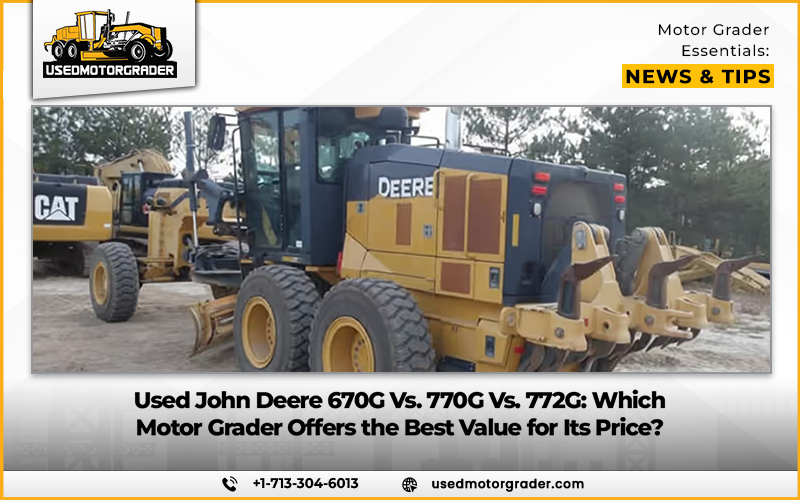
Search for a used John Deere motor grader for sale, and you will notice something quickly: the 670G, 770G, and 772G look nearly identical in photos, share the same 9.0L engine family, and sit within about 40 horsepower of each other. Yet two machines carrying the same badge can be listed well over $100,000 apart. In this John Deere motor grader comparison, we focus on what really moves value: drive system, model year, hours, and condition. Everything below comes from Deere’s own documentation plus the asking prices and auction results we reviewed in November 2026.
What Actually Separates the 670G, 770G and 772G?
Short answer: the 670G and 770G are tandem-drive graders; the 772G adds hydrostatic six-wheel drive and the most power. All three use a John Deere PowerTech 9.0L six-cylinder engine, an 8-speed forward/8-speed reverse PowerShift transmission, and 22° of frame articulation, per Deere’s 670G, 770G, and 772G pages.
| Spec (current Deere data) | 670G/GP | 770G/GP | 772G/GP |
| Net power (top gear) | 175 kW (235 hp) | 190 kW (255 hp) | 205 kW (275 hp) |
| Peak torque | 1,225 Nm | 1,314 Nm | 1,379 Nm |
| Front-wheel drive | No | No | Yes (six-wheel drive) |
| Weight with push block and ripper | 19,230 kg (42,395 lb) | 19,425 kg (42,825 lb) | 20,500 kg (45,195 lb) |
| Blade pull at max weight | 15,501 kg (34,173 lb) | 15,501 kg (34,173 lb) | 22,453 kg (49,500 lb) |
| Max operating weight | 24,948 kg (55,000 lb) | 24,948 kg (55,000 lb) | 24,948 kg (55,000 lb) |
| Typical use | Road maintenance, county and municipal work | Road building, production grading | Heavy cuts, soft ground, steep work |
Sources: Deere’s 670G, 770G and 772G pages, and the 770G/GP brochure, which lists a standard 12 ft moldboard with 13 and 14 ft options.
Three points matter more than the table suggests:
- The 670G and 770G share the same published blade-pull figure. The real gap between them is engine output and torque (20 hp and 89 Nm), not pulling force.
- The 770G and 772G list the same mainframe dimensions and hydraulic output (56 gpm, 2,750 psi in Deere’s six-wheel-drive G-Series brochure). Stepping up mostly buys you six-wheel drive and 20 more horsepower.
- Specs shift with model year. Deere moved the G-Series to Final Tier 4 engines in late 2013, and its brochures list different power ratings for Final Tier 4, Tier 3, and Tier 2 engines. An older 770G may carry a Tier 3 or Tier 2 engine rated a little lower, so match the specs to the exact machine.
The 772G vs. 772GP Distinction
“GP” stands for Grade Pro. Deere’s G-Series brochures show GP models with cross slope and return-to-straight as standard, plus a choice of fingertip armrest or dual-joystick controls; standard G models use conventional levers. A Deere dealer’s 772G/GP page adds that GP includes position-sensing cylinders, which enable automation and SmartGrade. Both machines featured below are 772GP units, so GP features apply to them, but not to every 772G you will see advertised.
Model-by-Model: What Each Grader Offers
John Deere 670G. The entry point of this trio and the lightest on power. It suits road maintenance, ditching, subdivision and municipal work where you rarely need maximum pulling effort. Its case is acquisition cost. Its limits are torque and, in soft ground, traction.
John Deere 770G. The middle ground, and the model buyers ask us about most when searching John Deere 770G for sale. The extra horsepower and torque help on longer production passes and heavier material, without paying for six-wheel drive. When comparing used examples, check the engine tier, moldboard size, circle type (Deere offers a premium sealed circle as an option), and whether it is a G or GP.
John Deere 772G/GP. Six-wheel drive is the point. Deere said at the Final Tier 4 launch that six-wheel drive adds traction and a 30-percent increase in blade pull, and its current 22,453 kg blade-pull rating compares with 15,501 kg on the 770G. If you want to see how the 772G stacks up against Caterpillar, read our take on the John Deere 772G as an alternative to CAT motor graders.
What Are Buyers Paying? John Deere 772G Price and 770G/670G Pricing
Pricing reviewed November 2, 2026. Listing figures are dealer and marketplace asking prices, not sale prices. Auction figures are completed no-reserve sales and are labeled as such.
| Model | Year/hours (examples) | Observed asking prices |
| 670G/GP | 2010–2014, about 7,800–9,200 hrs | 78,000–99,900 |
| 670G | 2018–2021, about 3,200–5,100 hrs | 129,000–195,000 |
| 770G/GP | 2010–2016, about 3,900–9,900 hrs | 64,500–105,900 |
| 770G | 2017–2021, about 2,600–5,800 hrs | 149,500–237,500 |
| 772G/GP | 2015–2017, about 4,200–8,700 hrs | 92,000–164,000 |
| 772G/GP | 2018–2020, about 3,500–8,400 hrs | 150,000–225,000 |
These are ranges of the specific listings we reviewed from Machinery Trader, not market averages. Late-model, low-hour machines sit well above them: a 2024 770G with 1,261 hours was listed at $279,995.
Completed auction sales tell a lower story. One of the platform’s no-reserve results include a 2015 770G at $99,000 (January 15, 2026), a 2010 770G at $46,200 (February 17, 2026), and a 2012 770G at $47,300 (March 26, 2026). On the 772 side, a 2014 772G sold for $64,900 in Oklahoma on January 6, 2026, and a 2013 772GP sold for $61,600 in Pharr, Texas on July 16, 2026. On one government auction day in March 2025, a 2016 772GP sold for $148,500 while a 2016 772G sold for $86,900: same model year, a $61,600 spread. Asking prices are opening positions; auction results show where machines actually cleared, so we treat the two separately.
For regional context, see how CAT and John Deere compete in the Texas used grader market. For an older Texas data point, a 2014 770G with 9,895 hours sold in Pflugerville for $77,000 on December 31, 2024.
Why Two Graders With the Same Model Name Can Be $100,000 Apart
- Hours can outweigh model year. A 2013 772GP with 3,160 hours was listed at $189,500, more than a 2020 772GP with 7,449 hours at $175,000. Likewise, a 2020 770G with 3,949 hours asked $237,500.
- Six-wheel drive carries a premium. Among 2020 listings, a 770G with 5,111 hours asked $169,000, while 772G units with roughly 5,200–5,400 hours asked 199,000–215,000, a premium of about 30,000–46,000.
- John Deere 670G vs. 770G pricing overlaps. A 2018 670G with 4,827 hours asked $129,000; 2018 770Gs asked $137,970 (8,381 hours) and $155,000 (3,457 hours), a gap of roughly 9,000–26,000.
John Deere 670G vs. 770G vs. 772G: Which Delivers the Best Value?
Choose the 670G for maintenance, light grading, or subdivision work on stable ground, especially if capital is tight and you would otherwise pay for horsepower you never use.
Choose the 770G for production grading, longer hauls or heavier material when you want the strongest balance of capability and price. In the 2018 listings we reviewed, the 770G premium over a 670G ran about 9,000–26,000; at that level the extra power is a reasonable trade, but if a seller asks far more for similar hours, the 670G is the smarter buy.
Choose the 772G/GP for heavy cuts, soft or wet ground, steeper terrain, or grade-control work where traction decides production. In the 2020 listings we reviewed, the John Deere 770G vs. 772G premium was about 30,000–46,000. If you would pay that, make sure you will use the front-drive system every week.
Buying too small costs you extra passes and slower production. Buying too big ties up cash and adds a drive system you may never use. Don’t let fuel-economy or repair-cost claims decide this; verify drive, power, hours, and condition on the specific machine.
Condition and Configuration: Where the Real Money Is
A model number never tells you what a used grader is worth. Here is how condition turns into dollars:
- Engine and aftertreatment. Final Tier 4 machines use DEF and a diesel particulate filter. Deere reported in 2013 that its filter can run up to 15,000 hours before ash removal, so ask for service records.
- Circle, drawbar, and moldboard wear. Loose circles and worn wear inserts mean repair bills and sloppy grading, especially if you plan to run grade control.
- Tires and cutting edges. These are near-term cash outlays. A machine with fresh rubber and edges can be worth more than a cheaper one that needs both.
- Articulation joint, frame, and tandems. Cracks, weld repairs, or play here point to hard use and can outweigh a low hour meter.
- Hydraulics and electronics. Leaking cylinders, tired pumps, or a faulty monitor or grade-control kit add cost quickly.
- Hours versus maintenance. As a general scenario, a grader with 9,000 documented, well-serviced hours can be a safer buy than one with 5,000 hours and no records.
Two Real 772GP Examples From Our Inventory
Our 2020 John Deere 772GP, with 7,449 hours and a $175,000 asking price. It comes with a 14 ft blade, ripper, front hitch, 2 ft left extension, drawbar, circle slip clutch, front and rear hydraulics, snow wing and Brandt postless wing, 17.5 radial tires, and a low cab with A/C and heat. Serial number 1DW772GPPLF706434.
Our 2015 John Deere 772GP has 6,063 hours and is listed with pricing on request. It has a low cab with A/C, EH controls, a 14 ft blade, 17.5 tires, all-wheel drive, auxiliary hydraulics, push block, ripper/scarifier, and an inspection report attached. Serial number 1DW772GPPFF668885. Deere describes its GP fingertip armrest controls as electrohydraulic, which fits that EH controls detail.
The older machine has about 1,400 fewer hours and comes with an inspection report; the newer one is five model years younger with a different attachment set. Neither number alone decides which is the better buy. Both fall after Deere’s move to Final Tier 4 engines, and both are Grade Pro machines, so you are comparing real configuration and condition, not model names. Please contact us to confirm current availability of either machine and for further assistance.
How to Search for a Used John Deere Grader Without Overpaying
When you browse used John Deere motor graders for sale with us or anywhere else:
- Compare by year, engine tier, and drive type, not just 670G, 770G, or 772G.
- Weigh hours against service records and inspection reports.
- Decide whether GP controls, grade-control hardware, or six-wheel drive will actually earn their keep. If not, don’t pay for them.
- Budget for tires, cutting edges, and any circle or hydraulic repairs.
- Compare the ask with similar listings and completed auction results.
Paying more makes sense for lower hours backed by service proof, new tires and edges, GP controls you will use, or a drive system matched to your ground conditions.
Final Verdict
- Tightest budget: a well-maintained 670G, if your work is light to medium.
- Best balance of capability and price: the 770G, particularly when it prices close to a comparable 670G.
- Demanding grading: the 772G/GP, when traction and blade pull drive your production.
- Two similarly priced graders: pick the one with better records, tires, and tight wear components over the newer model year.
Find Your Next Grader at UsedMotorGrader.com
Ready to compare real machines? Explore UsedMotorGrader.com for well-maintained and top used motor grader models from CAT, John Deere, and Komatsu, and contact us about the machine that fits your work.
FAQs
1. What is the main difference between the John Deere 670G, 770G, and 772G?
A: The 670G (235 hp) and 770G (255 hp) are tandem-drive graders, while the 772G (275 hp) adds hydrostatic six-wheel drive and a published blade pull of 22,453 kg versus 15,501 kg.
2. How much does a used John Deere 772G cost?
A: In our November 2026 review, asking prices ran roughly 92,000–164,000 for 2015–2017 units and 150,000–225,000 for 2018–2020 units, with late-model machines higher and older high-hour auction sales lower.
3. Is the John Deere 770G a better value than the 772G?
A: Often yes, unless you need six-wheel drive. Comparable 2020 listings showed the 772G asking roughly 30,000-46,000 more than a 770G.
4. What should I check before purchasing a used John Deere motor grader?
A: Confirm year, engine tier, and drive type, then check service records, circle and frame condition, tires, cutting edges, hydraulics, and any grade-control equipment.