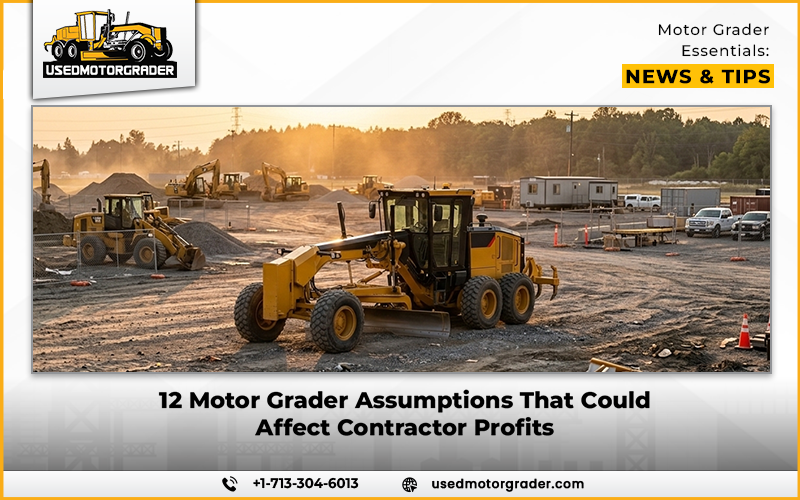
On October 12, 2026, two John Deere 772G graders appeared in public MachineryTrader results: a 2019 unit with 7,941 hours at $114,900 asking, and a 2020 unit with 7,352 hours at $202,500 asking. The meters differ by about 7 percent. The asking prices differ by $87,600. Neither headline number says which machine is the better buy.
Contractors lean on shortcuts: the lowest price, the lowest hours, the trusted badge, the engine that starts. Each can hide repair exposure, lost working days, freight, or a resale problem. Here, 12 common assumptions are tested against listings, auction results, manufacturer tools, and published cost ranges. Where inputs are assumed, the calculation is labeled as an example.
1. The Lowest Purchase Price Always Delivers the Best Value
Ranking by asking price skips the real comparison: total acquisition cost, which is purchase price plus fees, freight, initial repairs, and necessary upgrades. Financing and inspection costs sit on top.
Take two 2018 CAT 140M3 AWD graders from different sellers: $140,000 at 9,677 hours and $115,000 at 11,536 hours. The $25,000 gap is the break-even point. If the cheaper unit needs less than that in repairs, freight, and lost days, it wins. If it needs more, it loses. Low price can be good value, and a premium machine can be overpriced.
- Obtain a written repair estimate for each candidate.
- Get a delivered-freight quote, not a rule of thumb.
- Request the service file before negotiating.
Interest on the financed amount accrues from day one, including the days the machine sits in a repair bay.
2. A Low Hour-Meter Reading Means the Machine Has Plenty of Life Left
Hours record how long the engine ran, not how hard it worked. A grader that dressed light gravel and one that cut rocky base course can share a reading and little else. No source reviewed supports a universally acceptable hour count, so none is offered here.
Table 1 shows hours alone do not set price. The 2019 and 2018 CAT 140M3 AWD units sit at $188,000, $140,000, and $115,000 for 7,206, 9,677, and 11,536 hours, while the two 772G units above differ by 589 hours and $87,600. Price follows year, configuration, seller, and documented history too.
Weigh hours against service records, hydraulic response, engine and transmission behavior, wear patterns, and replaced components. Ask what work the machine did.
What Comparable Used Motor Graders Actually Cost in the Current Market
| Machine | Year | Hours | Location | Price | Notes and source |
| CAT 140M3 AWD | 2019 | 7,206 | Not disclosed | $188,000 asking | MachineryTrader |
| CAT 140M3 AWD | 2018 | 9,677 | Not disclosed | $140,000 asking | Same page |
| CAT 140M3 AWD | 2018 | 11,536 | Houston dealer | $115,000 asking | Publisher’s own inventory |
| CAT 140M3 | 2019 | 4,511 | Not disclosed | $205,000 asking | Same MachineryTrader page |
| John Deere 772G | 2019 | 7,941 | Not disclosed | $114,900 asking | MachineryTrader |
| John Deere 772G | 2020 | 7,352 | Not disclosed | $202,500 asking | 6WD; seller says government lease return, scheduled maintenance done (MachineryTrader) |
| CAT 140M | 2010 | Not disclosed | Not disclosed | $79,200 realized | Purple Wave contract price, closed 3/26/26 |
| John Deere 772G | 2010 | Not disclosed | Not disclosed | $95,700 realized | Purple Wave, closed 11/20/25 |
| John Deere 872GP | 2019 | Not disclosed | Not disclosed | $169,400 realized | Purple Wave, closed 2/26/26 |
Prices are asking prices unless marked realized, read from search-result views of each page, so listings may have sold since. This is a sample, not a national average: EquipmentWatch’s September 2025 average used asking price was $221,312 across 58,477 listings, at an average age near 9.5 years (Equipment World). Seller descriptions are not verified for condition, and Purple Wave’s premium treatment was not stated. What it shows: similar machines are listed tens of thousands of dollars apart, so condition and documents must explain the number.
3. The Recorded Hours Accurately Represent the Machine’s Entire Working History
Meters get replaced, clusters swapped, and files lost between owners without anyone acting in bad faith. Buyers should still cross-check. On Cat machines, a dealer technician using Cat Electronic Technician can display operating hours and fuel totals and review logged diagnostic and event codes.
- Match invoices and service dates to the claimed hours.
- Check that pedals, seat, edge, circle, and pins wear in line with the number.
- Ask for component replacement records and any meter or display changes.
- Request an ECM printout where the machine supports it.
An understated history shifts both the price you should pay and the repair budget you should hold. If records and meter disagree, the disagreement is the finding: price the uncertainty or move on.
4. A Newer Model Year or Respected Brand Automatically Means a Better Machine
Equipment World’s financing data for November 2024 through October 2025 put Cat at 47.3 percent of used financed graders, yet the two top-selling used models were Deere’s 772G (90 units) and 672G (77), ahead of the Cat 140 M3 (62) (Equipment World). Buyers are split, so reputation alone does not decide value, and sales volume says nothing about the unit in front of you.
Best used motor graders are those whose condition, configuration, documentation, and local support fit the work. Compare CAT motor graders and John Deere motor graders only when class, drive, technology package, and past application match. Check parts access, technician familiarity with that generation, and if your shop can service newer electronics.
5. Moldboard and Cutting-Edge Wear Are Merely Cosmetic
Edges are consumables, so wear is normal; the pattern is the signal. Cat’s used-equipment guide tells buyers to check if the edge center has cupped, and Ritchie Bros notes it is cheaper to replace an edge than a moldboard, so an edge run too long turns a modest cost into a larger one. Edge life varies widely with material, so wear needs context.
See what uneven motor grader moldboard wear can reveal about machine condition before inspecting. Uneven wear may point to operating habits, circle or drawbar play, or adjustment, but it proves none alone. A worn edge costs passes, fuel, and rework.
- Measure remaining edge thickness across the full width.
- Ask when the edge was last replaced.
- Check circle and drawbar play under power.
6. If the Grader Starts, Moves, and Steers, It Is Mechanically Sound
A short demonstration proves the machine runs, not that it works under load. Engine and transmission behavior, hydraulic speed when warm, circle rotation, drawbar and articulation play, temperatures, leaks, and logged codes can pass a short lap and fail in week one. Ritchie Bros lists the frame, circle, moldboard, linkage, cylinders, lines, and hoses for inspection, and Cat’s used-equipment guidance says a detailed inspection helps avoid immediate maintenance costs. Ask to see the machine start cold, work warm, and finish a loaded task, not only a lap.
Assume 10 lost working days at 8 hours and $150 of contribution margin per hour, all assumed inputs: 10 x 8 x $150 = $12,000 (Table 2). Commission a documented inspection by a qualified technician when price or age justifies it. Table 3 is a starting list, not a substitute.
7. Electrical Faults and Warning Lights Are Minor Problems
A warning light is a symptom, not a diagnosis. It might be a corroded connector or a failing sensor, harness, or controller. The sources reviewed give no defensible single repair price, so none is offered.
On any CAT motor grader for sale, ask a dealer technician to connect Cat ET and print active and logged codes; the same tool can also clear logged diagnostics, so ask if the history was recently reset. Read how to identify electrical warning signs in a Caterpillar grader listing.
- Operate every switch, gauge, and blade function, warm and after a cold start.
- Test grade-control sensors, display, and wiring where fitted.
- Request electrical repair history.
Intermittent faults are the hard ones: a fault that never shows on the lot can show on the job.
8. More Horsepower Automatically Means Higher Grading Productivity
Equipment World’s table lists the Cat 140 at 248 hp and 42,542 lb, and the Deere 772G at 275 hp and 46,044 lb. Divided out, both land near 6 hp per 1,000 lb (5.83 and 5.97). The Cat 150 AWD lists 200 hp at 43,950 lb, about 4.55, with a different drive layout.
Output also depends on traction, tires, blade width, material, cut depth, passes, and operator skill, so no production or fuel advantage is claimed here. Excess power on gravel maintenance adds price without measurable benefit, while a grader too small for the work costs money through extra passes and slower completion. The target is fit, not maximum.
List your three hardest jobs, then material, depth, and finish standard, before choosing. Consider why motor grader adaptability matters when equipment must handle different jobs.
9. Grade-Control Technology and Automation Always Pay for Themselves
Grade control can cut passes and rework on suitable work, but a feature list is not a payback. Final accuracy depends on sensors, calibration, hydraulics, and linkage wear, as explained in how a modern motor grader’s control loop translates ground information into blade corrections.
Dealer asking prices for grader kits run from $19,399 for a single-antenna system to $43,699 for a dual-antenna 3D kit, hardware only. Payback = $43,699 / annual net benefit. At an assumed $6,000 a year, that is 7.3 years; at $18,000, 2.4 years. Low utilization, simple work, incompatible machines, or untrained operators weaken the case. Ask for calibration records after any blade, circle, or cylinder repair, since worn geometry no longer matches what the system assumes.
10. Tires, Circle, Drawbar, and Articulation Components Are Secondary Concerns
These parts decide if the blade holds a line. Uneven circle wear can signal misalignment and pinion tooth damage, and rough ground is harder on the articulation point (Ritchie Bros). One Oklahoma county bid tabulation, for 2026 tires (period shown: July 1 to December 31), lists 17.5-25 grader tires at $1,040.33 to $1,065 each. Six tires: $6,242 to $6,390 before mounting, waste-tire fees, and tax.
Not every worn part needs full replacement; one tire or a shim may be the fix. Several findings together suggest broader neglect, and uneven tire wear deserves a question about pressure, alignment, or steering wear.
- Tires: matched wear, cuts, depth.
- Circle teeth and guide shoes.
- Drawbar connection.
- Articulation joint and pins.
- Steering linkage play.
11. Fuel and Routine Maintenance Represent Nearly All Operating Costs
Wear parts, tires, unplanned repairs, freight, interest, idle time, and lost production sit beside fuel and service. Read how capital expenditure differs from operating expenditure when buying a used motor grader, then price both. A Volvo CE manager quoted in an older Equipment World cost feature says a bolt-on edge can last 30 days or one afternoon, so a generic fuel or wear figure misleads.
Cost per hour is not cost per job. Example, all inputs assumed: Machine A at $95 an hour needs 60 hours for a 10-mile road, or 5,700(570 per mile). Machine B at $110 needs 45 hours, or 4,950(495 per mile). B costs $15 more per hour and $750 less per job. Operator labor and interest are excluded to avoid double counting.
The Financial Cost of Getting a Motor Grader Purchase Wrong
| Financial risk | Data or assumption | Calculation | Exposure | Basis and limits |
| Cheaper unit needs repairs | Asking $115,000 vs $140,000; hidden costs assumed at $10,000 or $40,000 | $140,000 – $115,000 = $25,000 break-even | $15,000 ahead, or $15,000 behind | Illustrative; units not verified as equivalent |
| Freight | 1,000 miles at $3.00 to $5.00 per mile | Miles x rate | $3,000 to $5,000 one way | Estimate from a carrier guide; excludes permits |
| Downtime | 10 days, 8 hours, $150 per hour margin | Lost hours x margin | $12,000 | Assumed inputs; excludes repair cost |
| Tires | Six at $1,040.33 to $1,065 | 6 x unit price | $6,242 to $6,390 | One county bid; excludes mounting, fees, tax |
| Technology | $43,699 kit; $6,000 or $18,000 yearly benefit | Investment / benefit | 7.3 or 2.4 years | Assumed benefit; excludes installation, subscription, training |
12. Used Motor Grader Prices, Availability, and Resale Potential Are Similar Everywhere
Equipment World’s data counted 249 used graders financed in Texas from November 2024 to October 2025, against 48 in California and 46 in Arizona. That shows buyer activity, not inventory. See what Texas’s used motor grader market reveals about regional demand.
For the wider picture, see why used motor grader pricing and demand vary across US regions. A 2026 carrier guide puts legal lowboy loads at $3.50 to $8.00 per mile and long hauls at $3.00 to $5.00, so 1,000 miles is about $3,000 to $5,000 before permits. Used motor graders for sale carry asking prices, which differ from sold prices; Purple Wave contract prices on March 26, 2026 were $79,200 for a 2010 CAT 140M and $70,400 for a 2008 unit.
Waiting does not guarantee a lower price: average used asking prices eased from $230,146 in January 2025 to $221,312 in September 2025, yet stayed above the prior five years. Early planning leaves time to compare, inspect, and arrange freight; see how advance equipment planning can improve used grader purchasing decisions.
- Compare three similar units on delivered cost.
- Budget freight and permits.
- Verify documents.
- Check comparable listings and auction results for resale demand.
What to Verify Before Buying a Used Motor Grader
| Area | Red flag | Evidence to request | Consequence | Action |
| Hours and records | Meter with no matching service history | Invoices, ECM totals, replacement records | Wrong price and repair budget | Reconcile before negotiating |
| Blade system | Cupped or uneven edge; circle or drawbar play | Edge thickness, replacement date, play check | Rework; larger repair if wear reaches the moldboard | Price the repair; get a technician’s check |
| Engine, drive, hydraulics | Smooth only when idle; leaks; slow cylinders | Warm, loaded test; leak inspection | Lost days; major component repair | Require written test findings |
| Tires and articulation | Mismatched wear, loose pins, steering play | Tread depth, joint inspection | About $6,242 to $6,390 per set in one bid; wider neglect | Treat patterns as a warning |
| Electrical | Lights on; codes cleared before the test | Active and logged code printout, repair history | Not reliably quantifiable | Verify with a dealer technician |
| Grade control | Kit listed without calibration records | Calibration history, software, installer | Payback in Table 2 may not occur | Pay only for features the work uses |
| Freight, papers, resale | Price quoted without delivered cost | Freight quote, title, records, comparables | $3,000 to $5,000 per 1,000 miles; thinner resale | Compare on delivered cost |
Conclusion: From Attractive Listing to Justified Purchase
A listing is a claim. A justified purchase is a file of evidence. Test every unit against five questions:
- Cost: what is the total acquisition cost, and does the choice survive a pessimistic repair and downtime case?
- History: do hours, records, and ECM data agree?
- Condition: did a qualified technician test the blade system, hydraulics, drive, tires, and electrical?
- Fit: does the specification match the work?
- Market: are freight, comparables, and resale exposure priced in?
A machine that clears all five at a price that holds under pessimistic inputs is a purchase. One that clears only the price test is a bet. None of this argues against buying used; it argues for buying evidence.
Start With the Machine Behind the Evidence
Begin at UsedMotorGrader.com. The Houston-based dealer lists Caterpillar, John Deere, Volvo, and Komatsu graders with hours, serial numbers, and, for most units, prices, and states that its machines are inspected before listing. Open the listing for the exact unit, review its condition notes, request the service and inspection documentation, and confirm availability before planning a job around it. Financing, rental, lease-to-own, and shipping and forwarding details are on the site, so you can price the complete purchase, not only the sticker.
FAQs
1. How many hours are too many for a used motor grader?
A: There is no universal limit. A high-hour grader with documented service, tight circle and drawbar, healthy hydraulics, and clean logged codes can serve better than a low-hour unit with neglected systems. Price the evidence, meaning records, inspection findings, and written repair estimates, rather than the meter alone.
2. What should contractors inspect before buying a used motor grader?
A: Start with records and logged codes, then the cutting edge, moldboard, circle, drawbar, articulation joint, tires, cylinders, hoses, and engine and transmission behavior under load. Use a qualified technician when price or machine age warrants one, and keep the written findings.
3. Is a lower-priced CAT or John Deere motor grader always the better deal?
A: No. The lower price wins only when hidden repairs, freight, and downtime cost less than the price gap. Compare total acquisition cost for each unit using written repair estimates and freight quotes, and confirm the machines are truly comparable in age, hours, and configuration.
4. How can contractors estimate the total cost of owning a used motor grader?
A: Add purchase price, fees, freight, and initial repairs, then annual wear parts, tires, fuel, service, interest, and expected downtime. Divide by planned work units, subtract a cautious resale estimate, label assumed inputs, and test a pessimistic case before committing.
Tags: Grading Business Profits, Used Motor Grader Contractors, Used Motor Graders Guide