A county road superintendent in the Texas Panhandle and a highway maintenance supervisor in northern Vermont could be handed the same budget this year to replace a motor grader. They would not buy the same machine, and neither would be wrong. One is fighting caliche dust, 100-degree afternoons, and energy-sector haul traffic that pounds farm-to-market roads into washboard. The other is fighting black ice, road salt, and a frost-heave season that turns pavement into a minefield every March. The grader that makes sense in Amarillo is not the obvious choice in Montpelier, and that gap says more about the American motor grader market than any national sales figure could.
Treating “the U.S. motor grader market” as one thing is understandable, it’s how trade publications report sales and how national equipment indexes get built. But it obscures a simple fact: a motor grader is a tool shaped by the ground underneath it. Six operating environments, each with its own climate, soil, road network, and dominant industries, produce six different sets of priorities for what a grader needs to do and how long it needs to last. That matters just as much for a buyer browsing Used Motor Graders For Sale In USA listings as for a fleet manager writing next year’s capital plan.
What Actually Defines a Regional Motor Grader Market
A regional grader market isn’t drawn along state lines. It’s drawn by terrain, climate, road type, dominant industries, seasonal workload, and who is actually buying. A county with heavy energy-sector truck traffic and a county fifty miles away without it can have very different grader needs even inside the same state DOT district. What ties a region together is a repeatable pattern: similar stress on the machine, similar work assignments, and similar buyers weighing price, power, traction, and serviceability the same way.
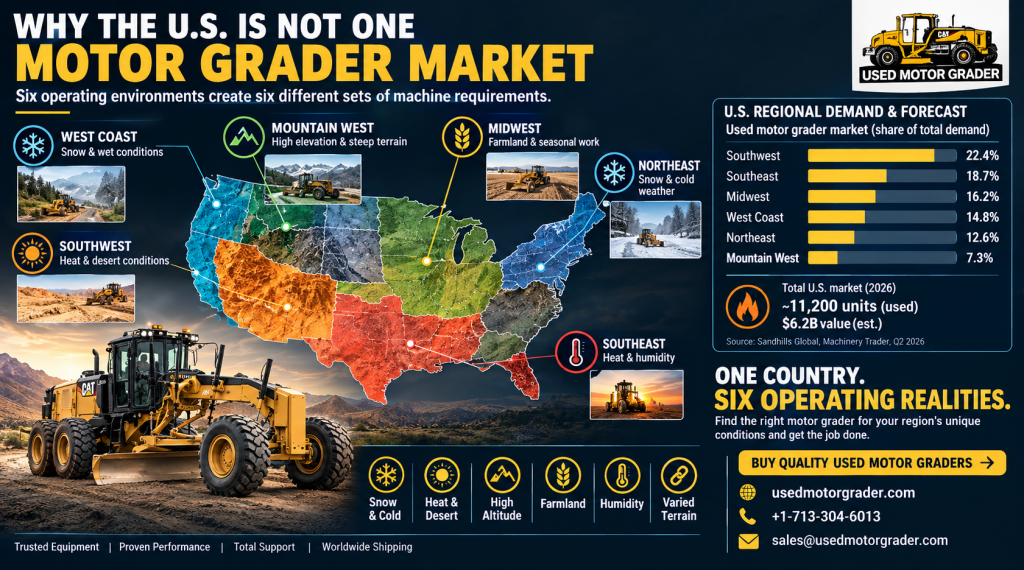
Six patterns recur clearly enough to organize this report: the Texas/Gulf Coast corridor, the Midwest, the Mountain West, the Southwest, the Northeast, and the West Coast. These are editorial groupings built around dominant operating conditions, not official federal statistical regions, and plenty of variation exists within each one. But the pattern holds well enough to explain why the same grader specification can be smart in one place and a poor fit sixty miles away.
Texas / Gulf Coast: Heat, Energy, Storms and Scale
Energy activity is the defining variable in West Texas. The Permian Basin held roughly 265 active drilling rigs as of mid-August 2026, accounting for about a third of total U.S. drilling activity, and rig counts swung by dozens of units within single months through 2026 as operators reacted to price signals. That volatility matters to road agencies because heavy hauling to and from well sites is what breaks down caliche and gravel county roads. Texas counties surrounded by oil and gas fields have pressed the state for years to help pay for repairs, since local road bases were never engineered for that scale of heavy-equipment traffic, and the damage falls disproportionately on county-owned rural mileage. TxDOT has responded at a scale unmatched elsewhere: the agency’s draft 2026 ten-year transportation plan pencils out to roughly $101.6 billion, marking a third consecutive year the program has cleared the $100 billion mark, built in part around energy-sector road needs and hurricane evacuation routes.
Storm exposure is the other constant. National Weather Service records covering more than a century of hurricane activity put the combined Gulf-and-Atlantic landfall rate at roughly one to two storms per year, and Texas’s 367-mile coastline alone has absorbed 37 hurricane landfalls over that stretch of record-keeping, a pace of a little better than one every three years somewhere along the state’s shore.
That regularity means contractors and public agencies need graders that can pivot from routine maintenance to emergency debris clearing and washed-out shoulder repair on short notice. Expected demand for AWD used graders heading into winter 2026-27 usually gets framed as a northern-climate story, but saturated ground after a tropical storm creates a traction problem that all-wheel-drive and tandem-drive configurations solve just as well as snow does.
Texas also carries outsized weight in the secondary market. The state’s inventory moves in volumes large enough that Houston’s used grader market has ripple effects across the rest of the country, and drilling activity further east has made it so East Texas has become one of the most active regions in the country for used grader turnover. A buyer anywhere else eventually runs into a machine that started its working life in Texas.
Midwest: Agriculture, Gravel Roads, Frost and Winter Maintenance
The Midwest’s market is built on two things rarely paired elsewhere: an enormous rural gravel-road network and a genuinely brutal freeze-thaw cycle. Federal Highway Administration figures put 71 percent of U.S. public roads in rural areas, with 45 percent of that rural mileage unpaved, and the Midwest carries a disproportionate share of it in the form of county and township farm-to-market roads connecting grain elevators and feedlots to the highway system. Those roads need routine reshaping and ditch work just to stay passable for seasonal grain and farm traffic.
Winter changes the job. Frost depth is the variable separating the Midwest from most other regions: observers tracking the 2024-25 winter recorded frost reaching two to four feet down across Minnesota and Wisconsin, a result of thin snow cover that failed to insulate the ground below. That depth sets up the spring-thaw damage that follows, when saturated subgrade beneath still-frozen surface produces the heaving and rutting Midwestern road crews budget around every year.
A grader built for this region needs enough weight and moldboard control to handle frozen ground in winter, then pivot immediately to soft, saturated gravel in spring, a profile that favors conventional tandem-drive machines with strong ballast options over narrowly specialized ones. Anticipated AWD demand heading into the 2026-27 winter season is worth tracking here, since traction on icy gravel shoulders is a real operational problem rather than a sales feature. Procurement also follows the calendar more predictably than in storm-driven regions: county budgets tend to plan major purchases around the post-harvest lull and ahead of the first hard freeze.
Mountain West: Elevation, Terrain and Remote Roads
The Mountain West’s defining constraint isn’t one climate variable, it’s distance and elevation working together. The Forest Service alone maintains more than 265,000 miles of road across the national forest system, of which only about 65,000 miles are built to a standard suitable for ordinary passenger vehicles, and a large share of that network sits in mountain states, often far from the nearest dealer parts counter.
Elevation has a real, physical effect on machine performance. As atmospheric pressure drops with altitude, a naturally aspirated diesel engine loses available oxygen and, with it, usable power, an established engineering relationship that becomes noticeable above roughly 5,000 feet and significant above 8,000 feet, a range that describes much of Colorado, Wyoming, and Utah’s working elevation. Modern turbocharged, electronically controlled engines compensate for much of this automatically, but a buyer sourcing an older used machine for mountain work should confirm how well that specific engine handles the derating, since a grader that ran fine at a Gulf Coast job site may lack the power to move material efficiently at 9,000 feet.
Terrain compounds the elevation problem. Steep grades and switchback roads put a premium on articulation, stable weight distribution, and predictable blade control, since a machine on a narrow forest-access road doesn’t have the margin for error a wide rural section-line road allows. Serviceability becomes a purchasing factor in its own right, a remote highway district has strong reasons to favor mainstream, well-supported configurations over a highly specialized machine that might sit idle waiting on a part.
Southwest: Heat, Dust, Caliche and Long Rural Networks
Arizona, New Mexico, Nevada, and the broader arid Southwest combine extreme sustained heat, persistent dust, and long rural networks serving mining, utility, and ranching operations spread across enormous distances. Phoenix set a record in 2024 with more than 100 consecutive days at or above 100 degrees Fahrenheit, breaking the previous mark of 76 straight days set back in 1993, and the following spring Tucson reached 100 degrees on April 11, 2025, the earliest date on record there for triple-digit heat.
That kind of sustained load punishes cooling systems, hydraulic fluid, tires, and any operator working a shift in a poorly climate-controlled cab.
Soil deserves more precision here than the word “caliche” usually gets. Caliche is a specific, calcium-carbonate-cemented soil layer common across Arizona, New Mexico, Nevada, and parts of Texas, not a catch-all term for every hard Southwestern surface. It compacts reasonably well as a road base in some cases, but engineers who have tested it generally rate its performance below standard crushed-rock base material, and it becomes unpredictable when saturated after the region’s infrequent but intense monsoon rain.
That means a grader operator working caliche needs different blade angle and moisture judgment than one working sand or decomposed granite, even though all three get lumped together as “Southwest terrain” from a distance. Dust exposure over long hours pushes buyer priority toward robust filtration and disciplined service intervals rather than any particular drivetrain, and because much of the region’s network serves mining, utility, and ranching interests rather than dense population centers, buyers here often favor simple, well-proven configurations a local independent shop can service over heavily optioned machines that assume dealer support is always close by.
Northeast: Freeze-Thaw, Snow, Salt and Infrastructure Wear
The Northeast combines dense, old infrastructure with a winter maintenance season that is short, intense, and chemically hard on equipment. Regional climate trackers logged the coldest Northeast winter since 2014-15 this past season, with December through February all running colder than normal, and a late-February blizzard set all-time storm-total and daily snowfall records at Rhode Island’s T.F. Green Airport. Winters like that compress a season’s worth of plowing, salting, and shoulder repair into a few frantic weeks, a very different rhythm than the Midwest’s steadier freeze-and-thaw cycle.
Salt separates the Northeast most clearly from every other region, and it cuts both ways: it keeps roads passable, and it corrodes everything it touches. The country goes through on the order of 22 million tons of deicing salt in a typical winter, with Northeastern states consistently among the heaviest users per lane mile. That has a direct, practical consequence for used buyers: a grader that spent its life in a Northeastern municipal fleet needs a frame, hydraulic-line, and wiring-harness inspection a Southwestern buyer might reasonably skip. Corrosion doesn’t always show up as rust on painted panels, it shows up in seized fasteners, pitted fittings, and wiring failures that surface months later.
Buyer behavior varies more within the region than the “snow belt” label suggests, too: a coastal Massachusetts municipality manages a different corrosion profile than an inland Vermont county fighting frost heave more than salt spray, and both differ from a private contractor doing subdivision work who cares more about fine-grading precision than winter capability. What’s consistent is that documented maintenance history carries unusual weight here, since two machines with identical hour meters can be in very different mechanical condition depending on how carefully a previous owner managed corrosion.
West Coast: Infrastructure, Wildfire Recovery and Regulation
California, Oregon, and Washington get grouped more often than their conditions justify. A grader working coastal fog-belt maintenance, one working Sierra Nevada mountain roads, and one doing post-fire reclamation in a Central Valley foothill community face three genuinely different jobs, even within a single state.
Wildfire has become an unavoidable part of West Coast road planning. California logged 8,036 wildfires in 2025, burning a combined 525,223 acres statewide, and fire seasons of that scale generate grader work long after the flames are out, reopening access roads, regrading erosion-damaged shoulders, and rebuilding surfaces damaged by fire apparatus and post-fire mudslides on destabilized slopes. That work is typically urgent, short-notice, and scattered, favoring contractors and agencies that keep versatile, reliable machines in reserve rather than narrowly specialized units.
California’s infrastructure spending is also unusually large and sustained. The state’s decade-long Road Repair and Accountability Act is projected to raise roughly $54 billion split between state and local transportation investment, enough to cover repairs on more than 17,000 lane miles of pavement and 500 bridges, with a stated goal of bringing 98 percent of state highway pavement to good or fair condition.
That level of sustained funding supports a steadier public-sector replacement cycle than storm- or drought-driven regions typically see, though emissions regulation adds a variable that doesn’t apply elsewhere in this report: older diesel equipment faces tighter operating restrictions in California than in most other states, which measurably shortens an aging machine’s practical service life there compared with an identical machine working in, say, rural Wyoming.
The Same Grader Can Mean Different Things in Different Regions
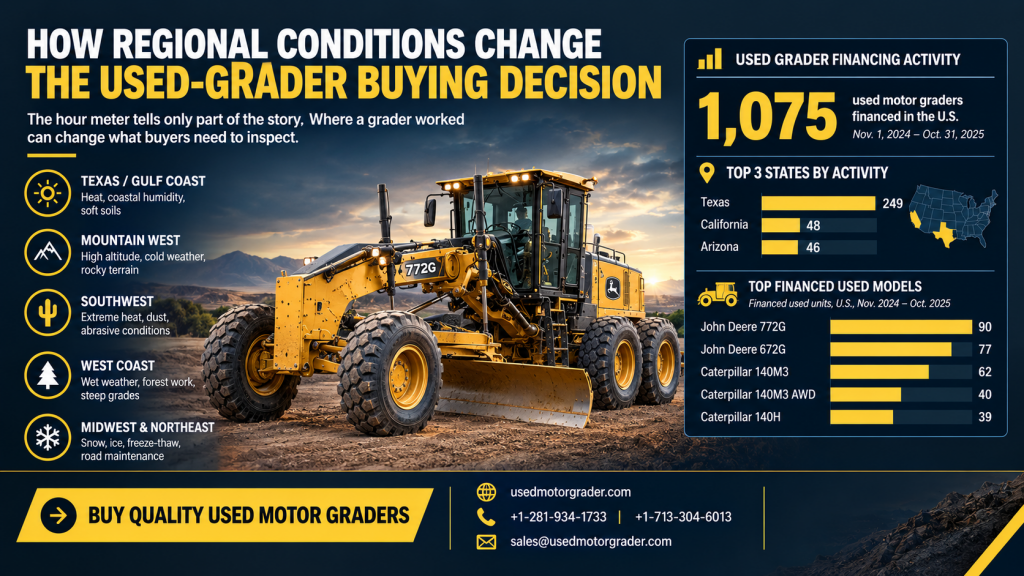
Picture a mid-size, 14-foot moldboard, tandem-drive grader with roughly 6,000 hours on the meter, a genuinely common used-market configuration. In West Texas, a contractor doing energy-access maintenance sees a workhorse that can reshape caliche roads all day and still handle occasional storm repair. In Minnesota, a county buyer sees a machine that needs a hard look at ballast and tire selection for frozen shoulder work, but otherwise fits the seasonal cycle well. In Arizona, a mining-access contractor cares less about winter capability and more about whether the cooling system and filtration held up after years of desert dust. Same machine, same hour meter, three different evaluations.
That’s part of why mid-sized graders have quietly gained real momentum in the U.S. market: they’re versatile enough to be defensible across most regional profiles, even when they’re not optimal in any single one. A heavily specialized machine, say, one optioned for snow removal with minimal cooling capacity, might be the obvious pick in northern Maine and a poor one in central Texas. The moderately configured, mid-size grader tends to survive that regional test better than either extreme.
How Geography Changes Used Motor Grader Buying Decisions
The real question a buyer should ask isn’t “is this a good grader?” It’s “is this a good grader for what I need to do, where I need to do it?” Machine age carries different weight by region: a 12-year-old grader that spent its life in dry Southwestern conditions with disciplined maintenance can be a sound purchase, while a 12-year-old grader from a Northeastern coastal salt zone deserves closer inspection regardless of how clean the hour meter looks.
Regional reputation matters enough that buyers actively research it. Questions about which U.S. regions consistently produce the best-quality used graders come up often, and while there’s no single objectively “best” region, the honest answer depends on climate exposure and how a previous owner maintained the machine, dry, low-corrosion climates with strong maintenance cultures do tend to produce machines needing less remedial work before resale.
Texas deserves separate mention for sheer market weight: the reasons no other state’s used grader market matches Texas’s overall demand go beyond energy activity; it’s the combination of scale, a large contractor base, and a network big enough to generate steady turnover in every price bracket. A buyer anywhere in the country scanning road grader for sale listings will likely encounter Texas-sourced machines more often than those from any other single state.
A machine’s destination should inform scrutiny of its origin, too. A grader that spent its working life on Gulf Coast storm-response roads and is now headed to a Mountain West buyer needs an honest look at corrosion, undercarriage wear, and hydraulic condition that a local buyer might not think to prioritize. Transport cost factors into that math as well, moving a grader a thousand miles narrows the price advantage of an out-of-region machine fast enough that local sourcing often wins on total cost even when the sticker price looks less attractive.
What This Means for the U.S. Used Grader Market
Ritchie Bros. auction data shows motor grader sales volumes running higher in the first quarter of 2026 than the same period a year earlier, with median pricing holding steady to slightly improved, and that volume strength carried into the second quarter of 2026, when motor grader pricing held roughly flat even as several other earthmoving categories posted gains. That’s a useful national signal, but it says nothing about which regions are driving the volume or the condition those machines are actually in, a gap a regionally informed buyer has to close on their own.
Inventory doesn’t stay where it started. A grader specified for Gulf Coast energy work regularly ends up, a decade later, doing fine-grading for a Mountain West contractor or seasonal maintenance for a Midwestern township. That migration keeps the national market liquid, but it also means a listing’s current location tells a buyer very little about the conditions the machine actually endured. Anyone weighing the seven key factors that drive used motor grader resale value will find that documented history consistently outweighs raw hour-meter numbers, a pattern that only sharpens once regional operating history enters the picture.
Regional demand imbalances create real opportunity, too. A contractor willing to source outside their home region, verify history carefully, and account for transport cost can often find better value than one limited to local listings, which is part of what’s driving some of the emerging business opportunities researchers are tracking among U.S. used motor grader contractors right now. None of this supports a claim that any configuration carries a guaranteed resale premium everywhere. The honest conclusion is that broadly versatile, well-maintained, moderately configured machines tend to travel best across regional lines, while heavily specialized machines built for one climate’s extremes can be a harder sell once they leave it, worth remembering for anyone scrolling Used Motor Graders For Sale In USA listings and wondering why two similar machines are priced so differently.
There Is No Single “U.S. Grader”
None of this means one region’s approach is right and another’s is wrong. A caliche-country contractor prioritizing cooling and simplicity over snow capability is making just as rational a decision as a Vermont county prioritizing traction and corrosion resistance over desert-grade filtration. The right grader has always been a function of the ground it works, the climate it survives, and the buyer’s own operating economics, not the brand on the hood or the price on the sticker.
Treating the United States as one motor grader market flattens exactly the differences that matter most to anyone trying to get years of productive work out of a machine, new or used, whether that search starts with a local dealer or a nationwide road grader for sale listing.
Regional Operating Environment
| Region | Dominant Operating Conditions | Key Road/Work Environment | Major Seasonal Pressure | Typical Applications |
| Texas / Gulf Coast | Extreme heat, hurricane exposure, heavy energy-sector hauling | County/FM roads, energy access roads, coastal highways | Aug–Oct storm season; near year-round heat | Energy-access maintenance, storm response, rural road upkeep |
| Midwest | Deep frost, spring thaw, extensive gravel-road network | Township/county farm-to-market roads, gravel roads | Winter freeze followed by spring thaw | Ag-road reshaping, ditching, snow removal |
| Mountain West | High elevation, steep terrain, remote access | Forest roads, mining-access roads, mountain highways | Long winter snow season; short construction window | Forest-road maintenance, mining access, mountain highway upkeep |
| Southwest | Extreme sustained heat, dust, short intense monsoon | Long rural/utility/mining roads, desert and caliche soils | Summer heat; late-summer monsoon | Utility and mining access, rural road maintenance |
| Northeast | Freeze-thaw, heavy road-salt use, aging infrastructure | Dense municipal and state road network | Short, intense winter season | Municipal snow/ice response, pothole and shoulder repair |
| West Coast | Wildfire exposure, sharp terrain variation, tight regulation | Mountain, coastal, and urban road network, forest roads | Fire season; wet-season landslide risk | Post-fire road recovery, highway rehab, forest-road maintenance |
Environment → Configuration Implications
| Region | Key Operating Stress | Important Grader Characteristics | Why It Matters | Typical Buyer Priority |
| Texas / Gulf Coast | Heavy haul traffic plus storm damage | Heavy-duty frame, strong hydraulics, AWD/6WD option | Handles washboarded haul roads and post-storm cleanup | Uptime and durability |
| Midwest | Deep frost followed by ground saturation | Ballast flexibility, strong moldboard control | Works frozen ground, then pivots to wet gravel | Reliability across two very different seasons |
| Mountain West | Elevation loss of power, remote terrain | Power reserve, articulation, stable weight distribution | Maintains output at altitude, handles grades safely | Serviceability and mainstream parts support |
| Southwest | Sustained heat, dust ingestion | Robust cooling, filtration | Prevents overheating and premature wear | Mechanical simplicity, low service burden |
| Northeast | Salt exposure, freeze-thaw cycling | Corrosion-resistant frame and hydraulics, sound undercarriage | Prevents premature structural and hydraulic failure | Documented maintenance history |
| West Coast | Wildfire recovery, emissions rules | Emissions compliance, all-around versatility | Meets state operating rules, handles varied terrain | Regulatory compliance and adaptability |
Purchasing Behavior and Used-Market Implications
| Region | New vs. Used Tendency | Configuration Priority | Condition Scrutiny Focus | Typical Procurement Timing |
| Texas / Gulf Coast | Heavy used-market volume | Power and durability | Frame/hydraulic wear from haul-road duty | Pre-hurricane-season buildup |
| Midwest | Used favored for county fleets | Ballast, tandem-drive reliability | Rust and wear from salted or wet gravel roads | Post-harvest, ahead of first freeze |
| Mountain West | Used favored, budget-driven | Serviceability, mainstream parts access | Altitude-related engine wear, undercarriage condition | Ahead of the short summer construction window |
| Southwest | Used favored | Cooling and filtration condition | Heat-related hydraulic seal and hose wear | Ahead of monsoon season |
| Northeast | Mixed; newer machines favored where corrosion risk is high | Corrosion resistance | Frame, wiring, and hydraulic-fitting corrosion | Ahead of winter |
| West Coast | Mixed; regulation influences turnover | Emissions compliance, versatility | Compliance status, fire-debris-related wear | Ahead of fire season / after major storms |
Ready to Find the Right Machine for Your Region
The regional differences covered in this report are not abstract, they are exactly what usedmotorgrader.com helps buyers navigate every day. Our inventory features well-maintained machines from popular manufacturers including Caterpillar, John Deere, Komatsu, Volvo, and CASE, each listed with the supporting documentation and available service history that matter most once you know what to look for.
Whether you need a heavy-duty configuration built for energy-corridor hauling, a reliable tandem-drive machine for seasonal gravel-road work, or a simple, serviceable unit suited to remote operation, our online listings make it convenient to compare machines suited to your specific operating environment from wherever you are working. Browse our current inventory to find your next grader, and reach out to our team with questions about a specific machine’s history before you buy.
FAQs
1. Why do regional operating conditions matter when buying a used motor grader?
A: Because climate, soil, and road type determine how hard a machine’s frame, hydraulics, cooling system, and undercarriage were actually worked, two graders with identical hour meters can be in very different mechanical condition depending on where they spent their working life.
2. Which U.S. operating environments place the greatest emphasis on AWD or extra traction?
A: Snow-belt regions like the Midwest and Northeast lean on traction for icy gravel shoulders and unplowed roads, but the Gulf Coast has its own traction demand after tropical storms leave ground saturated, so AWD priority isn’t limited to cold-climate buyers.
3. Why does a grader’s work history matter as much as its hour meter?
A: Hours measure use, not exposure. A low-hour machine that spent years near the coast in salt air or in a dusty desert environment can need more remedial work than a higher-hour machine maintained carefully in a milder climate.
4. Does a grader sourced from another U.S. region need extra scrutiny before purchase?
A: In most cases, yes. A buyer should ask what climate and work the machine actually experienced, not just where it’s currently listed, and weigh transport cost against any price advantage before assuming an out-of-region machine is the better deal.
Tags: Used Graders Market Analysis, U.S. Used Grader Market, U.S. Grader Operators