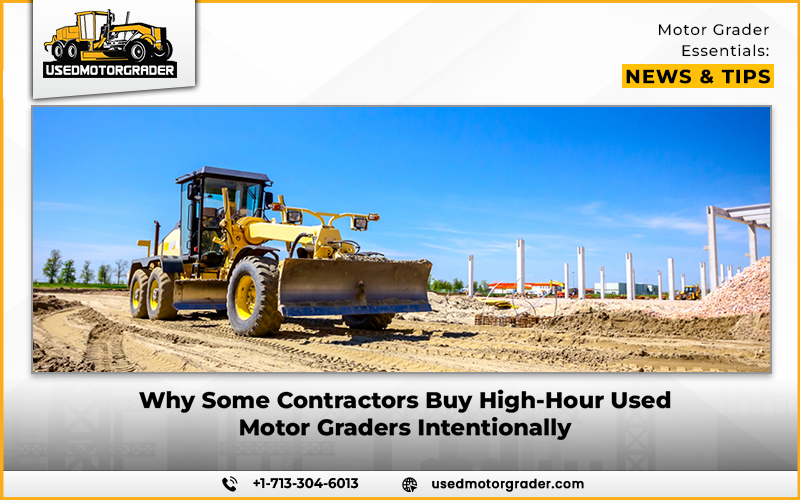
Search current listings for a motor grader for sale anywhere in the U.S., and a pattern jumps out fast: two machines from the same era, brand, and configuration can carry price tags $60,000 to $100,000 apart, with the hour meter as the only real difference on the spec sheet.
A 2014-era Cat 140M2 with 3,000 hours can list north of $150,000; the same model with 11,000 hours might sell for well under $70,000. Conventional wisdom says the lower-hour machine is the smarter buy. A meaningful share of experienced contractors disagree for their own fleets, and the math holds up better than it first appears.
EquipmentWatch’s resale data, drawn from tens of thousands of listings, put the average price of a used motor grader at roughly $230,146 in January 2025, easing to $221,312 by September 2025, with the average machine in that pool around 9.5 years old. That average blends near-new flips, mid-hour production machines, and high-hour veterans still earning a paycheck, the hour meter alone doesn’t explain where any single machine lands in that range.
Why High Hours Do Not Automatically Mean Low Value
An hour meter measures time, not health. A grader that logged 9,000 hours doing light municipal shoulder work under a disciplined maintenance program can be mechanically tighter than a 5,000-hour machine that sat outdoors, skipped fluid changes, and got run hard on a haul road.
Idle time counts the same as working time on most meters, so two machines with the same reading can have very different wear. Hydraulic and transmission durability has also improved enough in recent design generations that major components increasingly outlast the rest of the machine’s wear items. Hours are a data point, not a diagnosis.
The Economics Behind the Decision
The clearest driver of intentional high-hour buying is what’s happening at the low-hour end of the market. Export demand from Africa, Latin America, Southeast Asia, and the Middle East has been pulling clean, low-hour North American graders out of the domestic pool. As covered in a closer look at the growing premium on low-hour graders, a low-hour grader can command roughly 10 to 20 percent more selling into an export market than domestically, and domestic buyers chasing the same tight-hour machines are effectively bidding against overseas capital.
Industry owning-and-operating benchmarks show the flip side: a typical new mid-size grader depreciation model assumes roughly 1,500 hours of use per year over a five-year, 7,500-hour cycle, with a purchase price north of $260,000 depreciating to a residual in the low six figures. A contractor buying a high-hour machine at a fraction of that entry cost isn’t just saving on price, they’re freeing capital that would otherwise sit inside one asset, capital that can go toward trucks, attachments, an operator, or a repair reserve.
What Experienced Buyers Look at Instead of Hours Alone
Seasoned buyers treat the displayed number as a hypothesis, not a fact. Anyone shopping a used motor grader for sale listing should ask for:
- Maintenance invoices
- Fluid-analysis history
- ECM diagnostic pulls confirming the dashboard reading matches the engine’s stored data (where applicable)
As an analysis of the reliability of hour-meter data shows, displayed and true operating hours don’t always agree, and the incentive to under-report grows with the price gap between hour brackets. Beyond the meter, buyers check the circle drive and drawbar for slop, inspect tandem case oil, look at cutting-edge wear against the claimed history, and watch for signs of a prior major rebuild, which can reset a component’s remaining life even as the hour meter keeps climbing.
When a High-Hour Grader Can Make Business Sense
The workload matters as much as the machine. A county fleet manager shopping for a road grader for sale to blade gravel roads a couple of times a month has a very different risk tolerance than a contractor running double shifts on a fine-grade highway job.
Backup machines, seasonal snow-removal duty, occasional shoulder work, and low-intensity municipal maintenance are all applications where a proven, high-hour machine with clean records can beat a low-hour machine on a cost-per-hour basis, simply because annual utilization is too light to justify tying up capital in a premium asset.
Comparing Low-Hour vs. High-Hour Graders
| Buying Factor | Low-Hour Grader | High-Hour Grader |
| Typical acquisition-price position | Commands a premium, amplified by export competition | Substantially lower entry cost for the same model |
| Depreciation considerations | Steeper dollar depreciation off a higher base | Slower dollar depreciation; often near the value floor |
| Repair exposure | Lower near-term risk, higher unknown long-term risk | Higher near-term risk, but often quantifiable up front |
| Remaining-service considerations | Longer runway before major component work | Shorter runway; rebuilds may already be behind it |
| Parts/service considerations | Strong on current-generation models | Strong for high-volume legacy models (Cat, Deere, Komatsu) |
| Best-fit fleet role | Primary production machine, tight uptime margins | Backup, seasonal, or lower-intensity workloads |
| Primary financial trade-off | Pay more upfront for lower risk | Pay less upfront, budget for likely repair costs |
The Repair Reserve Changes the Calculation
The most disciplined high-hour buyers don’t just look at purchase price, they build a repair reserve into the decision. Real shop-rate data gives that reserve structure:
- Hydraulic pump replacement: $4,500 to $12,000
- Tandem seal and bearing service: $1,800 to $4,500
- Circle gear and ring work: $2,800 to $7,500
- Full engine reman (Cat, Deere, Komatsu): $24,000 to $52,000 installed
A contractor buying a $70,000 high-hour grader with a $20,000 contingency reserve is still well under the price of a comparable low-hour machine, and now owns a documented picture of what could go wrong rather than an unknown. This budgeting mindset fits the broader approach in profit strategies for small grader contractors, where controlling acquisition cost matters more to the bottom line than chasing the lowest hour count on the lot.
Brand and model shape how confidently a contractor should lean into a high-hour purchase. Cat, John Deere, and Komatsu account for the large majority of financed used motor grader sales in the U.S., and that installed base matters: a familiar model has more mechanics who’ve worked on it, more parts in circulation, and a deeper pool of comparable sales to benchmark price against. Scroll through nearly any motor grader for sale listing site and that concentration is obvious, not proof one brand is universally better, but it does mean parts and service are rarely the limiting factor on a mainstream high-hour machine.
When High-Hour Buying Becomes a False Economy
None of this works without discipline. A high-hour machine with no service records, evidence of deferred maintenance, documentation gaps across multiple owners, or visible hydraulic leakage can erase its price advantage the moment a tandem or a pump lets go unexpectedly.
Obsolete electronics or hard-to-source parts on older pre-emissions models can turn a routine repair into a weeks-long hunt. And a high-hour machine pressed into a high-utilization, tight-deadline production role is the worst match: the downtime a backup grader can absorb becomes a schedule-killing liability on a machine that has to run every day.
The Real Buying Equation
The hour meter is the easiest number to compare, which is exactly why it gets overweighted. Price, verified condition, maintenance history, component-replacement records, expected utilization, and downtime tolerance. All these together tell a far more accurate story than hours alone. A well-documented high-hour grader bought for the right role, with a realistic repair reserve behind it. Can beat a low-hour machine bought on the assumption that a small dashboard number guarantees few future headaches.
Ready to Source Your Next Grader?
Whether you are building a case for a high-hour workhorse or a tighter-hour production machine. The purchase only pays off when documentation backs up the price. When you are ready to find your next used motor grader for sale, usedmotorgrader.com carries machines from leading brands in excellent, well-maintained condition. With the service history and inspection documentation buyers need, ready to move to your site without the guesswork.
Browse the current inventory and weigh condition, history, and fit against your actual workload before you commit to a road grader for sale. Not just the number on the meter.
FAQs
1. Are high-hour motor graders worth buying?
A: Often, yes, if the price reflects the hours, the maintenance history is documented, and the machine is matched to a workload that doesn’t demand near-perfect uptime. Condition and records matter more than the hour count itself.
2. What operating-hour range is considered high for a used motor grader?
A: Most of the market treats anything above roughly 8,000 to 10,000 hours as high-hour. Though this varies by model, engine, and how the hours were accumulated.
3. What matters more than hours when evaluating a used grader?
A: Verified maintenance records, component-replacement history, hydraulic and tandem condition. Also, how the hours were earned (light municipal work versus heavy production) carries more weight than the raw number.
4. Can a high-hour grader still be profitable for a contractor?
A: Yes, particularly as a backup, seasonal, or lower-intensity machine. Where a lower acquisition cost plus a planned repair reserve can beat the total cost of a premium low-hour purchase.