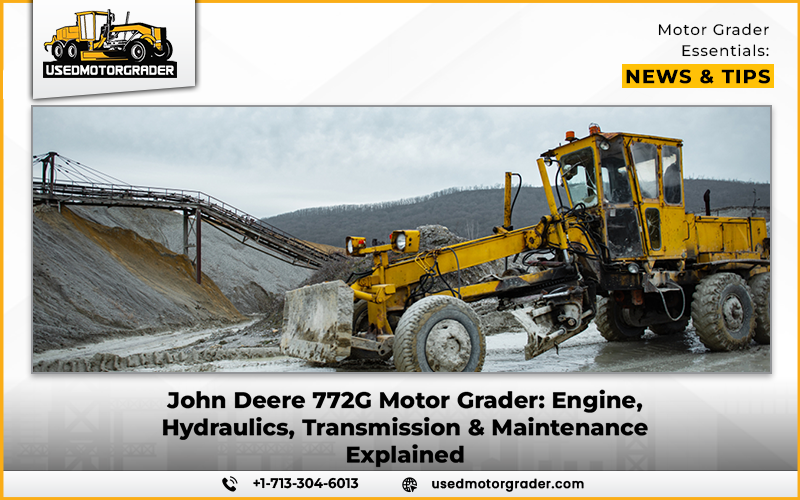
A motor grader’s real capability is not set by the horsepower number on its spec sheet. It’s set by how that power moves through the driveline, how the hydraulic system turns operator input into blade movement, and how well the machine has been maintained.
The John Deere 772G makes a good case study, a large, 6-wheel-drive grader built for road construction and heavy maintenance work, where engine output, hydraulic response, and transmission behavior all have to cooperate to produce a clean grade. Understanding those systems, not just the headline numbers, is what helps a buyer judge if a specific machine is worth the money.
John Deere 772G at a Glance
The 772G sits toward the upper end of John Deere’s G-Series grader lineup, built for road construction, subdivision development, aggregate-site maintenance, and heavy ditching where a smaller-frame grader would struggle. John Deere motor graders in this size class are commonly specified with front-wheel assist, and the 772G ships with John Deere’s 6-wheel-drive dual-path hydrostatic system as standard equipment rather than an add-on.
The plain “G” designation covers manual blade control, while the 772GP variant adds John Deere’s SmartGrade automated grade-control system. Both share the same core engine, hydraulics, and transmission described below.
| Specification | John Deere 772G |
| Engine | John Deere PowerTech PSS 9.0L, 6-cylinder turbocharged |
| Net rated power | 205 kW (275 hp) at Gear 7, 6WD on (FT4 configuration) |
| Displacement | 9.0 L (548 cu in) |
| Transmission | PowerShift Plus, direct-drive, 8 forward / 8 reverse |
| Typical operating weight | 20,217 kg (44,570 lb), FT4 configuration |
| Hydraulic system | Closed-center, pressure-compensated load-sensing |
| Fuel tank capacity | 416.5 L (110 gal) |
Engine: Power Behind the Grading Work
The 772G is built around a John Deere PowerTech PSS 9.0-liter, six-cylinder turbocharged diesel rated at 205 kW (275 hp) net at Gear 7 with 6WD engaged, with peak net torque of 1,375 Nm (1,014 lb-ft).
Deere also offers a PowerTech Plus 9.0L (EPA Tier 3/EU Stage IIIA) or a base PowerTech 9.0L (EPA Tier 2/EU Stage II), both rated at 201 kW (270 hp), a reminder that horsepower on a used listing can shift depending on the emissions package the machine carries.
The figure that matters more than peak horsepower is torque rise, rated at 55 percent on the FT4 engine, how much torque increases as the engine loads down from rated speed, and a rough proxy for how well the grader resists stalling when the moldboard bites into hardpan or drags a full windrow.
A high torque-rise engine holds usable power longer as resistance climbs, meaning steadier blade loading and less need to gear down to keep the cut moving.
Hydraulics: Where Blade Control Comes From
The 772G runs a closed-center, pressure-compensated load-sensing (PCLS) hydraulic system with a variable-displacement piston pump, delivering up to 212 L/min (56 gpm) at a maximum system pressure of 18,961 kPa (2,750 psi). A load-sensing circuit only pressurizes to match actual demand, so the pump isn’t wasting engine power moving oil the blade isn’t using at that instant.
That matters most when an operator runs several functions together, lifting the moldboard, side-shifting the blade, and articulating the frame while steering through a curve. Each function draws the flow it needs without starving the others, which shows up as smoother blade response during fine grading, slope work, and ditch shaping.
Blade lift above ground runs 490 mm (19.3 in), side shift is 683 mm (26.9 in), and shoulder reach outside the wheels is 2,083 mm (82.0 in), figures that set how far the moldboard moves without repositioning the machine. Steering is all-hydraulic power-frame articulation with crab steering, letting the tandems sit on firmer ground on soft shoulders or side slopes.
Transmission: Turning Engine Power Into Usable Grading Performance
Power reaches the ground through a John Deere PowerShift Plus transmission, direct-drive, 8 forward and 8 reverse gears, with modulated shift-on-the-go and Event-Based Shifting (EBS), which reads engine load to time each shift rather than shifting on a fixed schedule, keeping changes smooth from a fine finishing pass through to a faster run between cuts. An inching pedal gives fine control over ground speed independent of rpm, useful when creeping up to a curb line or easing into a windrow.
Behind it sits the 772G’s automatic dual-path hydrostatic 6WD system, with separate left and right circuits, variable-displacement pumps, and axial-piston wheel motors driving the front axle. A 15-position rotary control sets how aggressively front drive engages, and the system freewheels automatically at higher travel speeds.
A Precision Mode limits propulsion to the front wheels only, useful when rear-tandem drive would otherwise disturb a finish cut. Top travel speed with no tire slip is 45.5 km/h (28.3 mph) in Gear 8, giving the machine range to move between sites without sacrificing low-speed control.
Maintenance: Keeping a 772G Productive
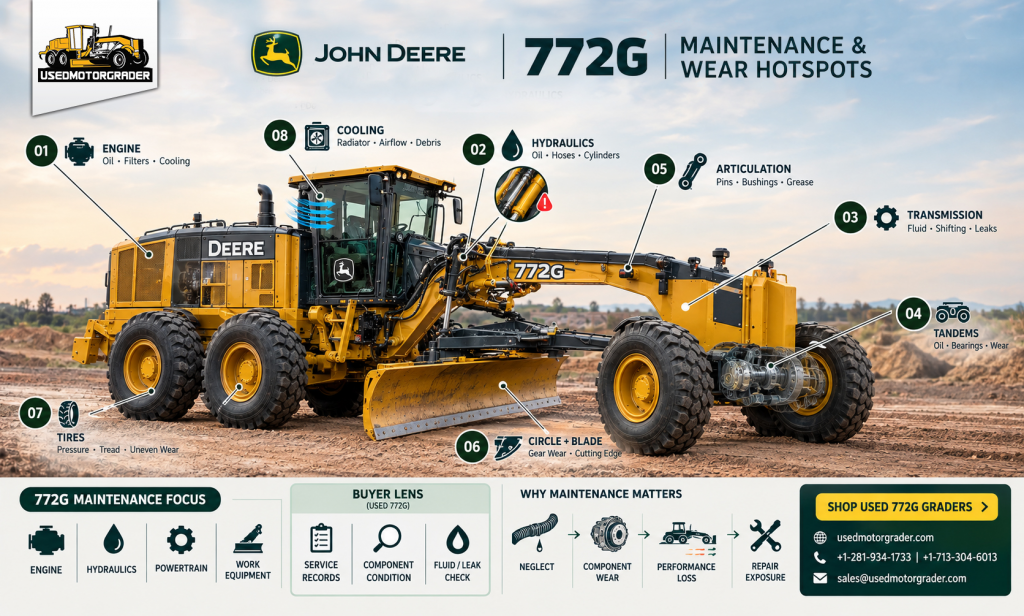
John Deere’s operator’s manual for the 770G/770GP/772G/772GP family lays out a schedule built around hour intervals, daily/10-hour checks, 50-hour and 250-hour points, an initial 500-hour service, and recurring intervals out to 1,000 and 2,000 hours and beyond. Exact tasks per interval are configuration-dependent and detailed in the official manual, but the categories a fleet manager should track include:
- Engine oil, fuel filtration, and cooling-system inspection
- Hydraulic oil and filter servicing
- Transmission fluid, supplied by its own independent reservoir with separate filtration and cooling
- Differential and final-drive lubrication, including the spiral-bevel differential’s clutch-type lock
- Grease points on the circle, drawbar, articulation joint, and steering linkage
- Moldboard wear inserts and the blade side-shift wear system
On FT4 engines, the diesel particulate filter’s ash-service interval is condition-based rather than fixed, and may not be needed until the first overhaul, worth confirming on a used machine, since a poorly tracked DPF history can point to deferred maintenance elsewhere.
What Used-Equipment Buyers Should Pay Attention To
A hydraulic system, transmission, and engine that all check out on paper still need to be verified in person, and that’s where service history carries real weight. Buyers looking at a John Deere motor grader for sale should ask for documentation covering:
- Engine oil analysis history and any major overhaul records
- Hydraulic cylinder seal condition and signs of leaks at hoses and fittings
- Circle drive and moldboard wear-insert condition relative to hour meter
- Transmission shift quality, since hesitation or harsh engagement can signal EBS or clutch wear
- Articulation-joint play, steering-component condition, and emissions configuration, since the latter affects rated power and operating weight
Hour meter numbers only tell part of the story. A 772G with heavy hours but thorough documented service can be a stronger purchase than a low-hour machine with gaps in its records, exactly why a used John Deere motor grader for sale with a complete maintenance file draws closer buyer interest than one with an unclear history.
Contractors building out a crew often treat this as part of a broader plan; our breakdown of adding a 772G as a fleet-expansion strategy covers how that stacks up against renting or buying new, and buyers cross-shopping brands may also want our comparison of the 772G against Caterpillar’s competing graders first.
How the Major Systems Work Together
None of these systems operates independently. Engine torque feeds the PowerShift Plus transmission. It routes power through the differential to the rear tandems. It also routes power via the hydrostatic drive to the front wheels.
All of it converts into traction against whatever the blade is cutting. That same engine drives the hydraulic pump supplying the blade, circle, and steering functions. So engine condition affects hydraulic performance just as directly as it affects ground speed.
A worn engine won’t just lose horsepower. It can starve the hydraulic pump under load, showing up as sluggish blade response exactly when precision matters most. Maintenance ties it together: skipped hydraulic filter changes accelerate pump and cylinder wear.
Neglected transmission fluid shortens clutch life, and deferred engine service shows up as reduced traction and blade control at once. That interdependence is a large part of why contractors keep choosing a used 772G for road-building projects over less-documented alternatives.
Final Takeaway
The 772G earns its place in a road-construction fleet through how its engine, hydraulics, and transmission work together. These are matched to each other, not through any single spec in isolation. For buyers comparing John Deere motor graders against other brands or other G-Series machines. The real evaluation comes down to verified condition across all three systems. Plus a maintenance record that backs up the hour meter.
Sourcing a Used 772G
Motor graders like the 772G hold their value when they are backed by real service documentation. That’s the standard usedmotorgrader.com works from when sourcing inventory. Current stock includes used 772G motor graders, and other used motor grader models maintained in genuinely sound working condition. With documentation to back up their history and straightforward access to inventory. For contractors who need a machine on site without unnecessary delay.
FAQs
1. What’s the difference between the John Deere 772G and 772GP?
A: Both share the same engine, hydraulic system, and transmission. The GP designation adds John Deere’s SmartGrade automated grade-control system. Along with return-to-straight steering control, the standard G model uses manual blade control.
2. What engine and horsepower does the 772G have?
A: A John Deere PowerTech PSS 9.0L six-cylinder turbocharged diesel rated at 205 kW (275 hp) net in the Final Tier 4 configuration. With lower-emissions variants rated at 201 kW (270 hp).
3. How does the 772G’s 6-wheel-drive system work?
A: An automatic dual-path hydrostatic drive powers the front axle. Through separate left and right circuits with variable-displacement pumps. Axial-piston wheel motors, with an operator-adjustable aggressiveness setting and automatic freewheel at higher travel speeds.
4. What should buyers check before purchasing a used 772G?
A: Engine oil analysis and overhaul history, hydraulic cylinder and hose condition. Moldboard and circle wear relative to hours, transmission shift quality, articulation-joint play. Which emissions configuration the machine carries.