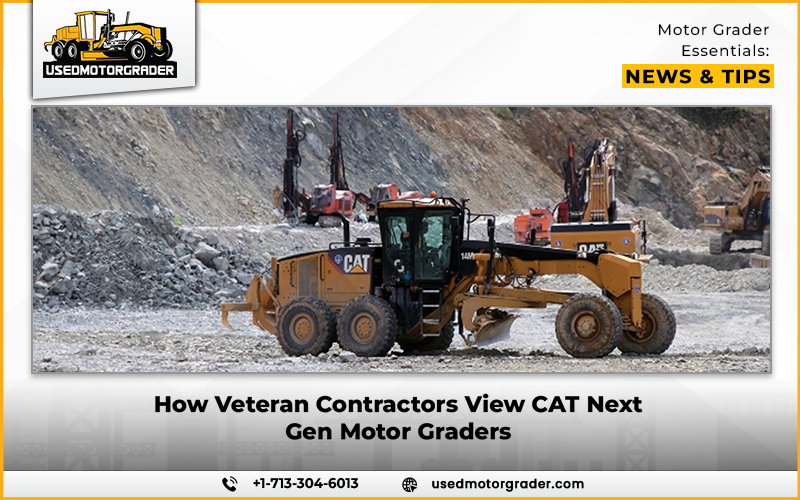
Put a thirty-year grader operator in front of a cab full of touchscreens, and you’ll get one of two reactions: quiet skepticism or genuine curiosity. That tension is playing out on jobsites in 2026 as Caterpillar rolls its Next Gen platform through the 120, 140, 150, and 160 lineup. Veteran contractors aren’t easily impressed by shiny displays. They want to know if a machine will still be earning its keep after 10,000 hours, and that’s the real test the new CAT motor grader family faces now.
What Does “Next Gen” Actually Mean for a CAT Motor Grader?
The Next Gen label refers to Caterpillar’s ground-up redesign of its motor grader cabs, controls, and technology packages, starting with the 120 and now extending to the 140 Joystick, 140 LVR, 150, and 160. Every model gets a redesigned cab, larger glass for better sightlines to the moldboard and tires, a rearview camera folded into a 10-inch touchscreen, and a reworked seat built for long shifts. The C9.3 engine delivers steadier net power as conditions shift, and the transmission has grown from eight speeds to nine for finer control across grading, roading, and ditching work. Much of that shift centers on the gearbox change, worth a closer look at how the nine-speed setup behaves in the field.
Do Veteran Operators Trust the New Electronics?
This is where opinion splits fastest. Caterpillar kept a few familiar touches on purpose. Including the analog bubble gauge longtime operators use out of habit, alongside a digital blade-slope sensor for backup accuracy. A Stable Blade feature automatically slows the machine when bounce would throw off the grade. Cutting down guesswork that used to come purely from feel. Reported testing exceeds 40,000 hours worldwide ahead of the 140 LVR’s release, a figure Caterpillar leans on to build confidence in the new electronics.
Hesitation shows up most around calibration, sensor upkeep, and diagnostics. Veteran crews built their trust in CAT machines over decades of simple, mechanical repairs, so anything routed through a screen invites caution until it proves itself.
Steering Wheel or Joystick: What Do Experienced Operators Prefer?
CAT’s answer has been to avoid forcing a choice. The 140 LVR keeps a traditional lever setup while adding 3D-integrated grade control, and the 150 offers both joystick and lever configurations. That flexibility matters because:
- Operators nearing retirement tend to stick with familiar lever or wheel layouts
- Younger hires trained on joysticks adapt to full electronic control almost immediately
- Fleet buyers increasingly order mixed configurations across a single crew
- Dealers report that comfort and reduced fatigue features often outweigh control-type preference in the final decision
Productivity, Comfort, and the Technology Question
Whether the added technology counts as a genuine productivity tool or an expensive extra keeps surfacing in trade coverage, and it’s worth a closer breakdown of that debate before writing off the cost. What’s clear from current listings is that a CAT motor grader with Grade with Cross Slope or similar automation tends to move faster through resale channels than a comparable machine without it.
Used Market and Resale Confidence
Resale listings across major auction platforms show:
- Well-maintained CAT motor grader units commanding stronger asking prices than off-brand competitors at similar hour counts
- 2022 and 2023 model-year graders with packages like ARO and Earthworks-enabled grade control appearing often in premium listings
- Older 12, 14, and 140-series machines still moving steadily, proving simplicity still has buyers
- Fleet operators favoring machines with documented maintenance history over pure hour counts
That pattern lines up with broader coverage of how Caterpillar’s newer grader models have reshaped buying behavior across the U.S. market.
Brand Loyalty Still Carries Weight
Decades of dealer support and parts availability matter as much to veteran buyers as any single feature. Choosing a CAT motor grader isn’t only about the cab redesign, it’s about staying inside a support network they trust. Common reasons that loyalty holds firm include:
- Established dealer networks with next-day parts commitments
- A long track record of resale strength across older grader generations
- Familiar service intervals and maintenance checkpoints
- Financing and trade-in programs built around fleet upgrades
Skip the long wait and rising new-machine costs, proven performance is sitting on the lot right now. Shop trusted, top-brand used motor graders built to outlast the job at usedmotorgrader.com.
FAQs
1. Is the CAT Next Gen platform reliable for daily construction work?
A: Extended testing hours suggest strong reliability, though real-world trust is still building as more units log field hours.
2. Do older operators struggle with the new controls?
A: Some adjustment is common, but CAT’s mixed lever and joystick options ease the transition.
3. Are used Next Gen CAT graders holding resale value?
A: Yes, current listings show steady demand and competitive pricing for well-maintained units.
4. Is the added technology worth it for smaller contractors?
A: It depends on application, but automation often pays off fastest on high-precision or high-volume grading work.
Tags: Veteran Motor Grader Operators, Used CAT Motor Graders, Next Gen Motor Graders