The Cat 140H has held its place as a benchmark mid-size motor grader since it entered production, and decades later it still turns up across municipal fleets, mining sites, and road-building operations. Part of that longevity comes down to how the machine is built, but a grader lives on tight tolerances.
The circle, drawbar, and moldboard depend on close mechanical fits, and the machine runs through a single power-shift transmission that has to handle years of load cycling. Small maintenance lapses do not stay small, they turn into downtime fast. This guide covers the machine’s key components, common problems owners report, and the inspection habits that keep a 140H productive and valuable.
Cat 140H at a Glance
A quick snapshot of what’s under the hood:
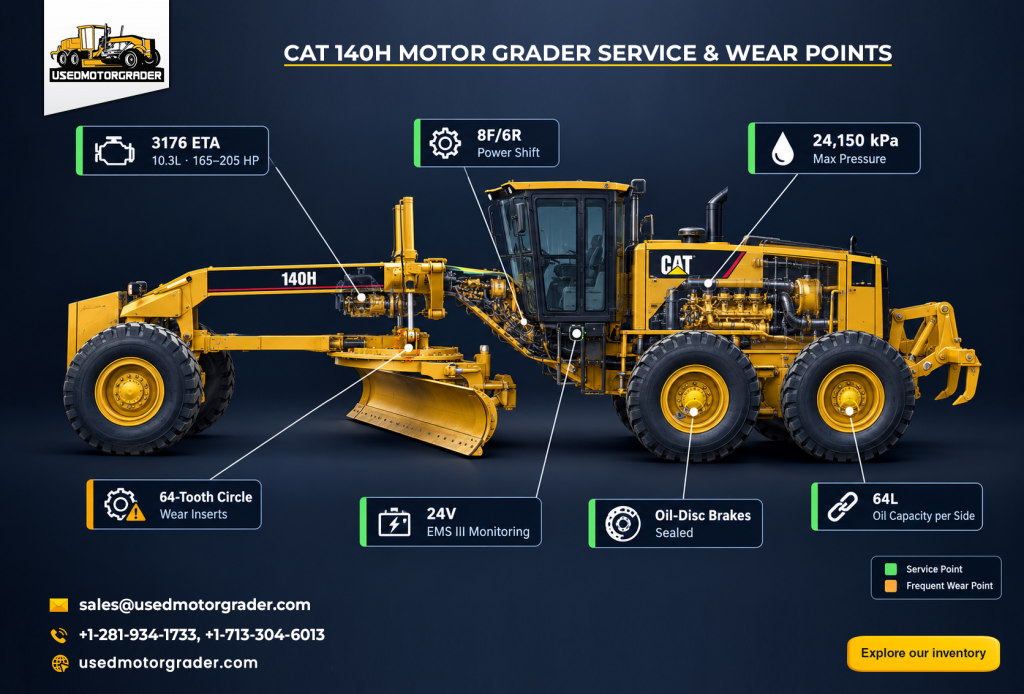
- Engine: Cat 3176 ETA, 6-cylinder, turbocharged, air-to-air aftercooled, 10.3 L (629 in)
- Power: 123 kW (165 hp) base, up to 153 kW (205 hp) with VHP Plus in gears 7–8
- Transmission: Direct-drive power shift, 8 forward / 6 reverse gears
- Hydraulics: Closed-center, load-sensing system, 206 L/min (54.4 gal/min)
- Weight: 14,677 kg (32,357 lb) base GVW, up to 21,261 kg (46,872 lb) max GVW
- Blade: 3,658 mm (12 ft) standard moldboard
Key Components That Demand Regular Attention
Engine, Cat 3176 ETA
The 140H’s power comes from the Cat 3176 ETA, a 6-cylinder diesel built to keep operating costs down.
- Electronically controlled unit-injection fuel system for high injection pressure and lower emissions
- Dual-filter fuel system reduces component wear
- Hydraulic demand fan cuts parasitic engine load automatically
Power Shift Transmission
Eight forward and six reverse gears cover everything from fine grading to high-speed roading.
- Four gears below 10.3 km/h (6.4 mph) suit fine earthmoving, gears 5–7 suit snow removal, gear 8 is for roading
- Electronic Transmission Control smooths shifts and reduces clutch stress
- Cat TDTO (TO-4 spec) is the required fluid, engine oil is not a substitute
Load-Sensing Hydraulic System
CAT’s Proportional Priority Pressure-Compensating (PPPC) valves let the 140H run multiple implements at once.
- “Triple-PC” valves balance flow across implements simultaneously
- Blade float lets the moldboard follow ground contours, useful for snow removal
- Independent oil supply prevents cross-contamination and aids cooling
- Hydraulic oil change interval: 4,000 hours, an extended-interval design
Drawbar, Circle & Moldboard
- A one-piece forged circle, 1,530 mm (60.2 in) diameter, uses 64 heat-induction-hardened teeth
- Six support shoes secure the circle to the drawbar, with nylon composite wear inserts between surfaces
- A Circle Drive Slip Clutch protects the assembly from shock loads when the blade strikes an immovable object
Tandems, Final Drives & Brakes
The tandems and brakes are built for load capacity and redundancy.
- Tandem housings hold 64 L (16.9 gal) of oil each side, final drives hold 47 L (12.4 gal)
- Service brakes are oil-disc, air-actuated, 23,948 cm² (3,712 in²) of surface area, sealed and adjustment-free
- Dual certified air tanks give each side an independent braking circuit
Electrical System & EMS III Monitoring
The 24-volt electrical system pairs with EMS III to flag developing problems early.
- Maintenance-free batteries rated at 750 CCA standard, with heavy-duty options up to 1,300 CCA
- EMS III continuously tracks critical parameters and alerts on abnormal conditions
- Over 200 parameters can be pulled or adjusted via Cat ET
Even well-built components fail predictably under specific conditions, here is what to watch for.
Common Problems Owners Report
Transmission Shifting & Solenoid Failures
Owners most often report gears failing to engage, commonly 1st, 3rd, or 4th, plus slippage under load, creeping when the pedal is depressed, and sluggish shifts. Technicians tracing these symptoms typically find worn shift solenoids, debris in the control valve body, worn clutch packs, damaged shift forks, corroded wiring, or contaminated fluid. On autoshift machines, the fault is often a failed speed sensor or a control module misconfiguration rather than a mechanical problem.
Hydraulic Overheating & Pressure Buildup
Sustained heavy operation can push the hydraulic system into overheating, sometimes with unusual pressure buildup in the tank. Common causes are a stuck main relief valve, degraded hydraulic fluid, or restricted cooling airflow through the radiator or oil cooler, each forces the system to work harder and generates excess heat.
Circle, Drawbar & Moldboard Looseness
The nylon composite wear inserts between the drawbar, support shoes, and circle wear down gradually, and the resulting play shows up directly as reduced fine-grading accuracy. Circle teeth and moldboard wear strips need periodic shimming to restore the factory-tight fit.
Tandem & Final Drive Wear
High-hour machines are prone to tandem chain and case wear when oil sampling and changes fall behind schedule. Heat and metal-particle contamination in aging oil accelerate this wear, one reason S·O·S fluid sampling matters as much on the tandems as on the engine.
Electrical & Sensor Faults
Intermittent fault codes affecting directional or gear function, a machine that drives in reverse but not forward, for example, are a common complaint. Before condemning the valve body, technicians typically check wiring continuity, solenoid resistance, and pressure sensor calibration, since faults there are far more common.
Inspection Tips & Preventive Maintenance Schedule
Daily Walk-Around Checklist
Caterpillar’s own owner guidance keeps the daily routine short:
- Check fluid levels and top off per the recommended schedule
- Inspect air and fluid filters, grouped together on the 140H’s dedicated Service Center
- Inspect the moldboard, cutting edge, and tires for cracks, wear, and damage
- Inspect the powertrain daily for debris buildup, leaks, and loose bolts
Scheduled Interval Maintenance
Engine oil and filter changes are due every 500 hours, reflecting the 140H’s extended-interval design, while hydraulic oil runs on a 4,000-hour interval. The industry-standard tiered PM structure widely applied to Cat equipment layers on top: PM1 at 250 hours, PM2 at 500, PM3 at 1,000, and PM4 at 2,000, each adding inspection depth.
Regular use of the radiator’s clean-out access also matters, since clearing debris prevents overheating-driven engine derates. Caterpillar recommends consulting the Operation & Maintenance Manual for exact intervals on a given serial number range.
The 140H “Service Center” Advantage
Caterpillar grouped nearly all check-and-maintenance points on the left-hand side of the machine, oil checkpoints, coolant gauges, air filters, spin-on filters, remote lubrication points, purge valves, and ecology drain lines, to make routine inspection faster and cut down on missed checks.
S·O·S Fluid Sampling
The 140H includes dedicated sample ports for engine oil, hydraulic oil, transmission fluid, coolant, and fuel, supporting Caterpillar’s S·O·S fluid analysis program. Regular sampling catches component wear before it turns into a failure.
Why Preventive Maintenance Protects Resale Value
A 140H with a documented service history, fluid changes, S·O·S sampling records, and timely attention to the wear points above holds its
value in a way an undocumented machine cannot. Buyers in the used motor grader market watch maintenance records closely, since a well-kept 140H means fewer surprises after purchase. Preventive maintenance is what separates a grader that commands a strong resale price.
Looking for a Cat 140H Motor Grader you can trust? Every used 140H listed on usedmotorgrader.com is inspected and sold in excellent working condition, with complete documentation, service history, ownership papers, and export paperwork, prepared for transfer. Reach out to us and find a reliable unit ready for your project.
FAQs
1. How often should the Cat 140H’s engine oil be changed?
A: Every 500 hours, reflecting the engine’s extended-interval design.
2. What fluid does the power shift transmission require?
A: Cat TDTO (TO-4 spec), engine oil is not an acceptable substitute.
3. How often does the hydraulic oil need to be changed?
A: Every 4,000 hours, thanks to the 140H’s extended-interval hydraulic design.
4. What typically causes transmission slippage or failure to engage gears?
A: Usually worn shift solenoids, valve body debris, worn clutch packs, or contaminated fluid.