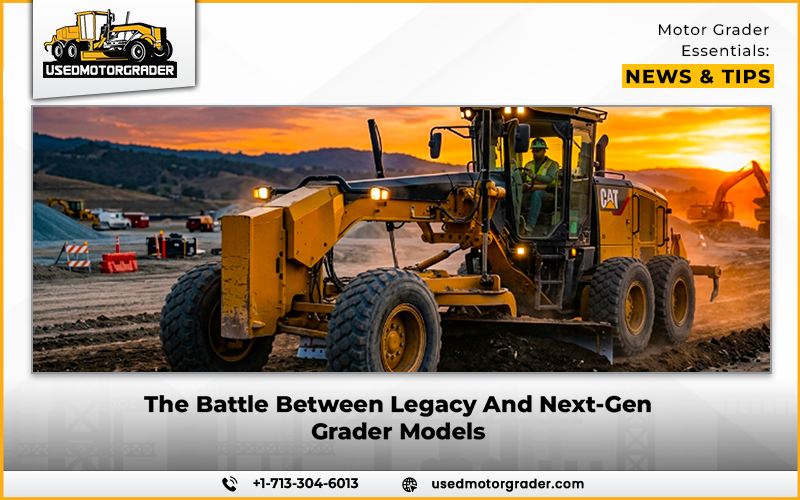
Choosing between outdated and modern equipment is no longer the only factor in the competition between legacy and next-generation grader models. These days, equipment buyers, fleet managers, and contractors want to know which choice offers more long-term value, reduced operating expenses, and increased productivity.
Many older machines continue to demonstrate their value through dependability and less ownership costs, even as modern graders incorporate automation and digital technologies. Rather than just purchasing the newest machine, the best option relies on your projects, financial constraints, and business objectives.
Knowing the true distinctions between a next-gen grader for sale and an older model might help you make a more informed purchase.
What Is the Difference Between Legacy and Next-Generation Motor Graders?
To put it simply, next-generation graders incorporate cutting-edge digital technology to enhance efficiency, accuracy, and machine management, whereas legacy graders are based on tried-and-true mechanical systems.
Traditional Graders
Motor graders from the past are renowned for:
- Basic mechanical controls
- Demonstrated dependability
- Simpler maintenance
- Reduced acquisition expenses
- Plenty of replacement parts available
Contractors that appreciate consistent performance and simple operation continue to favor these machines.
Next-Gen Graders
Modern technology and conventional durability are combined in next-generation graders, such as:
- Hydraulic systems with intelligence
- Combined grade control
- Steering using a joystick
- Remote diagnostics and telematics
- Enhanced comfort for the operator
- Features of predictive maintenance
These innovations are intended to decrease machine downtime and operator fatigue while increasing grading accuracy.
Quick Comparison
| Feature | Legacy Graders | Next-Generation Graders |
| Purchase Price | Lower | Higher |
| Controls | Mechanical | Electronic & Joystick |
| Automation | Minimal | Advanced |
| Maintenance | Simpler | More technology-based |
| Productivity | Operator-dependent | Technology-assisted |
| Telematics | Usually unavailable | Standard on many models |
| Fuel Efficiency | Good | Better |
Why Many Contractors Still Choose Legacy Grader Models
Indeed, legacy graders are still a great investment for a lot of companies.
Why They Are Still Well-liked
Legacy graders are still purchased by contractors because they provide:
- Reduced initial outlay
- Simpler methods of mending
- Decreased reliance on specialist technicians
- Robust support for aftermarket parts
- Controls that are familiar to seasoned operators
Operator confidence is another significant benefit. Excellent grading outcomes are frequently obtained without the need for automation by proficient grader operators who have worked with traditional controls for years.
In particular, legacy machines are ideal for:
- Maintenance of municipal roads
- Infrastructure projects in rural areas
- Secondary grading tasks
- Contractors working in isolated areas
An outstanding return on investment is another benefit of a well-maintained legacy grader. When supported by comprehensive maintenance records, buyers looking for a trustworthy next-gen grader for sale frequently discover that older models nevertheless provide dependable performance.
What Makes Next-Generation Graders Different?
Next-generation graders’ greatest benefit is that they make operators’ jobs easier rather than more difficult.
Productivity-Boosting Technologies
These days, modern graders have characteristics like:
- Systems for integrated grade control
- High-tech hydraulic controls
- Steering using a joystick
- Cab designs with high visibility
- Several camera systems
- Telematics for fleet tracking
- Alerts for predictive maintenance
These enhancements benefit operators:
- Finish grading more quickly
- Cut down on needless rework
- Boost the uniformity of grading
- Reduced fuel usage
- Cut down on operator fatigue
Predictive maintenance systems can detect possible problems before a component fails, allowing contractors to plan repairs before unplanned downtime happens.
Legacy vs. Next-Gen: Which One Delivers Better Value?
There is no universal winner because each machine serves different operational needs.
Side-by-Side Comparison
| Buying Factor | Legacy Models | Next-Generation Models |
| Initial Cost | Lower | Higher |
| Operating Cost | Moderate | Lower over time |
| Fuel Efficiency | Good | Excellent |
| Technology | Basic | Advanced |
| Operator Training | Experience-based | Technology-assisted |
| Resale Value | Stable | Higher demand |
| Downtime Prevention | Preventive maintenance | Predictive maintenance |
Fuel is estimated by the industry to be responsible for around 30% of all heavy equipment operating expenses. Significant long-term savings can result from even small increases in fuel efficiency.
Instead of concentrating just on the purchase price when comparing a next-gen grader for sale with an older model, consider the total cost of ownership (TCO).
While today’s comparison focuses on hardware, the next wave of grader innovation is increasingly being driven by software. Buyers planning long-term fleet investments should also consider how connected technologies and software support may influence equipment performance and resale value in the years ahead. Read more about the software influence to decide best graders for next-gen.
Best Applications for Next-Generation Graders
These machines offer the best value on:
- Building a highway
- Grading of airport runways
- Haul roads for mining
- Large-scale commercial projects
- GPS-driven earthmoving
- Initiatives for smart infrastructure
Automation shortens project completion times and increases grading accuracy for these applications.
However, these enhanced capabilities might not be fully utilized by contractors doing local road repairs, seasonal work, or routine maintenance.
Questions to Ask Before Choosing
Before to reaching a final conclusion, consider the following:
- Do my assignments need to be graded with extreme precision?
- Can my repair crew handle cutting-edge electronics?
- How many hours a year will the grader be in operation?
- Will I be more productive with automation?
- What is my long-term plan for reselling?
- To what extent does fuel efficiency matter?
- How much does ownership cost in total during a five-year period?
These inquiries can assist you in selecting a Caterpillar grader for sale that fits your operational objectives rather than spending money on characteristics your company might never utilize.
Conclusion: Which One Should You Invest In?
Choosing the grader that best supports your business goals is more important than figuring out which machine is generally superior in the competition between legacy and next-generation grader models.
For many contractors, legacy graders continue to provide outstanding value, steady performance, and inexpensive maintenance. In the meantime, fleet management, automation, fuel efficiency, and grading accuracy are all greatly enhanced by next-generation machines.
Examine your project requirements, operator experience, maintenance skills, and total cost of ownership before investing. The greatest investment is the one that continuously increases productivity and provides long-term value across every jobsite, regardless of whether you go with a new next-gen grader for sale or a tried-and-true vintage machine.
If you have made up your mind for used motor grader investment and are looking for options, do check out our collection of used motor graders, browse now and get the quote now, check all the things before purchasing, we will provide what we commit and we believe in full transparency while dealing.
Frequently Asked Questions
Is the increased cost of a next-generation grader justified?
Indeed. Increased productivity, reduced fuel consumption, and less rework are common ways for contractors working on large-scale or highly precise projects to recoup the extra cost.
Are graders from the past still useful?
Of course. For many road maintenance and earthmoving applications, legacy graders continue to be dependable, reasonably priced, and extremely productive.
Are next-generation graders fuel-efficient?
Yes, in a lot of situations. Compared to previous models, the overall fuel efficiency is increased by automation features, hydraulic optimization, and smarter engine management.
Tags: Top Motor Grader Models, Next Generation Graders, Motor Grader Models