A county road department in East Texas needs to reconstruct twelve miles of aggregate-base road before fall rains hit. The project calls for a grader that can hold a crown across variable subgrade, cut drainage ditches on both shoulders, and run ten-hour days for six straight weeks without a hiccup. The instinct is to reach for the biggest, newest machine on the lot, more horsepower, more blade, more of everything.
That instinct is usually wrong.
Ask the contractors, dealers, and fleet managers who actually buy used graders for heavy roadwork, and a different pattern shows up. The machines moving fastest through the U.S. used motor grader market aren’t the flagship models with the highest horsepower ratings. They’re the mid-size, six-wheel-drive workhorses that balance power, control, transport weight, and parts availability well enough to earn a second and third life on someone else’s jobsite. That’s why the John Deere 772G, the Deere 672G, and Caterpillar’s 140-series keep topping financed-sales data, auction results, and dealer turnover, not because they’re the most powerful graders ever built, but because they’re the ones contractors trust to show up and keep working.
This piece breaks down the ten used motor grader models carrying the most weight in U.S. heavy road construction right now, what the available data actually shows about that used motor grader demand, and where the data runs out.
Why Heavy Roadwork Changes the Used Grader Equation
“Heavy roadwork” is doing a lot of work in that phrase, so it’s worth being specific about what separates it from smaller grading jobs. Heavy roadwork covers highway construction and reconstruction, county and rural road rebuilding, road widening, shoulder construction, aggregate-base preparation, subgrade prep ahead of paving, ditch and drainage shaping, crown and cross-slope work, and final trimming before a paving train moves in. It also includes the large commercial and site-development jobs that feed directly into public road infrastructure, plus the long-duration fleet work where a grader is expected to log real hours week after week rather than sit idle between small jobs.
That’s a different job description than light grading, smoothing a gravel driveway, touching up a parking lot, or handling occasional maintenance on a private road. Light work tolerates a smaller, lower-horsepower machine with a shorter moldboard and less traction. Heavy road construction equipment does not get that luxury. A grader working a county road rebuild needs enough blade pull to cut through compacted subgrade, enough moldboard length to shape a full lane and shoulder in fewer passes, and enough traction to stay productive on wet or loose material without constant wheel spin.
That production requirement is really what drives demand for a specific used grader, not horsepower alone. Contractors weigh operating weight against blade size, traction and AWD availability against hydraulic response, and frame articulation against turning radius in tight municipal corridors. They also weigh things that never show up on a spec sheet: how familiar their operators already are with a given control layout, whether the local dealer stocks parts for it, how liquid the model is at resale, and how well it slots into a fleet already standardized on one brand’s controls and circle drive. Demand, in other words, is a mix of jobsite capability, ownership economics, and market familiarity, no single spec captures all three.
How Current U.S. Used-Grader Demand Should Be Measured
There’s no single, real-time dataset that ranks every used motor grader model by nationwide demand. What exists instead is a handful of imperfect but genuinely useful signals, and it’s worth separating them before ranking anything.
Financed-unit data, compiled by Fusable’s EDA from state UCC-1 filings on financed equipment, is the closest thing the industry has to a hard sales count, because it reflects machines that actually changed hands and were financed, not machines merely listed for sale. Marketplace listing volume on sites like MachineryTrader or Equipment Trader is a different animal: a large inventory can signal strong demand, or it can just as easily reflect a large existing fleet turning over. Auction results add a third layer, showing what buyers are actually willing to pay under competitive bidding, though skewed toward machines sellers choose to auction rather than sell privately. Installed base, dealer support, and plain longevity in the field round out the picture, shaping which models stay in demand years after a manufacturer moves to a newer platform.
For the top five models below, financed-sales data is direct and recent. For the remaining five, no single nationwide transaction dataset breaks out unit counts by model, so those placements are market-informed, built from marketplace listing activity, auction results, installed-base strength, and fit for heavy roadwork, rather than pulled from an official sales leaderboard. That distinction is flagged throughout.
The clearest hard numbers come from Fusable’s EDA financed-equipment data covering November 1, 2024 through October 31, 2025, the most recent full-year period with published unit counts at the time of writing.
| Rank | Model | Used Financed Units | Data Period | Evidence Type |
| 1 | John Deere 772G | 90 | Nov. 1, 2024 – Oct. 31, 2025 | Verified financed sales (EDA/Fusable) |
| 2 | John Deere 672G | 77 | Nov. 1, 2024 – Oct. 31, 2025 | Verified financed sales (EDA/Fusable) |
| 3 | Caterpillar 140M3 | 62 | Nov. 1, 2024 – Oct. 31, 2025 | Verified financed sales (EDA/Fusable) |
| 4 | Caterpillar 140M3 AWD | 40 | Nov. 1, 2024 – Oct. 31, 2025 | Verified financed sales (EDA/Fusable) |
| 5 | Caterpillar 140H | 39 | Nov. 1, 2024 – Oct. 31, 2025 | Verified financed sales (EDA/Fusable) |
A year earlier (Nov. 1, 2023–Oct. 31, 2024), the same top tier looked similar but not identical: the 772G led with 104 units, followed by the 140M3 (81), the 672G (79), the 140H (54), and the standard 140M (43). The core lineup held its position across both years even as total used volume declined, the 140M3 AWD replaced the standard 140M in the fifth spot, and every model on the list posted lower counts than the year before, consistent with a broader 15.2% drop in used financed motor grader sales industry-wide. Cat brands accounted for roughly 47.3% of all used financed motor graders sold during the latest period, clear evidence of Caterpillar’s overall footprint, even though no single Cat model outsold either Deere entry individually.
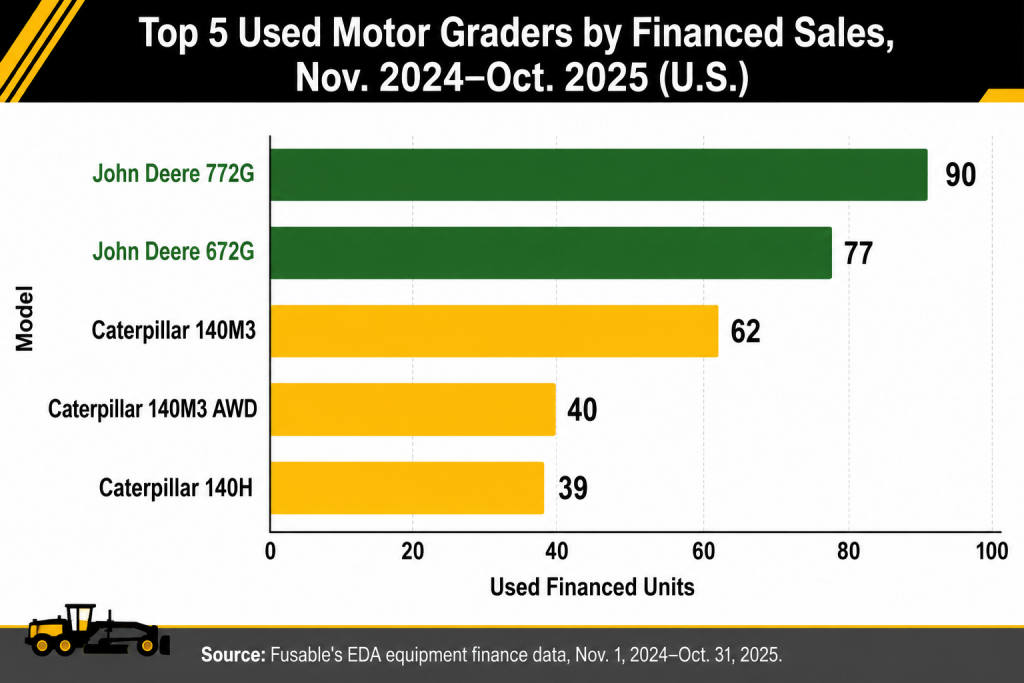
Deere’s 672G and 772G outsold every Cat 140-series variant individually in financed used-unit counts. Figures reflect financed transactions only, not total marketplace listings or auction volume.
Top 10 Heavy Roadwork Used Motor Graders in the U.S.
The models below move roughly from the highest-volume, most broadly deployed machines toward more specialized or higher-capacity options. The first five carry verified financed-sales figures; the last five are ranked on market-informed evidence because no single nationwide dataset breaks out unit counts for those specific models. Together, they represent the models most often cited as the best used motor graders for road construction by contractors, dealers, and fleet buyers working heavy civil and highway projects.
| Model | Approx. Horsepower/Class | Blade Configuration | AWD Availability | Heavy Roadwork Strength | Typical Buyer |
| Deere 772G/772GP | ~275 net hp | 12 ft moldboard | 6WD standard | Highway & county road construction | Highway contractors, larger fleets |
| Deere 672G/672GP | ~255 net hp | 12 ft moldboard | 6WD standard | County/municipal roadwork | Mid-size contractors, county fleets |
| Cat 140M3 | Varies by configuration, roughly 200–260 net hp | 12–14 ft moldboard | Optional | General highway & municipal grading | Highway & municipal contractors |
| Cat 140M3 AWD | Varies by configuration, up to high-200s net hp | 12–14 ft moldboard | Standard | Wet, loose, or variable-traction roadwork | Contractors in wet/soft-ground regions |
| Cat 140H | Varies by model year, roughly 150–185 net hp | 12 ft moldboard | Optional | Budget-conscious road maintenance | Budget-focused fleets, rental operations |
| Cat 160M/160M2/160M3 | Roughly 210–270 net hp | 14–16 ft moldboard | Optional/standard by trim | Large-scale highway & heavy grading | Heavy civil contractors |
| Cat 150/150 AWD | Roughly 200–272 net hp | 12–14 ft moldboard | Optional (AWD trim) | Highway maintenance, fine finish grading | Highway & DOT-adjacent contractors |
| Komatsu GD655-6/GD655-7 | ~218 net hp | 14 ft moldboard | Not standard | Road construction & fine grading | Contractors seeking a Cat/Deere alternative |
| Deere 770G/770GP | ~215 net hp | 12 ft moldboard | Tandem drive | Entry-point highway/municipal work | Budget-focused county fleets |
| Deere 872G/872GP | ~300 net hp | 14 ft moldboard (varies) | 6WD standard | High-capacity highway & heavy civil work | Large highway contractors |
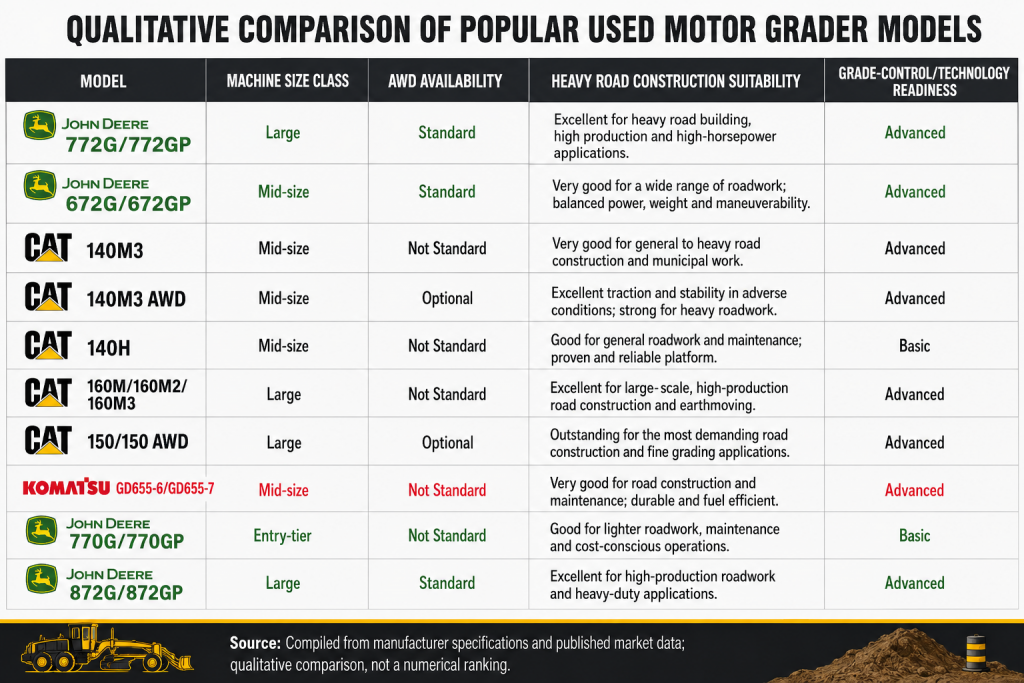
All ten models can handle heavy roadwork, but they sit in different size classes and technology tiers. AWD availability and blade length are the biggest practical differentiators within comparable horsepower classes.
1. John Deere 772G / 772GP
Deere’s 772G is the clearest demand leader in the current used market, and the financed-sales numbers back that up in both the latest period (90 units) and the year before it (104 units), more used units financed than any other single model tracked. The formula is straightforward: a 275-net-horsepower PowerTech engine paired with six-wheel drive and a 12-foot moldboard gives it enough blade pull and traction for highway subgrade, aggregate base, and heavy shoulder work without stepping into Deere’s largest frame class. Operating weight lands around 45,000–46,000 lb depending on configuration, keeping it transportable on a standard lowboy without special permitting.
The GP (Grade Pro) option adds cross-slope control, return-to-straight, and position-sensing cylinders that make the machine SmartGrade-ready, alongside a choice of fingertip or joystick controls, features that matter on highway and DOT work where cross-slope tolerances are tight. For fleets already running Deere iron, standardizing another grader onto the same control layout and circle-drive design simplifies training and parts inventory, which is part of why the model shows up so often in fleet-growth conversations; usedmotorgrader.com has covered how the 772G functions as a smarter fleet-expansion strategy for contractors weighing another unit against a full new-machine purchase. The best-fit buyer is a highway contractor, larger county fleet, or heavy civil operation that needs one grader capable of covering multiple roadwork applications without swapping machines between projects.
2. John Deere 672G / 672GP
If the 772G is Deere’s flagship demand leader, the 672G is the practical sibling that nearly matches it, 77 financed used units in the latest period, second only to the 772G, and a nearly identical count (79) the year before. The 672G runs a 255-net-horsepower PowerTech engine on the same 6WD platform, with an operating weight around 44,000–44,600 lb and the same 12-foot moldboard as its bigger sibling. The gap between the two is smaller than the model numbers suggest, roughly 20 horsepower and 1,500–2,000 lb, which is exactly why the 672G captures so much demand from contractors who need real roadwork capability without paying for the 772G’s extra output.
That size makes it a genuine sweet spot for county and municipal road departments doing regular maintenance grading, subgrade work, and drainage shaping, where the jobs are heavy but don’t need the extra horsepower a 772G offers. It shares the same GP technology options and Precision Mode speed control, so fleets running both models share training and parts across the board. The 672G’s best-fit buyer is a county or municipal fleet, or a mid-size contractor, that wants full roadwork capability at a lower acquisition and operating cost than the 772G, one reason it remains one of the most in-demand used motor graders on the market today.
3. Caterpillar 140M3
The 140M3 is Caterpillar’s highest-volume used grader by financed sales, 62 units in the latest period, down from 81 the year before, but still comfortably the top-selling used Cat motor grader. It’s worth being precise about generation here: the 140M3 represents the M-series platform Caterpillar produced roughly from the mid-2010s through around 2020, built around the C7.1 or C9.3 ACERT engine depending on configuration, with net power commonly in the 200–260 hp range and operating weight in the 42,000–45,000 lb bracket on a 12–14 foot moldboard. Caterpillar has since introduced a newer “Cat 140” lineup (including the 140 JOY and 140 LVR variants) as current production, so used 140M3 units are previous-generation machines rather than the manufacturer’s latest offering, a distinction worth knowing before comparing spec sheets across model years.
That earlier generation is exactly why the 140M3 remains in such heavy demand: it’s mechanically proven, parts are widely stocked through Caterpillar’s dealer network, and used supply is large enough that buyers can be selective about hours and condition. Grade Control Attachment Ready Option (ARO) and Cat Grade with Cross Slope were both available on the platform, so a used 140M3 can often be upgraded to modern grade-control technology without replacing the machine. The typical buyer is a highway or municipal contractor who wants Cat’s dealer support and control familiarity without current-generation pricing.
4. Caterpillar 140M3 AWD
The all-wheel-drive version of the 140M3 posted 40 financed used units in the latest period, placing fourth on the list, ahead of the standard 140H. The mechanical platform matches the standard 140M3, but AWD adds power to the front axle, giving the machine meaningfully better traction on soft, wet, muddy, or loosely compacted material where a rear-wheel-drive grader would spin and lose production. That difference shows up directly on jobsites: subgrade prep after rain, work on loose aggregate base, and winter maintenance in regions with snow or freeze-thaw cycles are all places where AWD changes how much a grader can accomplish in a shift, not just how it feels to operate.
That’s why AWD commands a real premium in the used market rather than reading as a nice-to-have footnote, contractors in Texas, Oklahoma, and other high-humidity or storm-prone regions specifically seek it out. usedmotorgrader.com has looked at why the 140M3 AWD still holds fleet value in 2026 for contractors weighing that traction premium against a standard 140M3. The best-fit buyer is a contractor working variable or difficult ground conditions, wet-climate road construction, drainage-heavy projects, or regions where losing production hours to poor traction actually costs money.
5. Caterpillar 140H
The 140H rounds out the top five with 39 financed used units in the latest period, and its story differs from the other four models here, it’s an older, discontinued platform that keeps finding buyers anyway. Depending on model year and emissions tier, the 140H ran anywhere from roughly 150 to 185 net horsepower on Cat’s 3306 or C9-family engines, with operating weight typically in the 34,000–38,000 lb range and a 12-foot moldboard, lighter and less powerful than the current 140-class machines, but mechanically simpler and cheaper to buy and maintain.
That combination, a large installed base, decades of Caterpillar dealer familiarity, and a much lower entry price than any M-series or current-generation grader, is exactly what keeps the 140H commercially relevant long after production ended. It’s not a machine bought for cutting-edge grade-control technology; it’s bought because it’s proven, parts are everywhere, and a well-maintained example still puts in a full day on county or municipal roadwork. usedmotorgrader.com’s look at the 140H’s resale strength in 2026 covers why older units are holding value rather than depreciating toward salvage. The best-fit buyer is a budget-conscious contractor, rental operation, or smaller municipal fleet that needs dependable road maintenance capability without new-generation pricing.
6. Caterpillar 160M / 160M2 / 160M3
No nationwide financed-sales breakout separates the 160M-series from Cat’s broader used grader numbers, so its position here is market-informed, built from marketplace listing activity, auction results, and its fit for heavy roadwork rather than a verified unit count. What it offers is a genuine step up in size from the 140-class: a Cat C9.3 ACERT engine producing roughly 210 to 270 net horsepower depending on configuration, an operating weight in the 45,500–47,500 lb range, and moldboards running 14 to 16 feet, meaningfully more blade than any 140-series grader.
That extra size helps on large highway projects and heavy civil work where a contractor moves more material per pass and wants fewer trips across a wide roadbed. It also comes with real trade-offs: higher acquisition cost, a heavier machine to transport, and fewer used units on the market than the 140-class, since fewer contractors buy into the larger frame to begin with. The best-fit buyer is a heavy civil contractor or larger highway operation working wide, high-volume roadbeds where the bigger blade earns back its extra cost in fewer passes, not a general fleet better served by a 672G or 140M3.
7. Caterpillar 150 / 150 AWD
The Cat 150 platform sits in an unusual spot on this list: newer than the 140M3 and 140H, positioned above the 140-class in Caterpillar’s current lineup, and posting strong new-machine financed sales (109 units for the 150 AWD alone in the latest period) even though it hasn’t yet built up the used-market volume of the longer-established models above it. Base models run a C9.3 engine rated 200–252 net horsepower, while the AWD version reaches up to 272 hp with power available to all four wheels; operating weight lands around 44,000–46,000 lb on a 12–14 foot moldboard.
Because the platform is relatively recent, used listings skew toward low-hour, well-documented machines still under or just past factory warranty, appealing to contractors who want current-generation grade-control technology (joystick or lever controls, Cat Grade with Cross Slope, enhanced visibility features) without buying new. Texas has been a particularly strong market for it; usedmotorgrader.com has covered the Cat 150’s popularity in the Texas market and, separately, how the 150 AWD fits modern road-maintenance needs in wet or variable-traction regions. The best-fit buyer is a highway or DOT-adjacent contractor who wants late-model technology and traction without paying new-machine pricing.
8. Komatsu GD655-6 / GD655-7
Komatsu is the clearest non-Cat, non-Deere presence on this list, and for good reason: the two market leaders account for the overwhelming majority of both new and used financed motor grader sales in the U.S., with Komatsu consistently claiming third place. The GD655-6 runs a Komatsu SAA6D107E-3 engine rated at 218 net horsepower, weighs 37,346 lb standard (41,667 lb with a rear ripper), and carries a 14-foot moldboard; the newer GD655-7 keeps roughly the same power and blade length at a slightly higher 38,250 lb operating weight, with updated cab and control technology.
The GD655’s dual-mode transmission, full power-shift for production grading, with a torque-converter mode for fine finish work at a steady crawl, is a genuine mechanical differentiator that Komatsu markets as a fuel-efficiency and precision advantage over comparable Cat and Deere transmissions. Combined with a longer wheelbase that helps fine-grading accuracy, it makes the platform a real option for contractors who don’t want to be locked into a single brand’s control ecosystem. usedmotorgrader.com’s coverage of how the 2016 GD655-6 brings efficiency to road construction digs into that case in more detail. The best-fit buyer is a contractor comparing brands directly, or one who values Komatsu’s transmission and finish-grading characteristics over Cat’s or Deere’s control layout, used Komatsu motor graders remain a credible third option in nearly every regional market.
9. John Deere 770G / 770GP
The 770G doesn’t carry the financed-sales volume of the 672G or 772G, so its position here reflects installed base, dealer support, and roadwork suitability rather than a verified national unit count. It’s also a useful example of how model numbers don’t map cleanly to size: the 770G runs Deere’s tandem-drive configuration at 215 net horsepower and roughly 42,800 lb operating weight, lighter and less powerful than the 6WD 672G despite the higher model number, because Deere reserves its higher horsepower ratings for the 6WD “2” variants that can actually put that extra power to the ground through a second drive axle.
That makes the 770G a genuine entry point into Deere’s larger frame class, a bigger chassis than the 670-series, priced and rated below the 672G because it skips six-wheel drive. For municipal and county fleets doing steady road maintenance rather than the toughest subgrade or aggregate-base work, that trade-off makes sense: lower acquisition cost, a simpler drivetrain, and still a 12-foot moldboard capable of real roadwork. The best-fit buyer is a budget-conscious county or municipal fleet that wants Deere’s control layout and dealer network without paying for six-wheel drive it may not fully need.
10. John Deere 872G / 872GP
The 872G is Deere’s largest grader in this lineup, and it’s worth being direct about its position: this is a high-capacity option for contractors who genuinely need the extra size, not a machine that should read as more in demand than the 672G or 772G simply because it’s bigger. It runs a 300-net-horsepower PowerTech engine, standard 6WD, an operating weight around 46,700–47,600 lb, and blade pull rated near 49,500 lb, noticeably more than any other model on this list.
That capacity matters on the largest highway jobs and heavy civil projects where a contractor is moving significant material volume and wants a single pass to do more work, the kind of application that also explains why a low-hour 872GP set the top auction price for any motor grader in the most recent tracked period, selling for $660,000 at a Texas auction. But that same size cuts against mass-market demand: higher acquisition and operating costs, heavier transport requirements, and a smaller pool of contractors whose projects actually call for that much machine. The best-fit buyer is a large highway contractor or heavy civil fleet running wide, high-volume roadbeds, not a general fleet better served by the 672G or 772G.
What These Demand Patterns Say About U.S. Road Contractors
Line up the verified numbers and a clear pattern emerges: contractors consistently choose mid-size, six-wheel-drive graders over both entry-level machines and the largest flagship models. The 672G and 772G together account for more financed used units than every Cat model combined, and within Caterpillar’s own lineup, the mid-size 140-series outsells both the compact and large ends of the range. That’s not a coincidence, it reflects contractors optimizing for the grader size that matches typical heavy roadwork, not the biggest spec sheet available.
| Model | Current Demand Evidence | Heavy-Roadwork Fit | Technology Appeal | Dealer/Parts Strength | Market Position |
| Deere 772G/772GP | Verified: #1 used financed (90 units) | Highway & county reconstruction | SmartGrade-ready, GP option | Strong Deere network | Demand leader |
| Deere 672G/672GP | Verified: #2 used financed (77 units) | County/municipal roadwork | Same GP options as 772G | Strong Deere network | Value-capability balance |
| Cat 140M3 | Verified: #3 used financed (62 units) | General highway/municipal grading | ARO, Cat Grade upgrade-ready | Largest Cat dealer footprint | Highest-volume used Cat model |
| Cat 140M3 AWD | Verified: #4 used financed (40 units) | Wet/soft-ground roadwork | Same as 140M3 plus AWD traction | Largest Cat dealer footprint | Traction premium |
| Cat 140H | Verified: #5 used financed (39 units) | Budget road maintenance | Basic; grade-control retrofit possible | Long-standing Cat network | Legacy value leader |
| Cat 160M/160M2/160M3 | Market-informed: auction & listing activity | Large-scale highway/heavy civil | Cat Grade compatible | Strong Cat network | Size-class step-up |
| Cat 150/150 AWD | Market-informed: strong new-sales momentum | Highway maintenance, fine grading | Current-gen Cat Grade, control choice | Strong Cat network | Newer platform gaining used volume |
| Komatsu GD655-6/GD655-7 | Market-informed: consistent third-place brand share | Road construction, fine grading | Machine-control compatible | Solid, smaller network than Cat/Deere | Established alternative brand |
| Deere 770G/770GP | Market-informed: installed base & fleet use | Entry-point highway/municipal work | Basic GP options available | Strong Deere network | Budget Deere entry point |
| Deere 872G/872GP | Market-informed: top auction pricing | Largest highway/heavy civil jobs | Full GP/SmartGrade suite | Strong Deere network | High-capacity specialist |
Mechanical Capability vs Technology
There’s a real question buried in a lot of these buying decisions: does it make sense to buy an older, mechanically proven grader that lacks current grade-control technology? The honest answer depends on the job. A contractor doing repetitive municipal maintenance grading, where an experienced operator can hold a crown by eye, often gets more value from a mechanically simple 140H or 770G, durable frame, familiar controls, parts on the shelf, low complexity to service, than from paying a premium for cross-slope automation they may barely use.
Technology earns its cost on different work: DOT-spec highway grading with tight tolerance requirements, large subgrade jobs where automated cross-slope control saves real material and rework, or fleets standardizing on one grade-control ecosystem across multiple machines. In those cases, a 140M3 AWD, 150 AWD, or GP-equipped Deere pays for its technology premium quickly. The distinction that matters isn’t “most advanced” versus “most basic”, it’s matching a machine’s capability to what a specific project actually requires.
Why Bigger Does Not Always Mean Better
The financed-sales numbers make this point better than any argument could: the largest, most powerful grader on this list, the 300-horsepower Deere 872G, sits at the bottom of the ranking, while the mid-size 672G and 772G dominate the top. More horsepower doesn’t automatically mean more productive grading if the machine is oversized for the job; it often just means more fuel burned per hour and a heavier, harder-to-transport unit working a project that never needed that much capacity.
Contractors weighing a 160M3 or 872G against a 140M3 or 772G are really weighing transport logistics, fuel and operating cost, and whether their operators are already trained on a given control layout, all against blade capacity they may only use on a fraction of their projects. Fleet standardization compounds this: a contractor running four 672Gs gets shared parts inventory and cross-trained operators, while one oversized grader in the same fleet becomes a maintenance and training outlier. The best used motor grader for heavy roadwork is usually the one sized to the project’s actual output requirement, not the one with the biggest number on the spec sheet.
How Region, Dealer Support and Resale Affect Demand
Geography shapes used grader demand as much as the machine itself. Texas is, by a wide margin, the strongest state for financed used motor grader activity, 249 units financed in the latest tracked period, more than California (48) and Arizona (46) combined, and 319 units the year before, when Oklahoma and Arizona rounded out the top three. That gap reflects the scale of Texas road and highway construction, the density of contractors and rental fleets working the state, and a correspondingly deep dealer and auction network for Cat, Deere, and Komatsu equipment.
That regional concentration matters beyond simply where inventory is easiest to find. States with heavy road-construction volume tend to have stronger dealer parts support, more competitive used pricing from higher supply, and better resale liquidity when it’s time to sell, real, if unofficial, contributors to why certain models cluster in certain regions. A contractor in a lower-volume state may pay a premium for the same model simply because fewer units and less dealer competition exist locally, which is worth factoring into any buying decision beyond the sticker price.
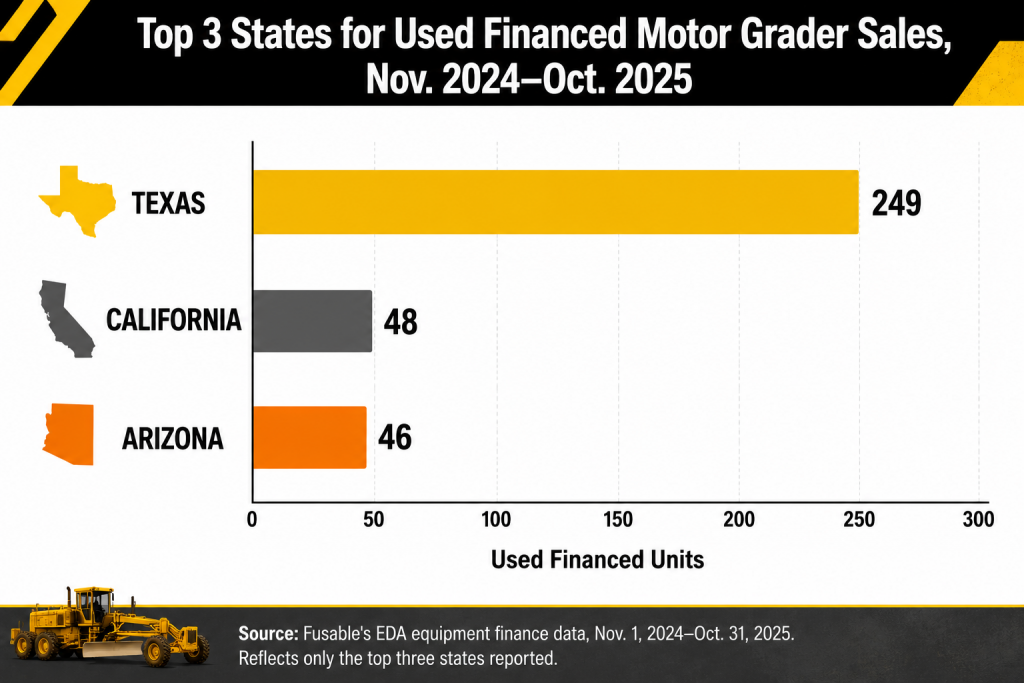
Texas financed more than five times as many used motor graders as second-place California. Only the top three states have verified unit counts here; other states aren’t ranked.
How Buyers Should Match the Grader to the Road Job
The models above aren’t interchangeable, and the right choice usually comes down to project scale and ground conditions rather than brand loyalty alone.
Choose the 772G or 140M3 when the work is standard highway or county-road construction and you want a proven, widely supported mid-size grader. Choose the 672G when the job is real roadwork but doesn’t require the extra 20 horsepower of a 772G, most county and municipal maintenance falls here. Choose the 140M3 AWD or 150 AWD when ground conditions are wet, loose, or otherwise traction-limited; the AWD premium pays for itself in lost-production hours avoided. Choose the 140H or 770G when budget matters more than the newest technology and the work is steady maintenance rather than the toughest subgrade jobs. Choose the 160M3 or 872G when the project genuinely calls for maximum blade width and material-moving capacity, wide highway roadbeds, heavy civil work, and the added transport and operating cost is justified by the job itself. Choose the GD655-6/GD655-7 when you want a proven alternative to Cat’s or Deere’s control ecosystems, particularly for fine-finish work.
Final Takeaway
The used motor grader market isn’t rewarding the biggest machine on the lot, it’s rewarding the mid-size, well-supported models that match what heavy roadwork actually demands: enough power and traction to move material efficiently, a blade sized to the job, and a control layout and parts network contractors already trust. That’s the real story behind the Deere 672G/772G pair and Cat’s 140-series topping the financed-sales data, and it’s a useful filter for working through this list.
usedmotorgrader.com stocks inspected Cat, Deere, and Komatsu graders with documented service history and financing support, everything needed to put a proven machine to work on your next road project.
FAQs
1. What is the most in-demand used motor grader for heavy roadwork in the U.S.?
A: By verified financed-sales data, the John Deere 772G leads the used market, with 90 units financed between November 2024 and October 2025, more than any other single model. The Deere 672G and Caterpillar 140M3 follow closely behind, rounding out a top three dominated by mid-size, six-wheel-drive machines.
2. Is the John Deere 772G a good used grader for highway construction?
A: Yes. Its 275-horsepower engine, six-wheel drive, and 12-foot moldboard give it enough traction and blade capacity for highway subgrade, aggregate base, and shoulder work, while its 45,000–46,000 lb operating weight keeps it transportable on a standard lowboy without special permitting.
3. Is AWD worth paying more for on a used motor grader?
A: It depends on ground conditions. AWD meaningfully improves traction and productivity on wet, loose, or soft material, which matters in humid or storm-prone regions. For contractors working consistently dry, firm ground, the premium may not pay off as quickly.
4. Are older Cat 140H graders still in demand in the U.S.?
A: Yes, the 140H posted 39 financed used units in the latest tracked period despite being an older, discontinued platform. Its low acquisition cost, mechanical simplicity, and deep Caterpillar parts support keep it commercially relevant for budget-focused fleets.
Tags: Top 10 Used Motor Graders, Top Motor Grader Models, Motor Grader Demand USA