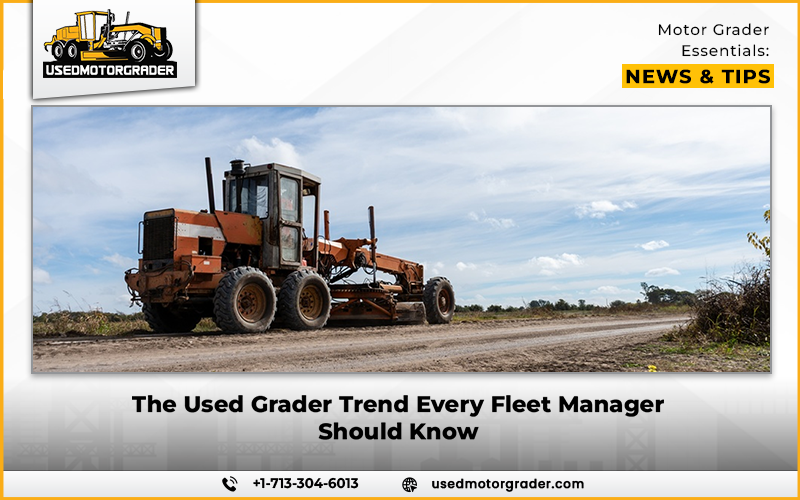
The used grader trend that fleet managers should be aware of in 2026 is straightforward: purchasers are paying more for equipment that are prepared for the projects that fleets anticipate winning in the future. Finding the lowest asking price is no longer the exclusive goal of the market. The dilemma for fleet managers is whether a grader can produce consistently and yet be appealing when it’s time to sell.
What Is the Biggest Used Motor Grader Trend in 2026?
The largest tendency is the rising cost of well-maintained, late-model graders with practical configurations, service histories that can be verified, and technological readiness. According to current market data, sales of 1,075 financed motor graders decreased 15.2% year over year during the 12-month period ending in October 2025, but advertised prices stayed relatively stable. Better deals may not always follow from fewer transactions.
Why Are Fleet Managers Buying Used Graders Differently in 2026?
New-equipment economics is one explanation. Financing expenses and large replacement budgets make quality used equipment appealing when it can go into production soon. Simultaneously, fleet renewal cycles might keep desirable equipment in service longer, reducing the availability of clean, late-model units. Waiting for a significant price decline can be risky.
Calculate the ownership cost for a fleet manager, which includes the purchase price, finance, fuel, maintenance, repairs, utilization, and resale. A $150,000 grader that requires extensive work can be worse than a $175,000 unit with better records.
Which Used Grader Specifications Are Becoming More Valuable?
Three areas require attention.
- AWD might be useful while working on soft shoulders, steep terrain, snow, loose aggregate, or in conditions where traction is important. It is not always worth spending extra. Match the specification to the utilization.
- Grade-control preparedness is another growing concern. Current Cat 140 equipment can be outfitted with Cat Grade technology, including 3D-ready systems. Cat claims that grading in 3D can save guesswork and rework. Check that the machine supports the technology that your personnel are already using.
- Finally, check the emissions configuration. A late-model Tier 4 equipment may better meet your needs, but consider after-treatment conditions, service support, and parts availability.
Is a Low-Hour Used Grader Always the Better Buy?
No. Hours are useful, but they do not convey the entire tale. A 5,000-hour grader with consistent maintenance and largely road maintenance work may be more deserving of attention than a 3,500-hour unit that has been used in harsh environments and has a poor track record.
Examine the circle and pinion, drawbar, articulation joints, hydraulic cylinders, tandem assemblies, transmission, wheels, moldboard, cutting edges, and frame. The maintenance history should reflect completed repairs and important components approaching service.
The Hidden Trend: Documentation Is Becoming Part of the Machine’s Value
Service paperwork can have an impact on buyer confidence, negotiations, financing, and resale. Request service bills, rebuild records, inspection reports, oil analysis findings, telemetry data (if accessible), and confirmed hours.
Two graders with comparable hours may have varying marketability if one has a proven operating and maintenance history. According to Komatsu, Komtrax provides servicing warnings, operating history, fault information, and fuel-usage data on supported equipment. That history converts preconceptions about the condition into evidence.
What Does This Trend Mean for Fleet Managers?
It means that your purchasing criteria should shift from “What is the cheapest acceptable grader?” to “Which grader creates the lowest operational risk for its intended work?”
If you need a machine right away, favor the condition and application fit over waiting for an unknown discount. If you have two or three years till replacement, keep an eye out for ideal configurations. For precise work, look at grade-control compatibility. In difficult terrain, assess AWD and drivetrain condition. If resale is important, prefer documented devices with recognizable characteristics.
Which Grader Brands and Models Should Fleet Managers Watch?
Caterpillar, John Deere, and Komatsu remain key names to consider since their grader families are well-known and offer configurations suitable for a variety of applications. Watch out for Cat 140M and 140M3, John Deere 670G, 672G, and 772G, and Komatsu GD655-class equipment.
Do not declare one brand to be the universal winner. A well-maintained grader that suits your operators, service network, terrain, and contracts might be a more valuable fleet asset than a more expensive machine with the incorrect configuration. Komatsu’s current GD655-7, for example, features a 14-foot moldboard, 218 net horsepower, and grade control, demonstrating why specification is as important as brand recognition.
The Fleet Manager’s 5-Point Used Grader Buying Check
Before making a purchase, evaluate each candidate based on five factors: condition, application fit, maintenance history, technology readiness, and resale potential. Consider the purchase price as one component of the decision, not the decision itself. A practical weighting could be 25% condition, 20% application fit, 20% maintenance history, 15% technological readiness, 10% resale value, and 10% purchase price. It is not universal, but it drives your team to focus on risk rather than price.
Bottom Line: Buy the Grader That Will Still Be Valuable Later
The best used motor grader purchase in 2026 is not always the cheapest machine. It is the machine that combines dependable condition, appropriate configuration, believable documentation, beneficial technological readiness, and a viable resale path. The greatest used motor grader should earn their spot via use, not just a reduced purchase price.
Before purchasing, compare the equipment to your next three years of work, not simply today’s assignment. If it is compatible with your applications, operators, service capabilities, and future clients, you are purchasing productive capacity rather than just equipment.
When evaluating used motor graders, contractors and fleet managers should verify the real machine history, configuration, and condition before bargaining. When assessing graders for your fleet, look for proof rather than assumptions: records, inspection findings, component health, and task fit are what transform a used purchase into a reliable asset.
Choose a grader that is designed to earn, perform, and maintain value rather than just going for the lowest price. Get the ideal machine before the best configurations are gone by looking through our selection of used motor graders for sale or rental.
Tags: Used Motor Grader Market Trends, Smart Fleet Management, Road Grader Industry Trends