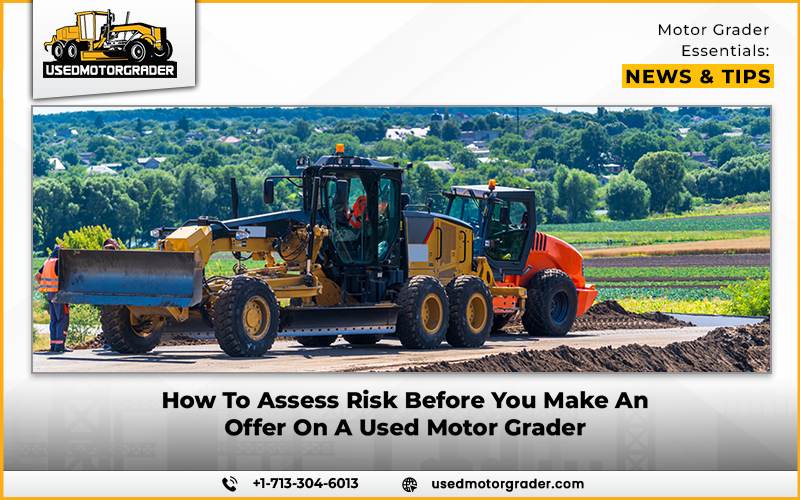
Two motor graders can sit side by side on a dealer lot, same model year, same hour meter reading, and still be worth two very different numbers to the same buyer. One spent its life on a county road crew doing light maintenance passes. The other worked haul roads at a quarry, absorbing shock loads and abrasive material every shift. The hour meters agree. Almost nothing else does.
Experienced buyers know this instinctively. They rarely ask “is this a good machine?” as a single yes-or-no question. Instead, they gather evidence from several directions, hours, and maintenance records. Also from application history, component condition, ownership background, configuration, parts support, technology, and their own intended use. They combine it into something closer to a risk profile. That profile, not the sticker price or the hour meter alone, is what determines what a serious buyer is willing to pay.
Why Hours Alone Don’t Define Risk
The hour meter is the first number most buyers look at, and for good reason: it’s the most consistent proxy available. It shows how much work an engine, hydraulic system, and driveline have absorbed. But heavy equipment forums, auction inspection reports, and equipment appraisal guides all point to the same limitation: the meter counts running time, not the intensity of that time. An hour spent idling in a yard and an hour spent pushing frost-heaved gravel under full blade downpressure register identically on the clock but leave very different wear behind.
Meters also drift and get replaced. Auction houses routinely note on inspection reports when a meter has been swapped or when service records show a reading higher than what the current meter displays. So the documented history can be reconciled against the number on the dash. That reconciliation matters more than the raw figure. A machine showing 8,000 hours with a complete, consistent service file is a different proposition than one showing the same number with gaps, mismatched fluid records, or no supporting documentation at all. Hours become genuinely useful only once they’re checked against everything else in the file.
The Evidence Behind a Grader’s Risk Profile
Once a buyer stops treating the hour meter as the whole story, the question becomes what else to look at, and how to weigh it. In practice, that means pulling together several distinct evidence streams:
- Documented service and repair history, not just a verbal summary from the seller
- Where and how the machine actually worked, the application, not just the industry
- The physical condition of major wear components, checked against the claimed hours
- How many owners the machine has had, and whether the story stays consistent
- The specification and configuration relative to the buyer’s own job requirements
- How well the model is supported by parts and service in the buyer’s region
- What technology is on board, and what it will take to keep running
None of these factors is decisive on its own. A grader can pass on hours and still carry serious risk in application history; it can look rough cosmetically and still have a clean drivetrain. The value of the exercise comes from triangulating across all of it.
Application History Changes the Meaning of Wear
Where a grader worked shapes what its wear actually means. A machine that spent years on highway and county road maintenance sees relatively predictable, lower-shock loads. One that maintained haul roads at a mine or quarry has been running with a wider moldboard matched to truck traffic. Absorbing rock impact and abrasive material that accelerates wear in the circle, drawbar, and cutting edges. Caterpillar’s own mining grader literature is built around exactly this distinction. Machines like the Cat 16 GC and Cat 24 are purpose-configured. With hardened circle components and reinforced structures specifically because standard road-maintenance wear assumptions don’t hold up on haul roads.
Snow and winter service adds another layer: frequent cold starts, salt exposure, and high-speed plowing passes stress the driveline and cooling system differently than warm-weather grading. This is why experienced buyers pay close attention to blade and moldboard condition. As a physical record of the machine’s working life. Uneven cutting-edge wear, circle looseness, or an asymmetric wear pattern can say more about how a grader was actually used than the seller’s description does. A closer look at motor grader moldboard wear and what uneven blade wear reveals about a machine’s history and is a useful next step for anyone trying to read those signs firsthand.
Maintenance and Repair Records Reveal the Machine’s Past
A thick folder of service records is only useful if it’s credible and consistent. Buyers look for evidence that preventive maintenance happened on a regular interval, fluid and filter changes, greasing of circle and drawbar pivot points, hydraulic service, rather than sporadic entries that suggest deferred maintenance between long gaps. Motor graders have more moving joints than most earthmoving equipment, and inconsistent lubrication shows up quickly as looseness in the circle and moldboard slides, the same tolerances that determine whether the machine can hold a finish grade. Some of the most common ways owners inflate their own long-term costs are exactly these small, repeated maintenance mistakes that drive up costs over the life of a grader, which is why a documented, on-interval service history carries real weight in a buyer’s assessment.
Repair history deserves separate attention from routine maintenance. Major work, an engine or transmission rebuild, hydraulic pump replacement, or circle or tandem repair, is not automatically a red flag. A well-documented rebuild performed with OEM components, backed by a shop invoice and a clear reason for the failure, can actually reduce a buyer’s near-term risk by resetting the clock on that component. What concerns experienced buyers is the opposite pattern: recurring repairs to the same system, undocumented work, or welding and fabrication that doesn’t match the rest of the machine’s condition.
Configuration, Parts Support and Technology Shape Future Risk
A mechanically sound grader can still be the wrong purchase if its configuration doesn’t match the work ahead. Horsepower class, moldboard width, and drive layout are decided at the factory and are expensive to change afterward. Industry buyer guides generally note that 12-foot blades suit municipal and light maintenance work, 14-foot blades are the standard for road construction, and 14- to 16-foot boards fit heavy subgrade and mining use, while all-wheel drive typically adds a meaningful premium to acquisition cost in exchange for real traction gains in snow, mud, and steep grades. A grader that’s underspecified for its intended workload will fight the operator every day; one that’s overspecified adds cost and fuel burn without a matching productivity gain.
Parts and service support is a financial risk variable, not just a convenience. Caterpillar, John Deere, and Komatsu graders tend to hold value better in the resale market largely because of dealer network depth and parts availability, technicians know the machines and components are stocked regionally, which shortens downtime when something fails. Less common or discontinued model lines can trade at a meaningful discount for exactly the opposite reason: a thinner buyer pool and longer waits for specialized parts.
Technology adds a further layer. Grade-control systems, 2D laser or sonic setups, or full 3D GNSS-based systems from Trimble, Topcon, or factory-integrated platforms like Cat GRADE, can meaningfully improve grading accuracy and reduce rework in the hands of a buyer who needs that precision. But they also introduce dependencies: sensor and mast components that can be damaged or stolen, calibration requirements, and a reliance on technician availability if something in the control loop fails. For a buyer whose work is straightforward road maintenance, a heavily optioned grade-control package may add cost and complexity without a matching payoff.
The Buyer’s Intended Utilization Changes the Equation
The same grader can represent very different risk to two different buyers. A contractor planning to run the machine 1,500 hours a year on finish-grade highway work needs different things from it than a municipality using it seasonally for snow removal and light shoulder work. Expected annual hours, tolerance for downtime, in-house repair capability, and how long the buyer intends to keep the machine all change how much a given risk actually costs. A buyer with a well-equipped shop and a spare grader in the fleet can absorb a hydraulic repair that would sideline a one-machine contractor for weeks. This is the step that turns a technical inspection into a financial decision: the same worn component means a different dollar amount to different buyers.
How Professionals Turn Evidence Into an Offer
Once the evidence is gathered, experienced buyers work through it in roughly the same sequence, even if they don’t formalize it: what does the documented history actually show, what could realistically go wrong given that history, how expensive or disruptive would that problem be, how strongly does the evidence support that risk being real, and does the machine’s configuration fit the intended job. Only after working through those questions does a number get attached to the offer.
This is also where first-time buyers tend to lose ground, focusing on a single attractive data point, a low hour reading, a clean paint job, while skipping the rest of the evidence chain. A rundown of the mistakes that catch first-time grader buyers off guard is a useful check against exactly that shortcut. Buyers who search listings for a used motor grader for sale and evaluate several candidates side by side tend to develop a feel for which sellers provide real documentation and which offer only a verbal history, and that difference alone often separates a fair offer from an expensive guess.
The Real Question: What Will This Machine Cost Me After Purchase?
The buyers who consistently make good used-equipment decisions are not asking whether a grader looks good today. They’re asking what they’re likely to inherit after the sale closes. What exposure sits behind the hour meter, the service file, and the configuration sheet. Among used motor graders of similar age and hours, that inherited exposure separates a fair price from an expensive mistake. That is why a documented, well-matched machine is worth paying more for than an unknown one.
Risk Signal Reference Table
| Risk Signal | What Buyer Examines | What It May Indicate | Why It Matters to the Offer |
| Operating hours | Meter reading vs. service and repair records | Consistency (or mismatch) between claimed and documented use | Sets the baseline, but only alongside condition |
| Maintenance records | Interval consistency, fluid/filter history | Preventive care vs. deferred maintenance | Predicts near-term repair exposure |
| Application history | Prior industry, terrain, load type | How hard the machine actually worked | Explains wear patterns hours can’t show |
| Component condition | Circle, moldboard, drawbar, hydraulics | Normal wear vs. approaching replacement | Direct estimate of near-term repair cost |
| Repair history | Documentation, parts used, root cause | Whether a repair reduced or masked risk | A rebuild can lower risk if verified |
| Configuration and technology | Horsepower, blade size, grade control | Fit for the buyer’s actual work | Poor fit is a cost even on a sound machine |
| Parts and service support | Brand, dealer network, model popularity | Expected downtime if something fails | Converts mechanical risk into lost time |
Final Thoughts
A used motor grader’s real value isn’t printed on the hour meter or the asking price. It’s built from everything a buyer can verify about its past and how well it fits the work ahead. If you’re evaluating a used CAT 140H, a 140M, or another well-maintained used motor grader for sale. Our website lists machines in excellent to substantial operating condition with supporting documentation available and straightforward access to purchase. Review the available history and condition details on any machine that interests you before deciding what it’s worth to your operation.
FAQs
1. Are operating hours enough to judge a used motor grader?
A: No. Hours are a useful starting point but say nothing about how those hours were accumulated. A machine with moderate hours and excellent documented condition is often a safer buy than a low-hour machine. With inconsistent records or visible wear that doesn’t match the meter.
2. Why does previous application matter when buying a grader?
A: Application determines the type of stress the machine absorbed. Haul-road or mining work wears the circle, drawbar, and cutting edges differently than highway maintenance. Even at identical hour counts, knowing the work history helps explain what the physical condition is actually telling you.
3. Can a major repair actually reduce buyer risk?
A: Yes, when it’s documented well. A verified engine or transmission rebuild performed with OEM parts and a clear reason for the failure effectively resets the clock on that component. This can lower near-term risk compared with a machine that hasn’t had that work done.
4. How should expected utilization affect the purchase decision?
A: The same technical condition carries different financial weight depending on how much the buyer plans to run the machine, how long they intend to keep it, and how much downtime they can absorb. A repair that’s a minor inconvenience for a large fleet can be a serious setback for a one-machine contractor.