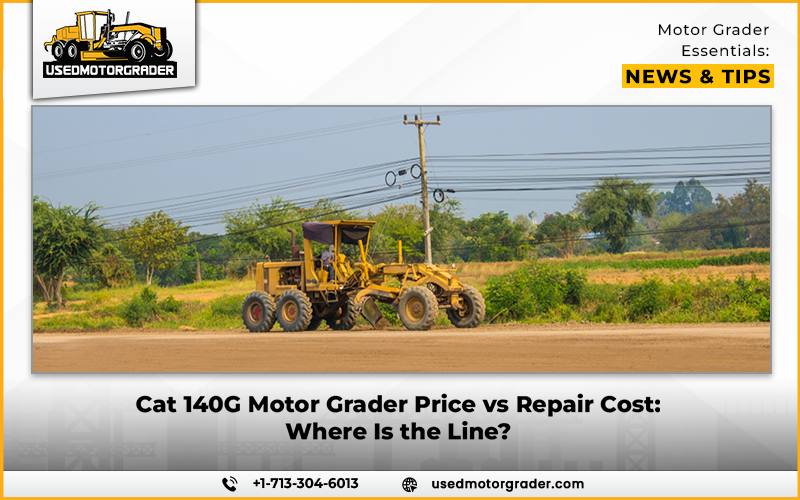
When the asking price for an older CAT 140G is significantly lower than that of a modern grader, purchasing it may appear appealing. But the essential question isn’t whether the grader is inexpensive to purchase. The question is whether the purchase price plus the maintenance required to make it reliable still represents a worthwhile investment.
Until now, numerous dealers have listed Cat 140G computers for $31,000 to $98,631, demonstrating how condition, configuration, and repair history affect value. This guide explains where repair spending no longer makes economical sense.
How Much Does a Used Cat 140G Cost in 2026?
According to dealer advertisements, a used CAT motor grader currently costs between $31,000 and $98,631, though this range should never be regarded as a fixed worth. A 1981 machine with a loose front end, a loose circle, hydraulic leaks, and braking issues is listed for $31,500, while a 1986 model with an enclosed cockpit, air conditioning, a 14-foot moldboard, a push block, and accumulators is listed for $60,000.
The spread is supported by actual auction outcomes. In September 2025, a 1983 140G with 2,541 hours sold for $35,750; in March 2024, a 1992 machine with 13,598 hours sold for $58,300. As a result, circumstance rather than just hours determines value.
It is common for buyers to mix mechanical condition with cosmetic improvement. A rebuilt seat, paint, decals, or clean tires can all enhance look without raising the cost of ownership. Components that have an impact on production should be given priority during inspection. It could be more cost-effective to invest in a machine that starts easily, shifts smoothly, articulates smoothly, maintains hydraulic pressure, and has a tight circle than in a machine that looks cleaner but has neglected mechanical systems.
What Repairs Can Turn a Cheap 140G Into an Expensive Machine?
Engine and Cooling System
Start with the 3306 engine. Look for excessive blow-by, hard starting, smoke, low power, oil leaks, cooling issues, and signs of previous rebuild work. CAT continues to offer 140G-specific repower and overhaul alternatives, such as a Tier 1 comparable repower kit and engine overhaul kits, indicating that repairability remains a strength. However, the availability of parts does not make a comprehensive rework affordable.
Transmission and Drivetrain
Transmission, differential, tandem, final-drive, and drive-chain issues require immediate attention since they can impact both mobility and production. Test every gear, listen for unusual noises, inspect fluids, and ensure that the machine pulls consistently under load.
Hydraulics, Circle and Blade
Hydraulic cylinders, pumps, valves, hoses, circle drives, circle shoes, moldboards, and blades all have a direct impact on grading performance. CAT inspection examples focus on these systems, and worn components can turn a seemingly functional equipment into a pricey repair operation.
What Is the Most Expensive Repair on a Cat 140G?
Engine, transmission, and major drivetrain work are typically the most dangerous repair categories since they involve expensive parts, extensive labor, and downtime. Hydraulic and circular repairs can also get complicated when numerous worn components are discovered together.
Columbia County, Wisconsin, offers a good caution. A CAT motor grader repair that was originally quoted at $32,000 increased to $57,500 after disassembly revealed additional issues. The extra $25,000 was unknown at the time, so buyers should proceed with caution when making first estimates.
When Does Repairing a Cat 140G Make Financial Sense?
Repairing the machine makes sense when the post-repair cost is significantly less than the cost of purchasing a comparable, productive replacement.
Apply this calculation:
True keep-or-repair cost = Current machine value + immediate repairs + deferred-repair reserve + downtime cost
Then compare that figure to the cost of purchasing, transporting, inspecting, and likely first repair for another used motor grader.
Do not use a simple rule like “repairing becomes wrong when the bill reaches 50% of the machine price.” A structurally sound grader requiring one major repair may be a better investment than a less expensive machine requiring five minor repairs to the engine, hydraulics, tandem, and circle.
For example, if a $40,000 grader requires $10,000 of predictable work and has a strong drivetrain, the $50,000 all-in position may be appropriate. However, if the same machine shows signs of transmission wear, hydraulic weakness, and circular damage, the actual budget might quickly shift toward replacement territory.
When Should You Stop Repairing a Cat 140G?
Stop and reconsider when multiple main systems require attention at the same time, structural or articulation issues arise, repair prices approach the cost of a cleaner replacement, or downtime jeopardizes contracts. CAT continues to maintain many 140G components, however some have been discontinued or require dealer-supplied replacements. This can convert a technical repair into a scheduling problem.
How Do You Estimate Repair Cost Before Buying a Cat 140G
Estimate the repair cost before negotiating the final price, not after the machine has arrived at your yard.
- Insist on a cold start.
- Inspect fluids.
- Test the transmission under load.
- Operate all hydraulic functions.
- Inspect the circle and moldboard for excessive movement.
- Inspect the tandem and differential areas.
- Examine the frame and articulation points.
- Examine rebuild or service records.
When visual inspection fails to provide conclusive evidence, oil and fluid analysis can help. Obtain a documented inspection and differentiate immediate repairs from those that can be realistically planned for the next operating period. Ask the seller to document recent component work rather than taking verbal promises.
Cat 140G Repair vs Replacement: 3 Buyer Scenarios
Scenario 1: Purchase and Repair. A $40,000 grader with a known $8,000 to $12,000 repair cost and solid core components may make sense.
Scenario 2: Buy cheaply and discover major issues. Before investing additional money in a $35,000 grader that requires powertrain, hydraulic, and circular work, it is time for a new comparison.
Scenario 3: Purchase a Better Machine. Paying $55,000 to $70,000 for a better, job-ready example can be more cost effective when it comes to reducing downtime and deferred maintenance.
Final Verdict: Where Is the Line on a Cat 140G?
There is no universal dollar line. For every CAT motor grader you inspect, price the machine, price the known defects, reserve money for hidden wear, and put a value on downtime. That is how you avoid turning a low purchase price into a high ownership cost.
Before investing more money in repairs, compare the cost to job-ready Used CAT Motor Graders for sale/rent in our inventory. Explore our used motor graders from CAT and other top brands to find the best fit for your budget, application, and project requirements.
Frequently Asked Questions
How much does a used Cat 140G cost?
According to the major dealers’ lists, it ranges from $31,000 and $98,631, with condition and configuration dictating the difference.
Is the Cat 140G worth repairing?
Yes, when significant components are essentially sound and the repaired machine costs less than a comparable replacement.
What should I check before purchasing?
Examine the engine, gearbox, hydraulics, circle, blade, tandem, articulation, structure, and maintenance history.
What is the biggest risk of purchasing a cheap Cat 140G?
Hidden deferred repairs. A low asking price can rapidly vanish when several systems require maintenance.
Should I purchase a cheaper 140G and rebuild it?
It works when the chassis and core systems are sturdy and the rebuild scope is clearly defined prior to purchase.
Tags: Grader Repair Costs, Grader Price Trends, Caterpillar Grader 140G Specs