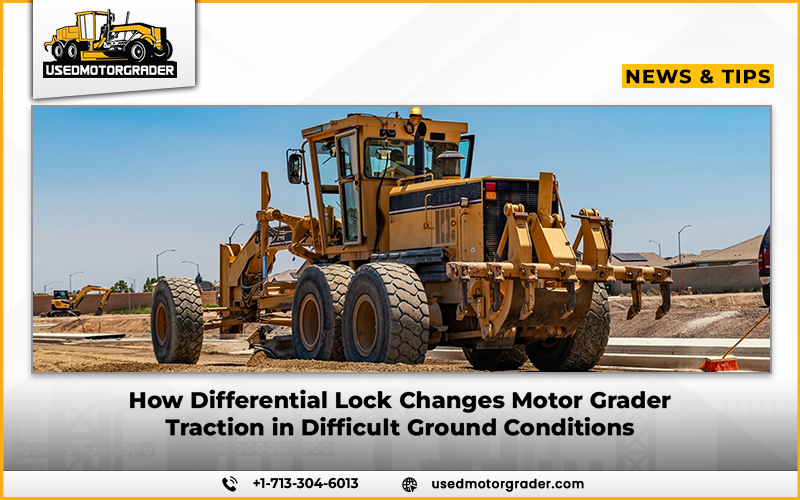
A grader is cutting a shoulder in wet clay when the outside tandem wheel starts spinning. The opposite wheel still has grip, the engine is barely working, and the blade keeps grinding forward at half speed. Nothing is broken, the machine simply cannot put the power it has onto the ground.
That is the puzzle differential lock solves: traction is not set by horsepower alone, but by how the drivetrain manages torque between the drive wheels once conditions cause uneven loading or wheel slip.
What an Open Differential Normally Does
Every tandem-drive grader relies on a differential so its left and right drive wheels can turn at different speeds, most useful in turns, where the outer wheel covers a longer arc than the inner wheel.
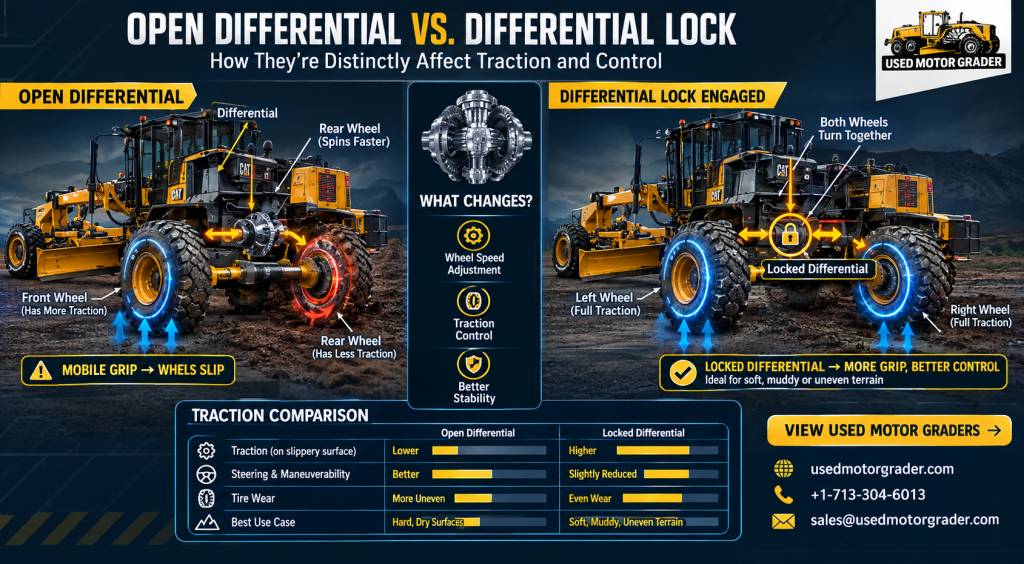
It also splits engine torque roughly equally between its two output shafts. On firm ground, that works fine. Once one wheel loses grip, the torque reaching the wheel that still has traction is capped at whatever level caused the other wheel to break loose. A wheel spinning in mud needs almost no torque to keep spinning, so that becomes the ceiling for both sides, even with power to spare. The grader has torque it cannot apply, not a malfunction, just how an open differential is built to behave.
What Differential Lock Changes
A differential lock mechanically couples the two output shafts, usually through a hydraulically actuated clutch pack, so both wheels turn at the same speed. That removes the low-traction wheel’s ability to cap torque delivery to its partner, the locked axle can instead send usable torque to whichever wheel still has grip, up to what the engine and transmission can supply.
Power flows from engine to transmission, into the final drive and axle, through the differential, and out to the wheels. The lock sits at that stage, it adds no horsepower and changes nothing upstream, only how existing torque gets shared at the wheels. That makes it a traction-management tool, not a substitute for engine power.
The Traction Math, Kept Simple
One basic relationship underlies this: tractive force is roughly the coefficient of traction between tire and ground, multiplied by the normal load pressing that tire down. Mud, wet clay, saturated soil, loose aggregate, and sand all lower the coefficient of traction; soft shoulders, ruts, and crowned or sloped surfaces change the normal load wheel to wheel. Either factor can leave a wheel with less usable grip no matter how much power the engine produces, though the real outcome still depends on tire condition, axle loading, and operating technique.
Differential Lock Across Difficult Ground
Wheel slip develops fast in mud and saturated soil as the coefficient of traction drops; locking helps keep both sides of the tandem contributing drive. In loose gravel, the lock can preserve drive continuity, but excessive spin still displaces material.
Soft shoulders and rutted ground change wheel loading side to side, and locking helps when one wheel is simply carrying less weight. On slopes, gravity shifts load unevenly, so any traction benefit has to be weighed against steering response. On frozen or hard ground, locking offers little advantage on uniform surfaces, but the picture changes fast if a wheel suddenly crosses into an icy or soft patch.
| Ground Condition | Traction Challenge | Differential Lock Effect | Operator Consideration |
| Wet clay/mud | Uneven grip, wheel slip | Helps maintain drive across wheels with usable traction | Avoid excess wheel spin; follow OEM guidance |
| Loose gravel | Slip and material displacement | Can improve drive continuity when traction is uneven | Balance traction against a clean pass |
| Soft shoulder | Changing wheel loading | Helps when one side loses effective grip | Watch steering behavior and stability |
| Firm/high-traction ground | Little need for assistance | Minimal benefit; open differential still aids turning | Avoid unnecessary lock engagement |
| Uneven/rutted ground | Rapid shifts in wheel loading | May help preserve drive through variable grip | Match operation to surface and setup |
The effect depends entirely on the condition the grader is working in, not a blanket improvement.
The Trade-off: Traction Versus Differential Action
Locking has a cost. In a turn, the outer and inner drive wheels need different speeds; forcing them to match causes tire scrub, driveline wind-up, and added stress on axle and final-drive parts. Operators who leave the differential locked through normal turning on firm ground will notice harsher steering and faster tire wear, which is why many current graders now offer automatic systems that engage or release the lock without constant operator input.
Manufacturer guidance generally cautions against prolonged engagement on high-traction ground, so operators should follow the applicable operator’s manual rather than a general rule of thumb.
Configuration Shapes the Outcome
Differential lock never works alone. Traction is a system-level result shaped by tandem-drive configuration, axle and tandem-housing design, tire condition, machine weight distribution, blade position, and travel speed. Two machines with an identical lock can behave differently in the same mud once tire condition or blade load changes, one reason moto grader classes and performance differences matter when matching a machine to an application.
How Manufacturers Approach It
Implementation is not universal, so buyers should confirm what a specific machine actually has. Caterpillar’s Auto Differential Lock monitors machine and application parameters to unlock and re-lock the differential automatically; it’s standard on Cat M Series graders and retrofittable to earlier M Series units. Anyone comparing a CAT motor grader for sale against other listings should check which generation carries it, since earlier H and K Series machines used simpler manual controls.
John Deere motor graders in the G-Series lineup use a hydraulically actuated, clutch-type differential lock applied on-the-go, with selectable manual or automatic modes. Several models fold auto differential lock into a single-button preset alongside auto-shift and articulation return. Komatsu’s GD655-7 carries a full locking differential as standard equipment, described by the maker as delivering traction in severe conditions.
Tire Condition Still Decides the Outcome
A functioning differential lock cannot fix bad tires. Worn tread, mismatched sizes, or incorrect inflation all reduce how much available torque converts into forward movement, no matter how well the lock engages. A CAT motor grader for sale with strong drivetrain specs but neglected rubber will still struggle in soft ground, which is why tire condition and blade performance should be inspected alongside the differential-lock system, not separately from it.
What This Means When Evaluating a Used Grader
Before buying a used Caterpillar, Komatsu, or one of the John Deere motor graders on a dealer’s lot, confirm:
- The specific machine and generation includes differential lock, and how it is engaged
- Controls and warning indicators respond correctly
- No driveline noise from the tandem or differential housing
- No signs of abnormal or uneven tire wear
- Service history and maintenance documentation are available
That checklist barely changes by brand, and matters most in moisture-heavy regions, where how soil conditions affect used motor grader selection often decides how hard the lock gets used over a machine’s life.
What This Means in the Field
Differential lock does not create traction from nowhere, it changes how the torque the drivetrain already has gets used once wheel grip becomes uneven. The operator still handles the rest of the job: blade load, speed, tire condition, steering, articulation, and depth of cut. That holds across a used CAT motor grader for sale, a Komatsu, or one of the John Deere motor graders on today’s market.
Contractors comparing well-maintained used motor graders from leading brands can find machines in good condition, with title and maintenance documents on hand, through the current inventory at usedmotorgrader.com, a practical starting point for demanding grading work.
FAQs
1. Does engaging the differential lock give the grader more power?
A: No, it redistributes existing torque between the two drive wheels; it doesn’t add engine output.
2. When should an operator lock the differential?
A: When one side of the tandem is losing grip in mud, loose material, or a soft shoulder, not as a default for normal travel.
3. Is it safe to leave the differential locked while turning?
A: Not on firm, high-traction ground, locked wheels are forced to the same speed, causing tire scrub and driveline stress. Follow the manufacturer’s operating guidance.
4. Does a used grader need special inspection for its differential lock?
A: Yes, confirm the feature works, check for tandem noise and uneven tire wear, and request service documentation.