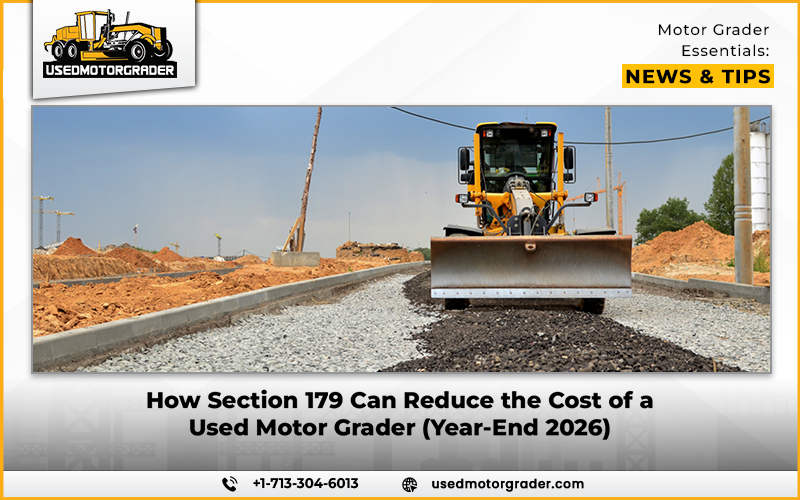
A used motor grader has more capacity than a new unit. The tax year might have an impact on when contractors replace outdated equipment or prepare for a new roadwork season. At the conclusion of the year, Section 179 motor grader planning may become more tax efficient. Eligible enterprises may deduct qualifying equipment when it is put into service. This is not a dealer discount or a guaranteed refund; it reduces taxable business income. Before making a commitment, ensure that you understand the rules and circumstances.
What Is Section 179, and How Does It Work for Equipment Buyers?
Section 179 lets a business deduct qualifying equipment costs when placed in service, rather than through regular depreciation. The IRS lists machinery and equipment as eligible tangible personal property (Publication 946). A business grader may qualify for the Section 179 construction equipment deduction. A deduction lowers taxable income; a credit reduces tax owed. The business elects the amount to expense, subject to statutory limits and its income calculation; any remaining basis may still be depreciated under the regular rules.
Can You Claim Section 179 on a Used Motor Grader?
Yes. A used grader may qualify if eligible, purchased, and used for business. A Section 179 used motor grader is assessed like other machinery: how it was acquired and how the business uses it matter more than its age. If it has personal and business use, business use must exceed 50% in the year it is placed in service. Gifts, inherited assets, and purchases from certain related persons do not qualify. Passive rental use may face restrictions. See IRS rules for business use and purchases.
Section 179 used motor grader eligibility.
Eligibility depends on the purchase and business use, not whether the grader is new. Keep the bill of sale, loan, serial number, and delivery records. Businesses buying graders to rent out should check special lessor rules with a tax adviser.
What Is the Section 179 Deduction Limit for 2026?
Under Section 179 deduction 2026 rules, the maximum is $2.56 million. It phases out dollar for dollar when qualifying property placed in service exceeds $4.09 million. At $6.65 million in qualifying purchases, it is fully phased out. These limits apply across the taxpayer’s purchases, not per grader. Include other qualifying machines placed in service during the same tax year when estimating the phaseout. The deduction is also limited by active business income; disallowed amounts can generally carry forward.
How Much Can a Used Motor Grader Purchase Actually Save?
Suppose a contractor buys a qualifying grader for $120,000 and deducts the full amount. At an assumed 24% federal marginal tax rate, the deduction could reduce federal income tax by 28,800(120,000 × 24%. This is illustrative, not guaranteed; eligibility, business income, and the buyer’s rate matter. State taxes may change the result. The grader still costs $120,000 before financing, transport, and repairs.
Can You Finance a Used Motor Grader and Still Claim Section 179?
Often, yes. A business buying and owning a grader with a qualifying loan may generally deduct its eligible cost while repaying. A lease can produce a different result because the lessee generally deducts lease payments rather than claiming the owner’s Section 179 deduction. Review ownership and repayment terms with your accountant and lender. The deduction does not erase payments or working-capital needs.
Before selecting a financing structure, compare the available used motor grader financing options, including loans, leases, and rent-to-own arrangements. Understanding how each option affects ownership, monthly payments, and working capital can help you make a more informed purchasing decision.
Why December 31, 2026 Matters for Used Equipment Buyers
A calendar-year business generally must place the grader in service by December 31, 2026. The IRS means ready and available for its business use, not merely contracted or paid (Publication 946). Delivery alone may not be enough if repairs prevent operation. Schedule inspection, transport, repairs, and commissioning early. Keep dated readiness records and confirm your business tax year.
Section 179 vs. 100% Bonus Depreciation: Which Is Better?
These are separate first-year options. Section 179 has a dollar cap, phase-out, and business-income limit. Federal law generally allows 100% bonus depreciation for eligible property acquired after January 19, 2025. Used assets may qualify if new to the buyer and not acquired from a related party. Bonus depreciation follows Section 179. Read the IRS January 2026 guidance, then compare both methods and state treatment with a tax professional.
What Should You Check Before Buying a Used Motor Grader for Tax Benefits?
Choose for the work, not the deduction. Compare hours, age, service history, and major repairs. Have a technician inspect the engine, transmission, hydraulics, articulation, tandems, circle, and moldboard. Match horsepower, AWD, ripper, controls, and grade technology to the job. Estimate transport, repairs, financing, utilization, and resale. Calculate cost per productive hour: a cheaper grader losing days to repairs may cost more over a project. Used equipment tax deductions should support a sound purchase, not replace due diligence.
What Are the Risks of Buying Equipment Just for a Tax Deduction?
An unnecessary machine can tie up cash despite a deduction. Consider downtime, insurance, finance costs, and workload. If business use later falls to 50% or less during the recovery period, Section 179 recapture may apply. Selling the grader can also trigger depreciation recapture. Confirm state tax treatment before buying.
Conclusion
A Section 179 used motor grader purchase may improve tax timing, but eligibility and savings depend on your circumstances. Compare condition, productivity, uptime, and costs first.
Explore our high-performing used motor graders inventory if you are planning to purchase, or contact our team for availability, inspection details, pricing, and financing assistance. Ask your tax adviser to confirm eligibility.
Frequently Asked Questions
Can a used motor grader qualify for Section 179?
Yes, if eligible, purchased for business use and placed in service that year.
Can I finance a used motor grader and claim Section 179?
A qualifying financed purchase can qualify. A lease differs; confirm who owns the equipment for tax purposes.
Does my used motor grader need to be delivered before December 31, 2026?
It must be ready for business use by then; delivery alone is insufficient.