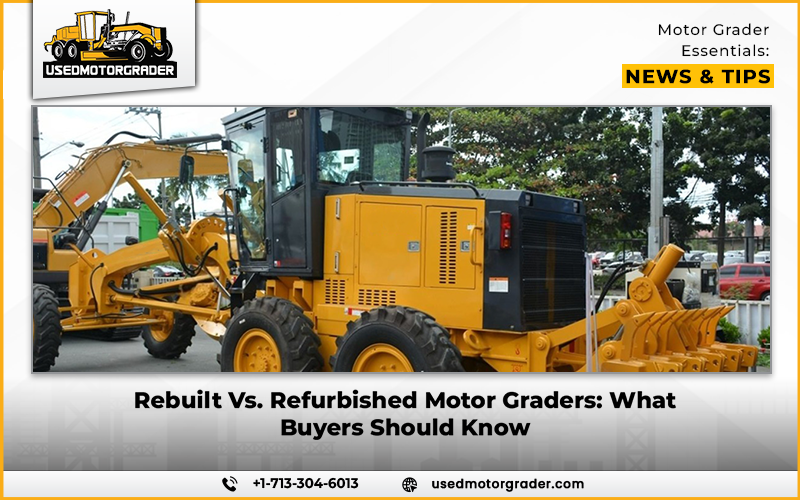
A machine advertised as rebuilt is not automatically a better investment than one advertised as refurbished. Sometimes “rebuilt” means a complete teardown to a defined standard. Sometimes it means one new engine in a grader whose transmission, circle, and drawbar are still wearing on their original schedule. In rebuilt vs refurbished construction equipment, the labels are used loosely, and rebuilt motor graders and refurbished motor graders alike show why the written scope of work matters more than the word in the advertisement.
Quick answer: A rebuilt motor grader has been disassembled, measured, and restored by replacing or reconditioning worn parts, either across the whole machine or only in selected major components. A refurbished motor grader has been returned to presentable, serviceable condition, anywhere from cosmetic cleanup to substantial mechanical repair. Neither term is a universal standard, so documented work decides value.
What Does a Rebuilt Motor Grader Actually Mean?
“Rebuilt” can describe a whole machine, an engine, a transmission, or a hydraulic system. A grader with a rebuilt engine is not a fully rebuilt motor grader, and rebuilt graders of any kind should come with a clear statement of what was done. Manufacturers also use the vocabulary differently. Caterpillar says rebuilt and refurbished are often used interchangeably but warns that manufacturers don’t follow the same steps or standards. Komatsu emphasizes remanufactured components plus tailored service and rebuild programs, while John Deere’s program starts with replacing required major powertrain components. Remanufactured usually means a component restored to original specifications, often through exchange. Overhauled and reconditioned depend on who did the work. Partially rebuilt means some systems were skipped.
A structured motor grader rebuild process looks like Cat’s Certified Rebuild sequence:
- Evaluation with fluid analysis, visual inspection, and service-history review.
- Complete disassembly and inspection of parts.
- Automatic replacement of parts that fail reuse guidelines, plus reconditioning of frames, linkage pins, bearings, and electronic control modules.
- Reassembly to specified torques, clearances, and pressures, with approximately 7,000 parts replaced by new or remanufactured Cat parts and all wiring replaced.
- Bench and performance testing, final inspection, and an operator evaluation.
Buyers should expect paperwork that matches: itemized parts, test results, and the rebuilder’s identity.
What Does Refurbishment Involve?
Motor grader refurbishment covers three broad levels:
- Cosmetic: washing, repainting, cab interior, seat, lights, and displays.
- Operational: fluid and filter service, hydraulic hoses and seals, tires, and replacement of visibly worn parts.
- Mechanical: selected engine, transmission, or hydraulic repairs short of a full teardown.
Done properly, refurbishment can be the smarter spend. When major components are sound, targeted work on hoses, seals, tires, and known weak points buys working life without paying for a complete rebuild. The risk is assuming a fresh coat of paint means mechanical restoration. Paint can be routine presentation or can cover leaks, so ask what was done underneath.
Rebuilt vs Refurbished Motor Graders: Key Differences
Scopes overlap, so read these as typical ranges, not absolutes.
| Comparison Area | Rebuilt Motor Grader | Refurbished Motor Grader |
| Scope of work | Defined restoration of the machine or specific major components | Targeted repairs and presentation; range is wide |
| Component disassembly | Usually teardown and measurement of rebuilt assemblies | Usually limited to affected parts |
| Engine and drivetrain | Often rebuilt or replaced with remanufactured units | Serviced, with selected repairs |
| Hydraulic systems | Pumps, valves and cylinders may be restored | Hoses, seals and fluids typical |
| Structural restoration | Frame and pin reconditioning in comprehensive programs | Case-by-case weld repair and wear correction |
| Electrical systems | Modules and wiring addressed in comprehensive programs | Faults repaired as found |
| Parts replacement | Reuse standards applied; itemized | Replaced as worn or visibly tired |
| Testing and calibration | Formal bench and performance testing in structured programs | Functional checks; varies by seller |
| Documentation | Itemized parts, test records, rebuilder identity | Service invoices; varies |
| Warranty possibilities | Often on replaced parts or components; terms vary | Seller-defined; confirm in writing |
| Initial purchase cost | Usually higher | Usually lower |
| Future repair exposure | Lower on rebuilt systems; untouched systems remain | Higher on untouched systems |
| Best-suited buyer | Demanding duty cycles, wants defined accountability | Sound base machine, moderate duty, tighter budget |
Which Motor Grader Components Should Buyers Examine?
The label says less than the condition of individual assemblies. Ritchie Bros. points buyers to the frame, circle, moldboard, articulation point, and hydraulics.
Engine and powertrain
Deere’s ReLife brochure lists the engine, transmission, axle, and rear tandem hubs as the major components its motor graders must have replaced to qualify for extended powertrain warranty, with an optional hydraulic pump and front hubs, pump, and motors on six-wheel-drive models. Rebuilding an engine while leaving a worn transmission, torque converter, differential, final drive or tandem untouched can still leave you facing the next large invoice. Ask about cooling-system work and load performance, and on AWD machines, the extra drive components.
Hydraulic system
Pump, control valves, cylinder rods, hoses, and seals all govern blade control, steering, and articulation. Cat’s rebuild testing includes hydraulic and pilot relief valve pressure checks, so ask for post-work pressure and leak test results.
Circle, drawbar and moldboard
This is where graders differ from other machines. Circle wear and backlash, circle teeth and wear plates, drawbar condition, blade slide, lift cylinders, and mounting points affect grading accuracy and operating cost even when the engine is fresh. Cat’s used-equipment team notes that articulation repairs can be hefty and that a moldboard costs more to replace than a cutting edge. Powertrain-focused programs don’t automatically cover these assemblies.
Articulation, axle, steering and structure
Check articulation pins and bushings, front axle, steering cylinders, wheel lean components, frame cracks, mounting points, and prior welds. Ritchie Bros. says articulation wear depends on terrain and advises checking front-to-rear alignment and repairs.
Electrical and electronic systems
Control modules, sensors, harnesses, displays, fault codes, and calibration all matter. Cat’s certified process reconditions modules and software; an engine-only job may not. Aftertreatment components apply only to models that have them.
Rebuilt vs Refurbished: Which Offers Better Long-Term Value?
Cheaper upfront is not the same as cheaper to own. Use this framework:
Total ownership cost = Purchase price + Immediate repairs + Scheduled maintenance + Expected major repairs + Downtime costs + Other ownership expenses.
Motor grader rebuild costs vary by model, region, and scope, so fill in each line for each machine, including repairs on systems the seller never touched. A lower-priced refurbished grader with a transmission near the end of its life can cost more over several seasons than a pricier machine with documented work, and the reverse is equally possible when its components are sound. Get written quotes for replacement components, specialist labor, expected downtime, local parts availability, and dealer support.
Dealer-published figures can frame the work. One Cat dealer advertises complete certified machine rebuilds at about 50–60% of new-machine cost with the customer’s core. That benchmarks rebuilding a machine you own, not the price of buying one.
Keep asking prices and sale prices apart. Asking prices show seller expectations; auction results, which Ritchie Bros. publishes as selling prices, show completed transactions. Compare only the same model, year, hours, configuration, region, and date. On resale, Cat says machines rebuilt to strict standards tend to hold value, but documentation supports confidence, not a fixed premium. Afterward, review the maintenance mistakes that increase used motor grader operating costs, because a rebuild resets wear, not habits.
What Do OEM Rebuild Programs Actually Promise?
Caterpillar. Cat Certified Rebuild spans machine, power train, engine, hydraulic, and component rebuilds. A machine rebuild receives a new Product Identification Number and a like-new standard warranty on replacement parts, with an optional Equipment Protection Plan. Dealers also sell other work: Peterson Cat lists a dealer rebuild with customer-defined scope separately from Certified Rebuild, and HOLT CAT distinguishes Certified from custom rebuilds. A rebuilt Cat grader isn’t necessarily Certified.
John Deere. Powertrain ReLife Plus pairs a technician inspection with remanufactured powertrain components, covering motor graders 670D–872D and 620G/GP–872G/GP, and work is done at dealers, including Certified Rebuild Centers designated to meet location-specific criteria. Deere components carry a one-year unlimited-hour warranty when dealer-installed. Extended coverage up to four years or 8,000 hours applies only to major powertrain components replaced under the program; other parts keep the one-year warranty. That is a component warranty, not a whole-machine guarantee.
Komatsu. Komatsu publishes remanufactured engines, transmissions, final drives, cylinders, pumps and electronics, plus service and rebuild programs designed to return machines to original specifications. Its published standard reman warranty is one year, unlimited hours, with a prorated Major Component Quality Assurance program up to five years or 12,000 hours. Treat any Komatsu “rebuilt” claim as scope-specific and ask exactly what was done.
A documented OEM-backed rebuild offers clearer process and accountability, but a qualified independent specialist can also do excellent work. Judge both on evidence.
How to Verify a Motor Grader’s Rebuild or Refurbishment History
Request before paying a premium for used rebuilt motor graders:
- Complete invoice naming the rebuilder, date, model, and serial number, with engine and component serial numbers.
- Itemized parts list separating original, OEM, remanufactured and aftermarket parts, plus components repaired or reconditioned.
- Work orders, technician reports and process photographs.
- Test evidence: engine, transmission, and hydraulic pressure results, fluid analysis, diagnostics, calibration, and final operating tests.
- Written warranty terms: duration, covered components, parts and labor, exclusions, travel costs, geographic limits, transferability, claim procedure, and whether the OEM, dealer, rebuilder, or seller backs it. Written terms outrank verbal promises.
Serial numbers on the machine, engine, and paperwork must match.
Questions to ask:
- Was the entire machine rebuilt, or only the engine or powertrain?
- Which original components were retained, and which were replaced?
- Who performed the work?
- Were OEM or aftermarket parts used?
- Is there a documented final test report?
- How many hours has the machine run since the work?
- What warranty covers the rebuilt components?
- Can an independent technician inspect it?
A rebuild label cannot tell you how the machine starts cold, shifts, steers, articulates, holds blade position under load, or whether it carries cracks, old welds, leaks, or fault codes. Our 25-point pre-purchase inspection checklist for a used motor grader covers these checks, including a practical grading test. An independent used motor grader inspection remains worthwhile even with thorough records.
Specifications work the same way. Our 2013 John Deere 772GP motor grader shows 8,478 hours, a 14-foot moldboard, a Blade Impact Absorption System, slip clutch, 17.5R25 tires, Auto Shift transmission and rear camera, and comes with an inspection report. The ripper’s missing shanks are an immediate-repair line item, and the report is machine-specific evidence to compare against your own technician’s findings. Hours and model year establish none of the mechanical condition.
Our 2009 Caterpillar 140M AWD motor grader shows 10,249 hours, a 12-foot blade, ripper, air-conditioned cab, and 14.00 tires. All-wheel drive adds drivetrain components, so their condition deserves attention beyond the hour meter. Neither machine is presented as rebuilt or refurbished, and different makes, configurations, and applications mean age and hours alone never rank them.
When Should You Buy a Rebuilt or Refurbished Motor Grader?
A rebuilt grader may be the better investment when:
- You need extended capability under regular, demanding shifts.
- Documented wear affects major systems.
- Substantial work followed a defined standard.
- Written warranty and test records support the price.
A refurbished grader may suit you when:
- The original machine is mechanically sound and only selected components need work.
- The application is less demanding or acquisition cost must stay low.
- Inspection results support its condition, and the price reflects remaining risk.
Weigh hours, age, service history, model reputation, parts availability, and application together. A well-maintained machine with original components can beat a poorly rebuilt one, and a rebuild label never substitutes for a condition assessment. Whether you are looking for a rebuilt motor grader for sale or a refurbished motor grader for sale, match documented scope to duty first, then compare real machines among our used motor graders for sale.
In Short
Whatever the label, the scope of work, component quality, documented procedures, inspection results, and expected ownership costs determine whether a grader is a sound investment. Ready to compare? Explore our selection of quality, well-maintained used Caterpillar (CAT), John Deere, and Komatsu motor graders, including used CAT motor graders and used John Deere motor graders, at usedmotorgrader.com. Compare models against your project requirements, then contact our team for machine specifications, inspection information, and available maintenance or rebuild documentation.
FAQs
1. Is a rebuilt motor grader better than a refurbished one?
A: Not automatically. A thoroughly documented rebuild usually offers more accountability, but a well-executed refurbishment on a sound machine can be better value. Scope of work, evidence, and price decide.
2. Does a rebuilt motor grader mean the entire machine has been restored?
A: Not necessarily. “Rebuilt” may describe the whole machine or just an engine, transmission, or hydraulic component. Ask which systems were disassembled, which parts were replaced, and which original components remain.
3. How can buyers verify whether a motor grader has genuinely been rebuilt?
A: Request the itemized invoice, rebuilder identity, matching serial numbers, parts list, test reports, and written warranty, then have an independent technician inspect the machine before purchase.
4. Is buying a refurbished motor grader worth the investment?
A: It can be, when the machine’s major components are sound, the price reflects remaining risk, and inspection results confirm the work. Compare total ownership cost, not purchase price alone.