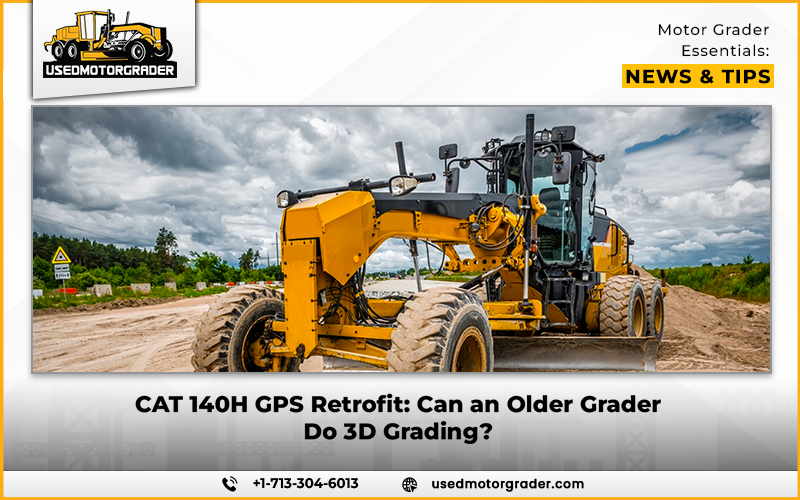
Buying an older motor grader can save a contractor a substantial amount upfront. But the calculation changes when a project demands precise elevations, complex slopes, digital design integration, and consistent grading accuracy. Can a used Caterpillar 140H handle those requirements, or does upgrading an older machine create more problems than it solves?
Yes, a Cat 140H can perform 3D grading when equipped with a suitable machine-control system, correctly configured, and mechanically fit for the work. Topcon has documented a highway project where two Cat 140H graders used its MC-Max machine-control system for fine grading before paving. That establishes a real-world example of this combination, although it does not guarantee compatibility or identical results for every 140H.
The important question is not simply whether GPS can be installed. Contractors need to know what the retrofit includes, whether the grader can hold the required grade, how the system will be calibrated, and whether the investment makes financial sense.
Here is how to evaluate a Cat 140H GPS retrofit before committing money to the machine or its technology.
Can a Cat 140H Be Retrofitted for GPS and 3D Grading?
Yes. A properly selected aftermarket machine-control system can give an older Cat 140H the positioning, design guidance, and, where the configuration supports it, automatic blade-control capabilities required for 3D grading.
Topcon’s MC-Max Grader brochure describes a modular approach that supports different positioning technologies and both newer CAN-based and older non-CAN motor graders. This flexibility makes aftermarket machine control relevant to older equipment.
However, compatibility must be established for the individual machine. The 140H’s serial number, hydraulic and electrical configuration, mounting arrangements, and the specific grade-control package all matter.
A mounting bracket’s existence is not proof that an entire retrofit package is currently available. For example, Cat’s parts catalog lists bracket part number 248-1503 against the 140H and several other grader models, but marks that part as discontinued. Cat advises customers to consult their dealer regarding replacement options and configuration suitability. Check the Cat parts listing here.
That distinction matters when buying a used machine.
Before purchasing a retrofit kit, obtain written confirmation from the system supplier or installer that the proposed configuration supports your exact Cat 140H. Ask which components are included, which must be sourced separately, and whether the system can provide the particular automatic-control functions your projects require.
A successful retrofit involves three separate requirements: compatible technology, a mechanically sound grader, and a dependable installation and support arrangement. All three must be addressed.
Which Cat 140H Makes the Best Retrofit Candidate?
The cheapest machine isn’t always the best buy. A Caterpillar 140H motor grader with healthy hydraulics, a tight circle and drawbar, a sound articulation joint, a good gearbox, and solid blade cylinders can be a better retrofit platform than a cheaper one with heavy wear. Two listings can look identical in photos and still differ a lot in condition and configuration, so compare service records, not pictures.
Look for these on any used Cat 140H with GPS:
- A reliable electrical system with intact wiring and sensor mounts
- Controlled, repeatable blade movement
- Stable hydraulics with no drift
- Documented maintenance and calibration records
- Enough remaining life to earn back the retrofit
When you compare a Cat Grader For Sale listing, ask for the serial number and a detailed description of any grade-control equipment currently on the machine. You might be looking at a smart find, or a pile of mismatched parts, and the serial number is how you tell the difference.
GPS, 2D and 3D Grade Control: What Is the Difference?
These terms are often used interchangeably in equipment listings, but they describe different capabilities.
GPS is one part of the broader Global Navigation Satellite System (GNSS) positioning family. GNSS provides location information; a complete machine-control solution combines positioning or other references with sensors, software, and machine-specific configuration to guide the blade.
| System | How it works | Suitable applications |
| GPS/GNSS positioning | Determines position using satellite signals, with precision dependent on the solution and conditions | Position information for a properly configured machine-control system |
| 2D grade control | Uses references such as rotary lasers, sonic sensors, or slope sensors | Simple planes, consistent slopes and routine grading tasks |
| 3D grade control | Relates the machine and blade to a digital design using suitable positioning and sensor inputs | Road corridors, drainage profiles, subdivisions, complex slopes and site development |
A basic GPS receiver does not automatically control a grader’s blade. It provides positioning information that must be interpreted by a suitable machine-control system.
A 2D system can be highly effective when the job calls for a consistent elevation or slope. A 3D system becomes more valuable when the design changes across the site, requiring the grader to follow varying elevations, horizontal alignments, drainage features, or three-dimensional surfaces.
The right choice depends on the work. A contractor maintaining gravel roads may not need a full 3D package on every machine. A contractor preparing road bases, industrial pads, or complex site surfaces may benefit much more from digital design integration.
What Does a Cat 140H GPS Retrofit Actually Include?
The components depend on whether the contractor wants visual guidance, automatic blade control, or a combination of functions.
A typical 3D GNSS grader system includes several interconnected elements.
- GNSS receivers: These determine the position of the relevant machine-control reference points. Some grader configurations use more than one receiver to help determine orientation and positioning.
- Machine and blade sensors: Inertial measurement units, angle sensors, and other suitable sensors measure machine attitude, blade geometry, and changes in orientation. Their specific number and placement depend on the system.
- Controller and software: The controller combines sensor information, positioning data, and the digital design to calculate how the current blade position relates to the intended surface.
- Cab display: The screen gives the operator a view of the design, current position, elevation information, and cut-or-fill relationship. The exact functions depend on the installed system.
- Hydraulic interface: An automatic-control configuration needs a compatible interface for commanding blade movement. A guidance-only arrangement may instead leave the operator responsible for making corrections.
- Correction service or infrastructure: High-precision GNSS machine control generally requires an appropriate correction source, such as a local RTK base station, network RTK service, or another supported correction solution.
Topcon’s documentation describes grader configurations combining controllers, positioning equipment, and multiple sensors, with additional hardware depending on whether the system uses GNSS, a robotic total station, or another reference method.
This is why two machines advertised as GPS-equipped can offer very different capabilities.
One may only display the blade’s position relative to a design. Another may automatically control elevation and cross-slope. A more complete configuration may support additional control functions, depending on the machine and installed equipment.
When requesting a retrofit quotation, ask the supplier to distinguish these capabilities in writing. Do not assume that a display, receiver, or sensor package includes automatic hydraulic blade control.
Why Mechanical Condition Matters More Than the Grader’s Age
A Cat 140H may be old enough to need careful inspection, but age alone does not determine whether it is a sensible 3D grading candidate. The more important question is whether the machine can move and hold its blade predictably under working conditions.
Machine control can calculate the desired blade position, but it cannot eliminate mechanical wear. Excessive play, inconsistent hydraulic response, or damaged components may undermine repeatability even when the electronic system is functioning correctly.
Before approving a retrofit, pay particular attention to the following areas.
| Component | What to inspect | Why it matters |
| Circle and circle drive | Backlash, wear and inconsistent rotation | Excessive play can make blade-angle positioning less repeatable |
| Drawbar and circle assembly | Worn joints and movement under load | Unwanted movement can affect blade positioning |
| Blade-lift cylinders | Leakage, drift and uneven response | The blade must respond consistently to operator or automatic commands |
| Moldboard and cutting edge | Uneven wear, damage and geometry | Blade condition affects material engagement and calibration |
| Articulation joint and pins | Looseness and excessive movement | Mechanical instability can affect machine handling and repeatability |
| Hydraulic system | Leaks, sluggish movement and inconsistent response | Control commands are useful only if the machine responds properly |
| Tandems, tires and final drives | Excessive wear and abnormal movement | Machine stability and predictable operation matter during finishing |
Consider a grader with a worn circle assembly and blade-lift cylinders that drift under load. Installing a high-quality GNSS system will not repair either problem. The electronic system may accurately calculate a required correction, but the machine may struggle to execute it consistently.
The same principle applies to the cutting edge. A badly worn or uneven edge can change how the blade engages the ground. Calibration should reflect the actual machine geometry and cutting-edge configuration, following the system manufacturer’s procedures.
This does not mean every sign of wear makes a retrofit unsuitable. The question is whether the condition is acceptable for the intended work, whether necessary repairs can be completed, and whether the repaired machine has enough useful life remaining to justify the investment.
Have the grader inspected before finalizing the technology quote. Price the repairs separately, then include them in the overall acquisition decision. A slightly more expensive machine with healthy hydraulics and a tight circle assembly may be a better purchase than a cheaper unit that requires extensive mechanical work before commissioning.
Positioning Accuracy Is Not the Same as Finished-Grade Accuracy
One of the most important details in a Cat 140H 3D retrofit is the difference between what the positioning system measures and what the grader ultimately builds.
These are three related but distinct concepts.
Positioning accuracy describes how accurately the system determines the relevant position. Suitable GNSS correction services can deliver centimeter-level positioning under specified conditions. Trimble’s correction-source documentation shows that different services have different performance specifications, including differences between horizontal and vertical measurements.
Blade-position accuracy concerns how well the control system determines the actual cutting edge’s position after accounting for machine geometry, sensor measurements, offsets, and calibration.
Finished-surface accuracy describes how closely the material surface produced by the grader matches the design and the project’s required tolerances.
A machine-control system with a positioning specification of a few centimeters does not automatically guarantee that the finished road or building pad will meet the same tolerance.
Several factors affect the result: correction quality, satellite visibility, coordinate-system configuration, calibration, mechanical wear, hydraulic response, blade condition, operating technique, and material conditions.
The design file matters, too. A correctly functioning machine can still produce an incorrect result if the wrong design revision, vertical datum, or coordinate-system settings are used.
For this reason, commissioning should include checking known control points or benchmarks and verifying the resulting surface through an appropriate independent survey process. The acceptance tolerance must come from the project’s requirements, not from a marketing claim about the receiver.
Recheck calibration when circumstances warrant it, including significant repairs, sensor movement, cutting-edge changes, or an impact that could affect the machine-control setup. Follow the manufacturer’s maintenance and calibration guidance rather than assuming that the original setup remains correct indefinitely.
How to Install, Calibrate and Commission the Retrofit
Installing the hardware is only one stage of the process. Before the machine starts producing work, the contractor needs to confirm that the equipment, reference data, and blade-control functions operate together correctly.
- Confirm the machine configuration. Record the serial number and identify the electrical, hydraulic, and mechanical configuration. Obtain a system-specific parts list and installation plan.
- Complete necessary mechanical repairs. Repair unacceptable wear or inconsistent movement before relying on the system for finish grading. Installing the equipment first and discovering mechanical problems later can increase downtime and costs.
- Install the approved equipment. Fit the appropriate receivers, sensors, controller, display, mounting hardware, wiring, and any required hydraulic interfaces. Mounting and welding work should follow approved instructions and proper safety precautions.
- Configure and calibrate the machine. Enter and verify the required machine geometry, sensor orientation, blade parameters, and offsets. The precise procedure depends on the machine-control platform and installed configuration.
- Validate the reference and design. Confirm correction-service availability, coordinate-system settings, vertical datum, and design revision. Check against a known reference point before relying on the displayed elevation values.
- Run a controlled trial. Grade a test section, inspect the system’s behavior, and compare the resulting surface with independent survey measurements. Make corrections where needed and document the results.
The contractor should also establish how the system will be accepted into service. Keep records of the calibration, measured deviations, outstanding issues, and any required follow-up work.
Do not skip the trial simply because the display looks correct. A digital model on a screen demonstrates that the system is presenting information; it does not prove that the finished surface meets the project’s specifications.
A Real-World Example: Cat 140H Graders on an Iowa Highway Project
Topcon’s published article, “If You Build It . . .”, describes two Cat 140H motor graders using MC-Max machine control for fine grading ahead of dowel-basket installation and paving on an I-380 highway project in Iowa.
The account provides an important piece of evidence for contractors considering an older grader: the Cat 140H has been used with a modern third-party machine-control platform in real highway construction.
It also illustrates why the application matters. Fine grading before paving requires control over the prepared surface, so a digital grade-control workflow can be valuable where the project has tight specifications.
However, the case study should not be stretched beyond what it establishes. It does not prove that every Cat 140H can accept the same package without modification, nor does it supply a universal finished-grade accuracy figure or a guaranteed percentage reduction in labor, fuel, or grading passes.
Treat it as evidence that the combination has been used successfully in a real application—not as a substitute for confirming the compatibility and condition of the machine you are considering.
When Is GNSS 3D Grading the Right Choice?
GNSS-based machine control can be a practical choice for open construction sites and road corridors where suitable satellite visibility, correction services, and design data are available.
But not every jobsite offers the same conditions.
Buildings, bridges, heavy tree cover, and other obstructions can interfere with satellite reception. In those areas, a robotic total station or another supported reference method may be more suitable. A laser-based or sonic 2D arrangement can also be appropriate when the task requires a consistent elevation or slope rather than a complex digital surface.
Consider the actual work before choosing the hardware.
- Open road projects: GNSS may provide the positioning coverage needed for long grading corridors and changing design elevations.
- Urban sites or obstructed areas: Evaluate whether satellite reception is reliable enough, or whether an alternative positioning method is needed.
- Simple slope and elevation work: A 2D system may deliver the required capability without the expense of a full 3D setup.
- Complex surfaces and changing profiles: A properly configured 3D system can help the operator follow the digital design across varying elevations, curves, and slopes.
Topcon’s MC-Max documentation supports several positioning approaches, while Trimble also describes machine-control solutions for motor graders. The right option depends on the specific equipment, site requirements, and service support available.
The goal is not to install the most advanced system. It is to buy the system that can deliver the required result consistently and economically.
How Much Does a Cat 140H GPS Retrofit Cost?
There is no single reliable retrofit price for every Cat 140H. The final cost depends on the grade-control functions required, hardware configuration, installation requirements, machine condition, and local support arrangements.
A useful budget starts with the full installed investment rather than the receiver’s advertised price.
| Cost category | What to include |
| Machine acquisition | Purchase price, inspection and transport |
| Mechanical preparation | Necessary hydraulic, circle, blade or other repairs |
| Grade-control hardware | Receivers, sensors, controller, display, brackets and interfaces |
| Installation and setup | Wiring, mounting, calibration and commissioning |
| Operating readiness | Training, design-data preparation and correction infrastructure |
| Recurring expenses | Applicable subscriptions, software, maintenance and support |
Not every configuration requires every item. Ask the installer to identify inclusions, exclusions, recurring fees, and components that must be supplied separately.
The financial comparison also needs to distinguish the cost of buying the grader from the incremental cost of adding 3D capability.
Calculate the actual business case
Start by calculating the total amount required to put the machine into productive service:
Total machine investment = Purchase price + Immediate repairs + Retrofit + Installation and commissioning + Other startup costs.
Then estimate the incremental benefit of the machine-control system. Potential benefits include fewer corrective grading passes, reduced rework, lower material waste, less survey-stake dependence, and more efficient use of skilled labor. The amount varies by project, existing workflow, operator experience, and system performance.
The savings should be supported by the contractor’s own data or clearly identified assumptions. Do not treat every possible benefit as a guaranteed saving.
For a retrofit decision, a useful formula is:
Break-even operating hours = Net retrofit investment ÷ Verified net savings per productive hour.
Net savings must account for the additional costs of operating and supporting the system. The relevant productive hours are those on jobs where 3D capability provides a genuine benefit, not every hour the grader runs.
For example, a contractor with steady road-construction work and recurring precision-grading requirements may use the system enough to justify the installation. A contractor whose Cat 140H mainly maintains gravel roads may have fewer opportunities to recover the same investment.
Downtime belongs in the calculation as well. Installation, commissioning, troubleshooting, and the availability of local technical support can affect when the machine begins earning revenue. A low-cost package that remains unusable for a critical project may prove more expensive than a better-supported option.
The soundest approach is to obtain a written installation quote, complete a mechanical inspection, estimate suitable annual work hours, and calculate the expected payback before committing.
Cat 140H Retrofit vs. Buying a Newer 140K or 140M
A retrofit can make sense when the existing machine is mechanically sound and the cost of adding suitable grade control is lower than the cost of replacing it with a machine that meets the same requirements.
But the purchase price alone does not settle the question.
| Factor | Retrofitted Cat 140H | Newer used grader |
| Initial investment | May be lower, depending on condition and retrofit scope | May require a larger purchase budget |
| Machine-control setup | Depends on the selected aftermarket system and configuration | May offer more integrated options, depending on specification |
| Mechanical condition | Existing wear and required repairs need careful assessment | Still requires inspection and service-history checks |
| Technology support | Depends on installer, system, parts and configuration | Depends on installed equipment and local support |
| Downtime | Includes installation and commissioning risks | Includes acquisition, repairs and onboarding risks |
A newer 140K or 140M is not automatically the better investment, just as an older 140H is not automatically the cheaper option over its remaining working life.
Compare the cost of each machine over the same planned ownership period or productive hours. Include acquisition, repairs, machine-control equipment, operating expenses, support, downtime, and expected resale value where reliable estimates are available.
If the 140H needs substantial mechanical work before a retrofit can even begin, its initial price advantage may disappear. If it is in good condition, supported by a capable installer, and has enough suitable work ahead, an upgrade may be commercially sensible.
Choosing a 3D Machine-Control System for a Cat 140H
Topcon MC-Max and Trimble Earthworks are two platforms worth evaluating, but brand recognition alone should not determine the purchase.
Topcon’s MC-Max Grader documentation describes a modular approach with different positioning and control options. Trimble’s Earthworks grade-control platform describes grader applications that use blade control and design guidance to help operators achieve the required surface.For an older Cat 140H, compare the systems on five practical points:
- Verified compatibility: Can the supplier support your machine’s exact configuration and serial number?
- Required functions: Does the proposed package provide guidance only, automatic elevation control, cross-slope control, or the particular combination your jobs require?
- Positioning options: Is GNSS suitable for your sites, or would a total-station or other reference method be more appropriate?
- Local support: Can you obtain replacement hardware, diagnostics, calibration assistance, and operator training when needed?
- Total cost: What are the installed price, recurring expenses, required infrastructure, and support obligations?
If your fleet already uses a particular platform, compatibility with existing design workflows, correction services, and operator training may simplify adoption. Even so, confirm the exact Cat 140H configuration instead of assuming that equipment used on another machine will transfer directly.
Cat 140H GPS Retrofit: Pre-Purchase Checklist
Before buying a used grader for 3D grading, confirm the machine’s physical condition, its technical suitability, and the financial case.
Machine condition
- Obtain the serial number, operating hours, service records, and maintenance history.
- Inspect the circle, drawbar, moldboard, articulation joint, hydraulic cylinders, tandems, final drives, engine, and transmission.
- Identify repairs needed before commissioning.
- Have the machine inspected by a qualified technician where appropriate.
Machine-control compatibility
- Obtain written compatibility confirmation from the installer.
- Request an itemized quotation showing hardware, interfaces, installation, calibration, and commissioning.
- Establish whether the system provides guidance or automatic blade control.
- Confirm correction-service availability and any recurring costs.
- Check replacement-part availability, warranty terms, and technical support.
Operational readiness
- Confirm that the system can use the design files and reference settings required for the work.
- Include operator training and commissioning time in the budget.
- Agree on a trial and independent finished-grade verification process.
- Compare the complete installed investment against suitable alternatives.
- Estimate how many productive hours of 3D grading the machine is likely to receive each year.
Be cautious when a listing describes a machine as “GPS ready.” Ask exactly what that means. It might refer to mounting provisions, previously installed components, basic guidance, or a functioning automatic-control system. Those are not equivalent.
Final Verdict: Is a Cat 140H Worth Retrofitting for 3D Grading?
A Cat 140H is not automatically too old for modern machine control. With the right configuration, suitable hardware, a sound mechanical base, and proper commissioning, it can become a practical 3D grading machine.
The strongest investment is not necessarily the machine with the lowest purchase price or the most expensive technology package. It is the machine that can deliver the required accuracy, remain productive, receive dependable technical support, and recover its cost through suitable work.
Before buying, confirm the retrofit’s compatibility, inspect the grader, obtain a complete installation quote, and calculate the expected return. Verify the finished surface rather than relying only on the display or a manufacturer’s positioning specification.
If you are comparing a used Caterpillar 140H motor grader, review its condition, existing technology, maintenance records, and configuration before deciding whether to retrofit it. Explore used Caterpillar motor graders or browse a wider selection to compare available machines.
A well-chosen older grader can remain a productive asset. The key is making sure the machine, the control system, and the work you intend to perform are a good fit before investing in the upgrade.
FAQs
1. Can a Cat 140H perform automatic 3D grading?
A: Yes, provided that the selected aftermarket system supports the individual machine configuration and includes the required automatic blade-control interfaces. The machine must also be mechanically suitable, correctly calibrated, and supported by an appropriate positioning and design workflow.
2. Is GPS alone enough for 3D grading?
A: No. GNSS provides positioning data, but a 3D machine-control setup also needs suitable sensors, a controller, software, design data, and the necessary machine interface. Automatic blade control requires additional compatible functionality.
3. How accurate can a retrofitted Cat 140H be?
A: The result depends on the complete system, correction source, site conditions, calibration, mechanical condition, and operation. GNSS equipment may offer centimeter-level positioning under specified conditions, but that does not guarantee the same tolerance on the finished surface. Verify the actual result against the project’s acceptance requirements.
4. Is Topcon MC-Max suitable for an older Cat 140H?
A: Topcon describes MC-Max as a modular platform that can support older non-CAN graders, and its published I-380 case study documents two Cat 140H graders using MC-Max. Nevertheless, obtain configuration-specific confirmation and a written installation plan before purchasing equipment.
5. Is retrofitting cheaper than buying a newer motor grader?
A: It can be, especially when the 140H is mechanically sound and will perform enough suitable 3D work to recover the investment. Compare purchase price, repairs, retrofit, operating costs, support, and downtime over the same ownership period. A low asking price alone is not enough.
6. Can a mechanically worn Cat 140H be made accurate with GPS?
A: Not simply by installing GPS. Excessive mechanical play, cylinder drift, or inconsistent hydraulic response can affect blade repeatability. Repair unacceptable wear first, then calibrate and verify the system.
Tags: Retrofit-Ready Motor Graders, Caterpillar 140H Strengths, Older Premium Grader