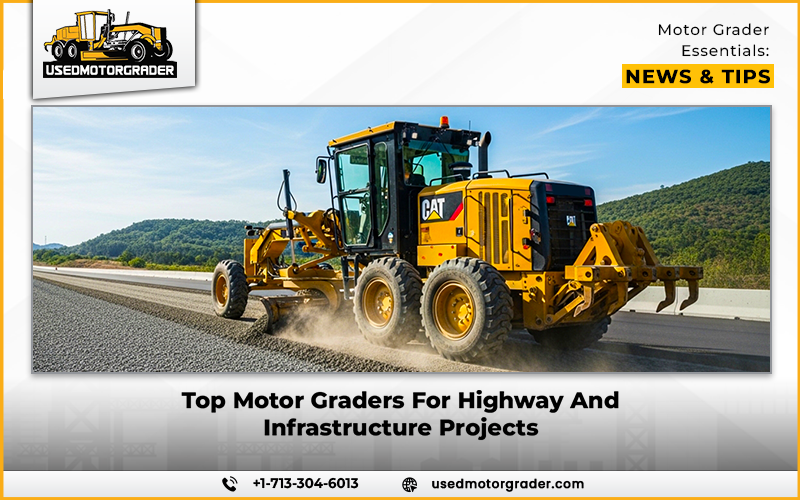
Precise grading is critical to the success of highway improvements. Before paving starts, the subgrade is leveled and shaped by motor graders. For highway and infrastructure projects, contractors look for the best motor graders because even little mistakes can result in uneven surfaces and costly repairs later.
The right grader reduces material waste, increases accuracy, and maintains timeliness. GPS grade control, telematics, fuel efficiency, and horsepower are all combined in modern machines. Making the best decision, however, necessitates knowing which characteristics truly translate into efficiency and profitability on your particular projects, as there are numerous brands and configurations accessible. Here is a realistic look at the best motor graders for highway and infrastructure work and the factors that should be considered most when choosing an investment.
Why Motor Graders Matter in Highway and Infrastructure Projects
Graders are responsible for sub-grade preparation, camber shaping, slope formation, and final finishing in large-scale highway construction. The thickness and drainage of asphalt are affected even by millimeters. When considering repaving budgets five to ten years from now, it becomes evident that appropriate grading dramatically lowers pavement maintenance costs over a road’s lifetime, according to the Federal Highway Administration.
Project budgets are directly impacted by precision grading’s reduction of material waste. In order to make up for uneven base layers, more aggregate or asphalt is needed, which raises the cost of labor, fuel, and transportation. Pavement life is increased and future maintenance cycles are decreased with accurate blade control, which guarantees uniform thickness and improved compaction.
Key Features to Consider Before You Buy
Engine Power
150–300+ horsepower is usually required for highway projects, depending on the size and material. Heavy-duty graders for airports and national highways, such as the Caterpillar 140 series, run at 250–300 horsepower. Effectively managing regional infrastructure are mid-range machines with 170–220 HP. Blade pull on hard soil is enhanced by higher horsepower, but bigger machines waste fuel on lighter tasks.
Moldboard and Control
For highway uses, blade width normally falls between 12 and 14 feet. Wider blades save time on lengthy stretches by requiring fewer passes. Nevertheless, when working to strict standards, precision is more important than width. Smooth pitch, circle rotation, and side shift adjustments, all necessary for satisfying highway tolerances, are made possible by advanced hydraulics.
Drive System
When rear-wheel drive machines fluctuate, all-wheel drive keeps you productive and offers superior traction on soft or uneven terrain. In areas that are subject to monsoons or spring ground saturation, six-wheel drive performs exceptionally well in damp or sandy conditions.
Operator Comfort
Fatigue has a direct effect on quality, and highway shifts sometimes last longer than ten hours. Fatigue is reduced by ergonomic sitting, easy-to-use controls, climate control, and visibility. According to studies, weariness can reduce productivity by 15%, which can result in major delays for lengthy projects.
Technology
GPS grade control and telematics increase accuracy over manual methods while lowering stake needs. Prior to malfunctions, predictive maintenance notifications identify issues. Even one day of downtime can cost thousands of dollars in penalties and delays for large projects.
Fuel Efficiency
Stage V and Tier 4 engines cut operating costs and emissions at the same time. With savings accruing every running hour, fuel economy is more important in year five than it was in year one.
After-Sales Support
Verify the availability of parts, warranty coverage, dealer response time, and training coverage. Strong service networks safeguard long-term investments and minimize downtime.
Top Motor Grader Models by Project Scale
| Project Type | Model | Horsepower | Key Features | Best For |
|---|---|---|---|---|
| Major Highways | Caterpillar 140 GC / 14M | 196–274 HP | Advanced grade control, proven durability | Highways, airports, heavy-duty infrastructure |
| Komatsu GD655-7 | 218 HP | Fuel-efficient, strong circle torque | Large infrastructure projects | |
| John Deere 670G | 220 HP | SmartGrade integration, smooth transmission | Precision highway work | |
| Urban Infrastructure | Caterpillar 120 series | 170 HP | Versatile, reliable | City roads, secondary highways |
| Komatsu GD535 | Medium | Efficient operation | Regional infrastructure | |
| John Deere 620G | Medium | Balanced power and technology | Municipal and mid-scale projects | |
| Budget Options | SDLG / XCMG models | Varies | Competitive pricing, reliable basics | Developing markets, cost-sensitive projects |
Note: Major highway models represent the best motor graders for heavy-duty infrastructure where precision and uptime determine profitability. Urban infrastructure models provide flexibility for municipalities and mid-scale contractors. Budget options lack cutting-edge automation but deliver solid performance in less demanding applications.
Buyer Checklist
Before signing, find out the answers to:
- Fuel consumption per hour on average while under load
- Is GPS grade control an aftermarket or factory-installed component?
- Details of warranty coverage and void triggers
- Timeline for parts delivery to your project sites
- Does operator training come with it?
Examine the entire lifecycle cost rather than just the purchase price.
Common Mistakes to Avoid
- The grader’s size wastes fuel and raises maintenance expenses.
- Advanced systems hardly provide their full potential when operator training is neglected.
- Projects are shut down due to failures caused by neglecting maintenance planning.
The Bottom Line
The foundation of a successful highway is the pavement. Durability, accuracy, and efficiency are guaranteed by the proper grader. Purchasing the best motor graders will result in stronger performance, reduced lifecycle costs, and less delays. Because great roadways begin with precise grading that meets specifications the first time, carefully compare models, assess dealer support, and select equipment that fits your operating realities.
FAQ’s
Why are motor graders necessary for building highways?
They provide accurate sub-grade leveling and regular drainage, both of which have a direct bearing on pavement strength and the length of time a road may be used without significant repairs.
Which motor grader size is most appropriate for large highway projects?
Large infrastructure projects and national roadways are usually best suited for heavy-duty graders with 200–300 horsepower.
What impact does accurate grading have on the longevity of highways?
By preventing water buildup and unequal load distribution, accurate grading lowers the likelihood of cracks and drastically lowers long-term maintenance expenses.
Which features should be given top priority by highway contractors?
Fuel efficiency, sophisticated grade control systems, powerful horsepower appropriate to your material, and dependable dealer support that truly comes through when you need it.
Tags: Best Motor Graders 2026, Best Motor Graders in USA, Infrastructure Projects